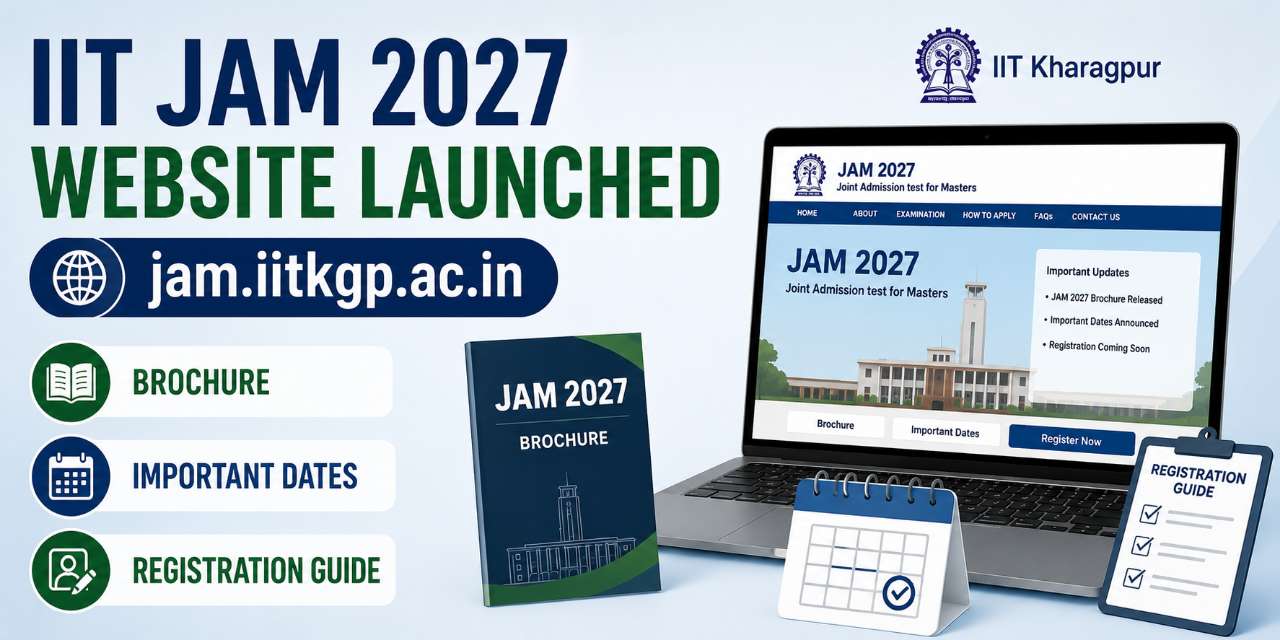
The Joint Admission Test for Masters (IIT JAM) 2027 cycle has officially begun. IIT Kharagpur, the organising institute, has launched the dedicated portal at jam.iitkgp.ac.in, giving science graduates across India a single, authoritative source for dates, eligibility, syllabus, and admission rules. If you are planning postgraduate study in Chemistry, Physics, Mathematics, Biotechnology, Geology, Economics, or Mathematical Statistics at premier institutes, this is the exam that opens those doors.
For the 2027–28 academic session, JAM is expected to facilitate admission to around 89 postgraduate programmes across 23 IITs, with roughly 3,000 seats on offer. The information brochure is scheduled for 22 August 2026, registration opens on 5 September 2026, and the exam is set for 14 February 2027. This guide explains what the new website means for aspirants, how to read the upcoming brochure, and how to prepare a strong application written for Indian students in clear, practical language.
What Is IIT JAM and Why Does the 2027 Website Launch Matter?
IIT JAM is a national-level entrance test for admission to postgraduate programmes in science and allied disciplines at IITs and other participating institutes. For more than two decades, it has been one of the most trusted routes for B.Sc., B.Tech., and integrated-degree graduates who want rigorous M.Sc., dual-degree, and research-oriented programmes without going through separate institute-level tests.
The launch of the JAM 2027 official website is more than a formality. It signals that the full admission calendar is now locked in at the organising end. From this point, candidates should treat jam.iitkgp.ac.in as the only reliable source—not social media forwards, coaching-centre WhatsApp chains, or unverified third-party pages. The site already hosts sections on examination schedule, eligibility, examination cities, required documents, and the JOAPS application portal.
Unlike undergraduate engineering admissions through JEE, JAM serves students who have already specialised at the bachelor’s level. That makes brochure details—subject combinations, qualifying degree requirements, and programme-wise cut-offs—especially important. The August 2026 brochure release will fill in remaining specifics such as application fees, detailed syllabus annexures, and counselling timelines.
IIT JAM 2027 Important Dates at a Glance
Based on announcements on the official portal and organising institute communications, the following timeline applies to JAM 2027. Always cross-check on jam.iitkgp.ac.in before acting, as tentative dates may be revised in the brochure.
| Event | Date |
|---|---|
| Official JAM 2027 website live | August 2026 |
| Information brochure release | 22 August 2026 |
| JOAPS registration opens | 5 September 2026 |
| Last date to apply | 12 October 2026 |
| PwD form upload (after fee payment) | From 5 September 2026 |
| Application correction window (tentative) | From 10 November 2026 |
| JAM 2027 examination | 14 February 2027 (Sunday) |
| Result (expected) | March 2027 |
Action tip: Mark the brochure date (22 August) and registration opening (5 September) in your calendar now. JAM registration windows are shorter than many national exams, and server load spikes in the final 48 hours often cause unnecessary stress.
Who Is Conducting IIT JAM 2027?
Indian Institute of Technology Kharagpur (IIT Kharagpur) is the organising institute for JAM 2027. Each year, one IIT hosts the exam, sets the question papers (with subject committees), runs JOAPS, and coordinates result processing before handing participating institutes the score data for admissions.
JAM scores are used primarily by IITs—including leading campuses such as IIT Bombay, IIT Delhi, and IIT Madras Chennai—along with IISc Bangalore, NITs, and other centrally funded institutions. If your goal is a research-focused M.Sc. or an integrated Ph.D. pathway inside the IIT system, JAM remains the most direct national route.
Programmes and Seats: What You Can Apply For
JAM 2027 is expected to cover admission to programmes such as:
- M.Sc. and M.Sc. (Tech.)
- MS (Research)
- M.Sc.–M.Tech. dual degree
- Joint M.Sc.–Ph.D.
- M.Sc.–Ph.D. dual degree
- Integrated Ph.D. (I-PhD)
With about 3,000 seats spread across 89 programmes and 23 IITs, competition varies sharply by subject and campus. Mathematics and Physics typically see higher applicant volumes; Geology and Economics may have smaller but equally competitive pools. Use the brochure’s institute–programme matrix to shortlist options early rather than waiting for results.
IIT JAM 2027 Exam Pattern and Test Papers
JAM 2027 will be held on Sunday, 14 February 2027, in two sessions. Candidates may choose one or two test papers, but if you opt for two papers, they must be scheduled in different sessions.
Session-wise Paper Schedule
Forenoon session (9:30 am to 12:30 pm):
- Chemistry (CY)
- Geology (GG)
- Mathematics (MA)
Afternoon session (2:30 pm to 5:30 pm):
- Biotechnology (BT)
- Economics (EN)
- Mathematical Statistics (MS)
- Physics (PH)
The exam is computer-based and conducted at centres across India. IIT Kharagpur has confirmed that there are no international test centres for JAM 2027; candidates must select an Indian examination city during registration.
Question Format and Scoring Basics
While the 2027 brochure will publish the final break-up, JAM papers traditionally include multiple-choice (MCQ), multiple-select (MSQ), and numerical answer type (NAT) questions. Understanding section-wise marking—including negative marking on MCQs—is essential for time management. Download previous-year papers from the official portal once available and simulate full three-hour sessions under exam conditions.
Preparation tip: If you plan to sit for two papers (for example, Mathematics in the forenoon and Physics in the afternoon), build separate revision blocks. The gap between sessions is not long enough for deep study; use it for light revision, lunch, and travel logistics only.
Eligibility Criteria for JAM 2027
Detailed eligibility will be printed in the information brochure on 22 August 2026. Historically, JAM requires candidates to hold—or be in the final year of—a qualifying bachelor’s degree with subject combinations matching the test paper applied for.
General Eligibility Points
- No upper age limit for JAM in recent cycles; confirm in the 2027 brochure.
- Candidates appearing in the final year of graduation may apply, subject to producing proof of completion before admission.
- Each IIT sets programme-specific minimum eligibility at the time of admission; clearing JAM alone does not guarantee a seat.
- Foreign nationals may have separate rules; check the brochure if applicable.
Science graduates from universities, autonomous colleges, and institutes such as central universities, NITs, and reputed private colleges are eligible if their degree matches paper requirements. Students from technology-focused backgrounds sometimes explore parallel paths—such as M.Tech. through GATE or programmes at institutes like International Institute of Information Technology Hyderabad or IIIT Delhi—but JAM remains the standard gateway for core science M.Sc. and research programmes at IITs.
What the Information Brochure on 22 August 2026 Will Contain
The JAM information brochure is the single most important PDF for aspirants. Treat its release on 22 August 2026 as your planning deadline for the next six months of preparation and paperwork.
Expected contents include:
- Complete eligibility rules and qualifying degree subjects
- Application fee structure (category-wise)
- Step-by-step JOAPS registration guide
- Photograph and signature specifications
- Examination city list and centre allocation policy
- Detailed syllabus for all seven test papers
- Admit card, result, and scorecard timelines
- Admission process through the consolidated JAM portal (JOAPS-based counselling flow)
- Participating institutes and programme list
- Persons with disabilities (PwD) and category certificate formats
How to use the brochure efficiently: On release day, download one copy and save it offline. Read eligibility and syllabus first, then the application section, then the admission/counselling chapter. Highlight programme codes for your target IITs and note document deadlines that fall before the exam itself.
JAM 2027 Registration Through JOAPS
Applications will be accepted only through the JAM Online Application Processing System (JOAPS), accessible from the official website. Registration opens 5 September 2026 and closes 12 October 2026.
Documents to Keep Ready
- Class 10 (SSC) marksheet or certificate (date of birth proof)
- Recent passport-size photograph (as per prescribed format)
- Scanned signature
- Valid email ID and mobile number
- Category certificate (SC/ST/OBC-NCL/EWS), if applicable
- PwD certificate and prescribed forms (upload after payment, where required)
- Qualifying degree details and marks, if available
After submission, track your application status on JOAPS. Typical status labels include received, under scrutiny, accepted, defect status, rectified, rejected, and admit card ready. Respond promptly to defect notices—unresolved errors can disqualify an otherwise valid application.
Do not wait until 12 October. Complete registration at least a week early so you have time to fix upload errors, payment failures, or certificate formatting issues.
Examination Cities and Logistics
JAM is conducted in multiple cities across states and union territories. The full list will appear on jam.iitkgp.ac.in under Examination Cities. Choose your city carefully during registration; changes may only be possible during the paid correction window (tentatively from 10 November 2026).
Plan travel and accommodation if your preferred city is outside your home town. For the 14 February 2027 exam, book refundable travel where possible until the admit card confirms your centre address. Carry the same photo ID you used during registration, along with the admit card, on exam day.
Admit Card, Result, and Scorecard
Although exact dates will be confirmed in the August brochure, JAM follows a predictable post-registration workflow each year. The admit card is released on JOAPS a few weeks before the exam and must be downloaded and printed. It lists your paper, session timing, centre address, and reporting instructions. No candidate is allowed into the hall without a valid admit card and photo identity proof.
Results are typically declared in March. For JAM 2027, the result is expected around 18 March 2027, after which scorecards become available for download. Your JAM score remains valid for the current admission cycle only. Preserve both the scorecard PDF and your registration credentials, as the admission portal will require login using the same JOAPS account.
How JAM 2027 Admissions and Counselling Work
JAM is a two-stage process: the entrance test and institute-wise admission through the centralised JAM admission portal (details in the brochure). After results, candidates register on the admission portal, fill programme and institute choices in order of preference, and seats are allotted in multiple rounds based on JAM score, category, and eligibility verification.
Choosing Institutes Wisely
All IITs do not offer every subject. For example, a strong Mathematics score may open options at several campuses, while Geology programmes may be concentrated at a smaller set of institutes. Research faculty profiles, placement and research output, and hostel facilities—not just city preference.
Students sometimes compare IIT postgraduate life with specialised institutes. A candidate interested in interdisciplinary computing may also explore IIIT Pune, IIIT Lucknow, or IIIT Guwahati, but for traditional M.Sc. Physics, Chemistry, or Mathematics at IITs, JAM is the primary channel.
Counselling Tips for First-Time Applicants
- Prepare a tiered list: dream institutes, realistic targets, and safe backups.
- Verify minimum percentage or CGPA requirements for each programme before locking choices.
- Keep scanned degree documents and category certificates ready for upload during admission rounds.
- Respond to seat allotment within the deadline; missing a round can forfeit your seat.
- Monitor the official portal for spot rounds and withdrawal rules if you hold multiple offers.
Preparation Strategy for JAM 2027
With the exam on 14 February 2027, most serious aspirants begin structured preparation 6–10 months in advance. Here is a practical plan aligned with the newly announced schedule.
Phase 1: Foundation (August–October 2026)
- Download the brochure on 22 August and finalise your test paper(s).
- Map the official syllabus against your B.Sc. notes; identify weak units.
- Complete JOAPS registration soon after 5 September—do not delay paperwork.
- Solve the last five years’ JAM papers for your subject to understand difficulty and question types.
Phase 2: Core Revision (November 2026–January 2027)
- Follow standard textbooks recommended for your discipline (brochure or past toppers’ lists).
- Join a test series or create weekly mock tests with strict timing.
- For dual-paper candidates, allocate separate weekly targets for each subject.
- Use the November correction window to fix any application errors.
Phase 3: Exam Sprint (February 2027)
- Revise formulas, standard results, and high-yield topics only.
- Take one full mock per week per paper, analyse mistakes, and avoid new topics in the final ten days.
- Confirm admit card, ID proof, and centre location immediately after release.
Consistency beats cramming for JAM. The exam rewards conceptual clarity and accurate numerical work under time pressure—skills built through daily problem practice rather than passive video watching.
Subject-wise Preparation Highlights
Each JAM paper tests depth within its discipline. Brief pointers by subject:
- Physics (PH): Focus on mechanics, electromagnetism, quantum basics, and mathematical methods. Previous JAM papers emphasise conceptual MCQs alongside numerical problems.
- Chemistry (CY): Physical, organic, and inorganic sections carry balanced weight. Practice reaction mechanisms and spectroscopy-based questions regularly.
- Mathematics (MA): Real analysis, linear algebra, differential equations, and calculus of variations appear frequently. Proof-style thinking helps in MSQ sections.
- Mathematical Statistics (MS): Probability, distribution theory, estimation, and testing are core. Strong calculus foundations are essential.
- Biotechnology (BT): Biochemistry, microbiology, molecular biology, and basic chemistry/physics crossover topics dominate.
- Geology (GG): Mineralogy, petrology, structural geology, and paleontology require diagram-based revision.
- Economics (EN): Microeconomics, macroeconomics, statistics, and econometrics at the undergraduate honours level form the base.
Application Fees and Category Benefits
Exact fee amounts for JAM 2027 will be listed in the August brochure. In previous cycles, fees differed for one paper versus two papers and for category (General, OBC-NCL, SC/ST, PwD, female candidates where applicable). Pay only through the official JOAPS payment gateway; never share OTPs or card details with third-party “application help” services.
Reserved-category candidates must upload valid certificates in the prescribed format. OBC-NCL certificates typically need to be issued within the financial year relevant to the admission cycle—verify the exact rule in the 2027 brochure to avoid rejection at the admission stage.
Common Mistakes to Avoid
- Relying on unofficial websites for dates or syllabus changes—use jam.iitkgp.ac.in only.
- Choosing two papers in the same session, which is not permitted.
- Uploading blurred photographs or incorrect signatures, leading to application defects.
- Ignoring programme-specific eligibility at target IITs after clearing the exam.
- Skipping mock tests in computer-based format, then struggling with on-screen navigation on exam day.
- Applying on the last day without buffer time for payment or document issues.
JAM vs Other Postgraduate Entrance Options
Indian science graduates often weigh several paths after B.Sc.:
- JAM — for M.Sc. and integrated Ph.D. programmes at IITs and participating institutes.
- GATE — primarily for M.Tech., some MSc, and PSU recruitment.
- CUET PG — for many central and state university programmes.
- Institute-specific tests — for universities and deemed universities outside the JAM system.
If your goal is a research-oriented science master’s inside the IIT ecosystem, JAM is usually the right focus. If you are pivoting to engineering or data-heavy industry roles, GATE or programmes at technology institutes such as IIIT Bangalore or Jaypee Institute of Information Technology Noida may align better. Clarity on your five-year career goal should drive exam choice, not peer pressure.
Conclusion
The launch of the IIT JAM 2027 website at jam.iitkgp.ac.in marks the start of a well-defined admission cycle for thousands of science graduates aiming at IIT postgraduate programmes. With the information brochure on 22 August 2026, registration from 5 September to 12 October 2026, and the exam on 14 February 2027, candidates now have fixed milestones to plan around.
Download the brochure on day one, register early on JOAPS, choose your test paper(s) based on eligibility and career goals, and build preparation around official syllabus and past papers. Whether you target IIT Delhi, IIT Bombay, or any of the 23 participating IITs, disciplined preparation and accurate paperwork matter as much as raw subject knowledge. Visit the official portal regularly for updates—and treat every other source as secondary until verified.