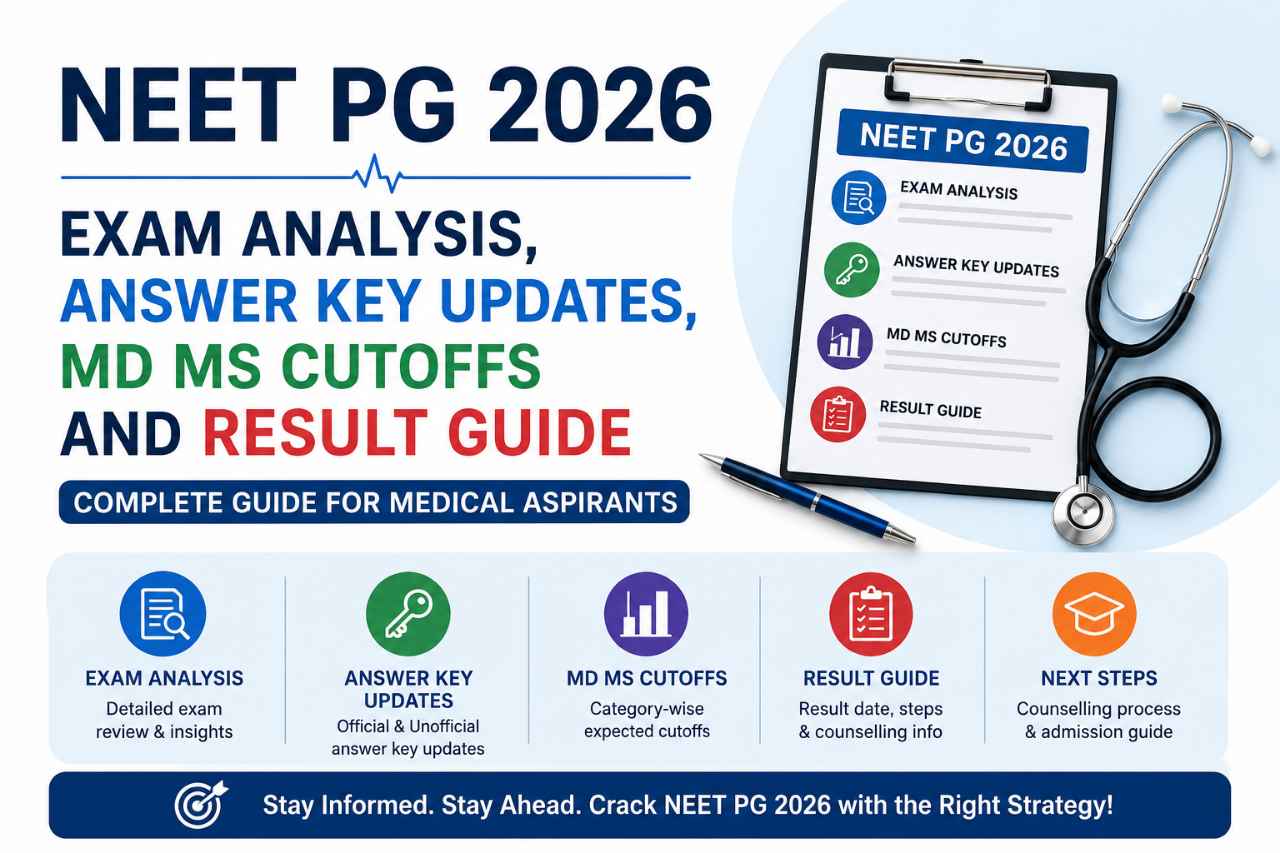
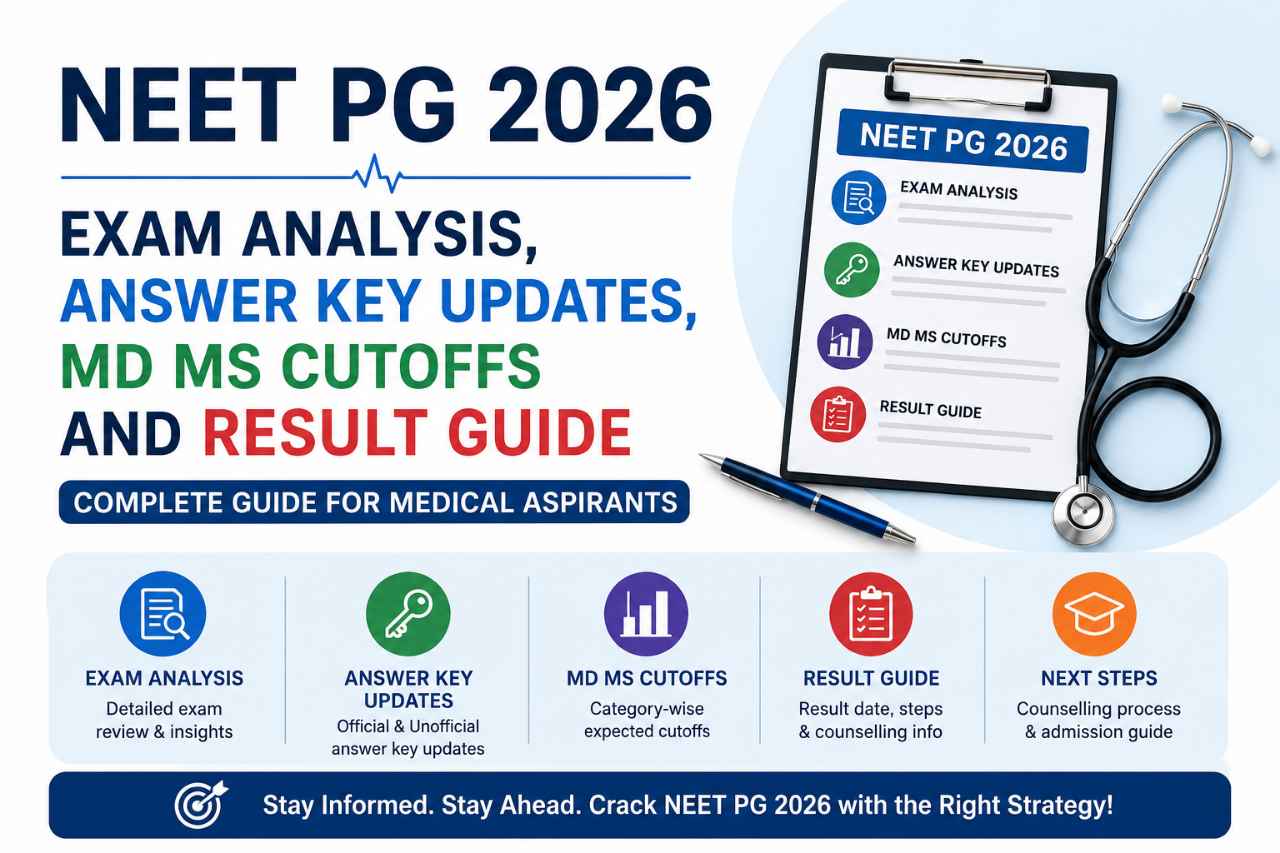
The National Board of Examinations in Medical Sciences (NBEMS) has successfully concluded NEET PG 2026, one of the most decisive postgraduate medical entrance exams in India. Based on initial student reactions, coaching institute analysis, and memory-based question discussions, the paper was broadly described as moderate to difficult, with a clear emphasis on practical learning and clinical reasoning rather than pure textbook memorisation.
For the more than 2.65 lakh candidates who appeared across 1,111 centres in 338 cities, this exam determines access to MD, MS, DM, MCh, and other postgraduate seats nationwide. If you are an MBBS graduate, intern, or repeat aspirant tracking admission trends, this detailed NEET PG 2026 analysis will help you understand what appeared on the paper, how difficulty may affect cutoffs, and what steps to take before counselling begins.
NEET PG 2026 at a Glance: Key Facts Every Aspirant Should Know
Before diving into subject-wise trends, it helps to understand the structural changes and scale of NEET PG 2026. Unlike undergraduate medical admissions governed by NEET UG, the postgraduate exam tests depth of knowledge across clinical and non-clinical subjects after completion of MBBS.
Exam Format and Timing
NEET PG 2026 introduced a notable change: the total number of questions was reduced from 200 to 180, while the exam duration remained 3 hours and 30 minutes. This means candidates had slightly more time per question on average, but the paper still felt lengthy to many because several items required multi-step clinical reasoning.
The exam continued to be conducted in computer-based test (CBT) mode. Each question carried equal weightage, and there was negative marking for incorrect responses—making accuracy as important as speed. Candidates who attempted every question without discrimination often lose marks; the 2026 paper particularly rewarded selective attempting when clinical stems felt ambiguous.
Understanding this pattern early helps MBBS students still preparing for undergraduate exams via NEET UG pathways: the skills that make a strong NEET PG candidate—pattern recognition, elimination, and calm decision-making—begin developing long before internship ends.
Scale and Logistics
NBEMS conducted NEET PG 2026 for over 2.65 lakh registered aspirants at more than 1,111 examination centres spread across 338 cities. The nationwide footprint reflects the intense competition for limited PG medical seats in government colleges, private institutions, and deemed universities.
A separate re-exam was announced for candidates in Jaipur after a power failure disrupted the session at one centre. Such logistical issues, though rare, remind aspirants to stay updated through official NBEMS notifications at natboard.edu.in.
| Parameter | NEET PG 2026 Details |
|---|---|
| Conducting body | NBEMS (National Board of Examinations in Medical Sciences) |
| Total questions | 180 (reduced from 200 in previous years) |
| Duration | 3 hours 30 minutes |
| Mode | Computer-Based Test (CBT) |
| Registered candidates | 2.65 lakh+ |
| Exam centres | 1,111 across 338 cities |
| Overall difficulty (student view) | Moderate to difficult |
| Video-based questions | Not reported in NEET PG 2026 |
NEET PG 2026 Difficulty Level: What Students and Experts Are Saying
Across social media platforms, coaching centres, and exit polls outside exam halls, the consensus on NEET PG 2026 difficulty fell in the moderate to difficult range. This does not mean the paper was uniformly tough; rather, it had a mix of straightforward recall questions, clinically oriented case-based items, and a smaller set of genuinely challenging problems.
Student Reactions: A Mixed but Instructive Picture
Several candidates described the paper as decent and moderate—neither unusually easy nor overwhelmingly hard. Meenu, who appeared in Patna, told Careers360 that the exam contained more practical-based questions and that rote learning alone would not have been sufficient. Another aspirant estimated that only around 15 to 20 questions were truly difficult, suggesting that strong fundamentals could carry most candidates through the majority of the paper.
However, not all feedback was uniform. Some students found the paper lengthy and complicated, especially when balancing time across lengthy clinical vignettes. A few also noted the absence of certain expected topics—such as questions on ECG interpretation and acid-base physiology—in the memory-based discussions circulating after the exam. Absence in initial recall does not always mean absence on the paper, but it signals that NBEMS continues to keep subject distribution unpredictable.
Why Practical Learning Dominated the Conversation
The most consistent theme in NEET PG 2026 analysis was the shift toward application-based assessment. Questions often presented a patient scenario, investigation findings, or management dilemma and asked candidates to choose the best next step, diagnosis, or drug of choice.
This aligns with broader reforms in medical education emphasising competency-based training. For students who relied heavily on mnemonics and isolated fact recall, the paper felt harder. For those who integrated internship experience, ward rounds, and image-based revision, the same paper felt manageable.
Actionable takeaway: Future NEET PG preparation should prioritise clinical correlation, standard treatment guidelines, and repeated practice with case-based MCQs over passive note reading.
Question Types and Subject Trends in NEET PG 2026
While NBEMS does not officially release the question paper immediately after the exam, memory-based reconstructions from coaching institutes provide useful—though provisional—insights into what appeared.
Clinical and Image-Based Questions
Students reported a healthy share of questions tied to radiology findings, histopathology slides, ECG strips (where present), and clinical photographs. These items reward candidates who practiced visual diagnosis during MBBS and internship rather than those who only revised theory PDFs.
Integrated and Multidisciplinary Items
Several questions blended concepts from two or more subjects—for example, pharmacology applied within a medicine case, or microbiology linked to surgical infection management. Integrated items are a hallmark of modern NEET-family exams and test whether a candidate can think like a clinician under pressure.
Topics That Felt Predictable vs Surprising
Core subjects such as Medicine, Surgery, Obstetrics and Gynaecology, Paediatrics, Pharmacology, and Pathology reportedly formed the bulk of the paper—consistent with historical NEET PG patterns. What surprised some aspirants was the framing: even familiar topics appeared as applied scenarios rather than direct one-line questions.
- Medicine and allied branches: Case-based diagnosis, investigation interpretation, and first-line management featured prominently.
- Surgery: Questions on trauma, emergencies, and operative decision-making were commonly cited in student discussions.
- Obstetrics & Gynaecology: Antenatal care, labour complications, and contraception appeared in applied formats.
- Paediatrics: Growth milestones, vaccination schedules, and neonatal emergencies remained relevant areas.
- Pharmacology: Drug interactions, contraindications, and mechanism-based choices were tested through clinical stems.
- Preventive & Social Medicine (PSM): Programmes, biostatistics, and epidemiology concepts continued to contribute scoring opportunities.
No Video-Based Questions in NEET PG 2026: What Aspirants Should Note
One important clarification from student accounts is that NEET PG 2026 did not include video-based questions. In recent years, medical entrance exams globally have experimented with multimedia formats; Indian aspirants often worry whether NBEMS will introduce video clips showing clinical signs, procedural steps, or dynamic imaging.
For NEET PG 2026, candidates reported a conventional CBT interface with text and static images. This is significant for preparation strategy: while video libraries and animated tutorials remain excellent learning tools, the exam itself still tested knowledge through still images and written vignettes.
That said, aspirants should not assume video questions will never appear in future cycles. NBEMS may evolve assessment formats, so staying adaptable in mock-test practice is wise. Coaching modules that rely exclusively on static PDFs should be supplemented with dynamic clinical videos for learning—even if the 2026 exam interface remained image-based.
Comparison With Other Medical Entrance Trends
NEET PG 2026's practical orientation mirrors concerns raised about undergraduate papers being misaligned with school curricula. While NEET at the UG level filters lakhs of Class 12 students into MBBS seats, NEET PG filters trained doctors into specialisations. The latter expects ward-level competence, which explains why rote-heavy strategies continue to underperform year after year.
Official NEET PG 2026 Answer Key: A First for NBEMS
Historically, NEET PG answer keys were largely released by coaching institutes based on memory-based questions, while NBEMS moved directly toward result declaration. For NEET PG 2026, NBEMS announced it will publish the official answer key on natboard.edu.in—a transparency milestone for postgraduate medical aspirants.
What the Official Answer Key Will Include
Through candidate login on the NEET-PG 2026 portal, aspirants will be able to view:
- Question identification numbers
- Official correct answers released by NBEMS
- The responses they marked during the examination
This allows candidates to calculate provisional scores before the final result and identify discrepancies if any question is challenged during the objection window (if announced).
Memory-Based Question Papers and Coaching Solutions
Because NBEMS does not distribute the actual question paper to candidates, coaching centres compile memory-based PDFs with solutions within hours or days of the exam. These are helpful for discussion and estimated scoring but should always be cross-checked against the official answer key once released.
Jaipur Re-Exam and Other Logistical Updates
NBEMS scheduled a re-exam for NEET PG 2026 candidates in Jaipur on September 5 from 3:00 PM onwards after a power failure affected the original session at an exam centre. Affected candidates must follow updated admit card instructions and reporting times shared through official communication channels.
If you appeared at a centre with technical disruptions but are not included in the re-exam list, document your issue and monitor NBEMS announcements closely. Timely registration for re-exam slots, when applicable, is non-negotiable.
Cutoff Predictions: Will NEET PG 2026 Cutoffs Rise or Fall?
Cutoff trends depend on three interacting variables: paper difficulty, number of candidates, and seat availability. When students describe a paper as moderate with only 15–20 genuinely tough questions, well-prepared candidates tend to score higher collectively—which can push cutoffs upward for popular branches and top institutes.
Factors That May Increase Cutoffs in 2026
- Reduction to 180 questions with the same time limit may have reduced panic pacing for prepared candidates.
- Practical questions favour interns and repeaters with clinical exposure.
- Stable or growing competition for MD/MS seats in high-demand specialties such as Radiology, Dermatology, Orthopaedics, and Medicine.
Factors That May Stabilise Cutoffs
- Lengthy clinical stems may have increased careless errors among time-pressed candidates.
- Negative marking penalises guesswork, compressing score distributions.
- Seat expansion initiatives—such as government approvals for additional PG medical seats over coming years—may ease pressure slightly in later counselling rounds.
Important: Cutoff predictions before the official result are speculative. Use memory-based scores only as a rough guide and wait for the NBEMS scorecard before finalising college preference lists.
From MBBS to MD/MS: How NEET PG Fits the Indian Medical Pathway
Understanding NEET PG in context helps both current aspirants and MBBS students planning ahead. After completing an MBBS degree—typically through admission via NEET UG—graduates must complete a rotating internship before becoming eligible for NEET PG. The postgraduate exam then determines specialisation and institute placement for the next three to six years of training.
India's medical education ecosystem spans central universities, state medical colleges, deemed universities, and institutes of higher learning across regions. While NEET PG counselling focuses on clinical postgraduate programmes, students exploring broader higher education pathways—whether in health sciences, management, or interdisciplinary fields—often research institutions such as Sri Sathya Sai Institute of Higher Learning or Netaji Subhash Chandra Bose Institute of Higher Learning alongside mainstream medical colleges.
Regional universities also play a growing role in professional education. Aspirants from Himachal Pradesh may explore campuses like Arni University, Katgarh, Indora, Kangra, while Uttarakhand hosts established names such as Graphic Era University, Dehradun, Graphic Era University Engineering, Graphic Era University Management, and Graphic Era Hill University for allied programmes. Uttar Pradesh institutions such as Era University similarly attract students weighing parallel career paths outside clinical practice. In Tamil Nadu, engineering and technology institutes including ACT Anna University, Chennai remain popular among students balancing multiple career options—including those who later pivot from a BA or non-medical degree toward paramedical or allied health routes before attempting postgraduate medical exams. Medical aspirants should nonetheless prioritise NMC-recognised colleges and accurate NEET PG rank data when building preference lists.
Preparation Lessons from NEET PG 2026 for Future Aspirants
Whether you are appearing in NEET PG 2027 or revising during internship, the 2026 paper offers clear preparation signals.
Build Clinical Reasoning Early
Start integrating ward learning with MCQ practice from the third year of MBBS onward. When you see a real patient with diabetic ketoacidosis, follow up by solving ten related MCQs the same week.
Use Standard Textbooks and Guidelines
Stick to recommended postgraduate entrance guides, Harrison/Davidson summaries for medicine, Bailey & Love concepts for surgery, and latest national health programme updates for PSM. Avoid over-reliance on shortcut notes that skip mechanisms.
Practice Timed Mock Tests Weekly
Simulate 180 questions in 210 minutes regularly during the final six months. Analyse not only wrong answers but also questions where you guessed correctly—those indicate unstable knowledge.
Revise Images Systematically
Create a personal atlas of high-yield X-rays, CT scans, histology slides, and dermatology images. NEET PG rewards visual familiarity even without video questions.
Plan Counselling Before Results
Draft a realistic preference list across All India Quota, state quota, and private/deemed options. Track seat matrix updates and bond/service rules for government seats in states like Odisha, where universities such as Maharaja Sriram Chandra Bhanja Deo University form part of the broader higher education landscape.
What Happens After NEET PG 2026 Results?
Once NBEMS releases results and cutoff qualifying scores, the Medical Counselling Committee (MCC) typically conducts All India Quota counselling for MD/MS seats. State authorities conduct separate counselling for state quota seats. Deemed and private universities may have additional rounds.
Key post-result steps include:
- Download scorecard and verify category, percentile, and All India Rank.
- Register on MCC and relevant state counselling portals within deadlines.
- Upload internship completion certificate, registration with state medical council, and category certificates.
- Participate in choice filling with a mix of ambitious and safe options.
- Report to allotted institutes within stipulated timelines to avoid seat forfeiture.
Candidates who miss first-round cutoffs should monitor subsequent rounds, stray vacancy rounds, and institutional spot admissions—while always verifying authenticity through official websites.
Expert Tips for Exam Day and Post-Exam Strategy
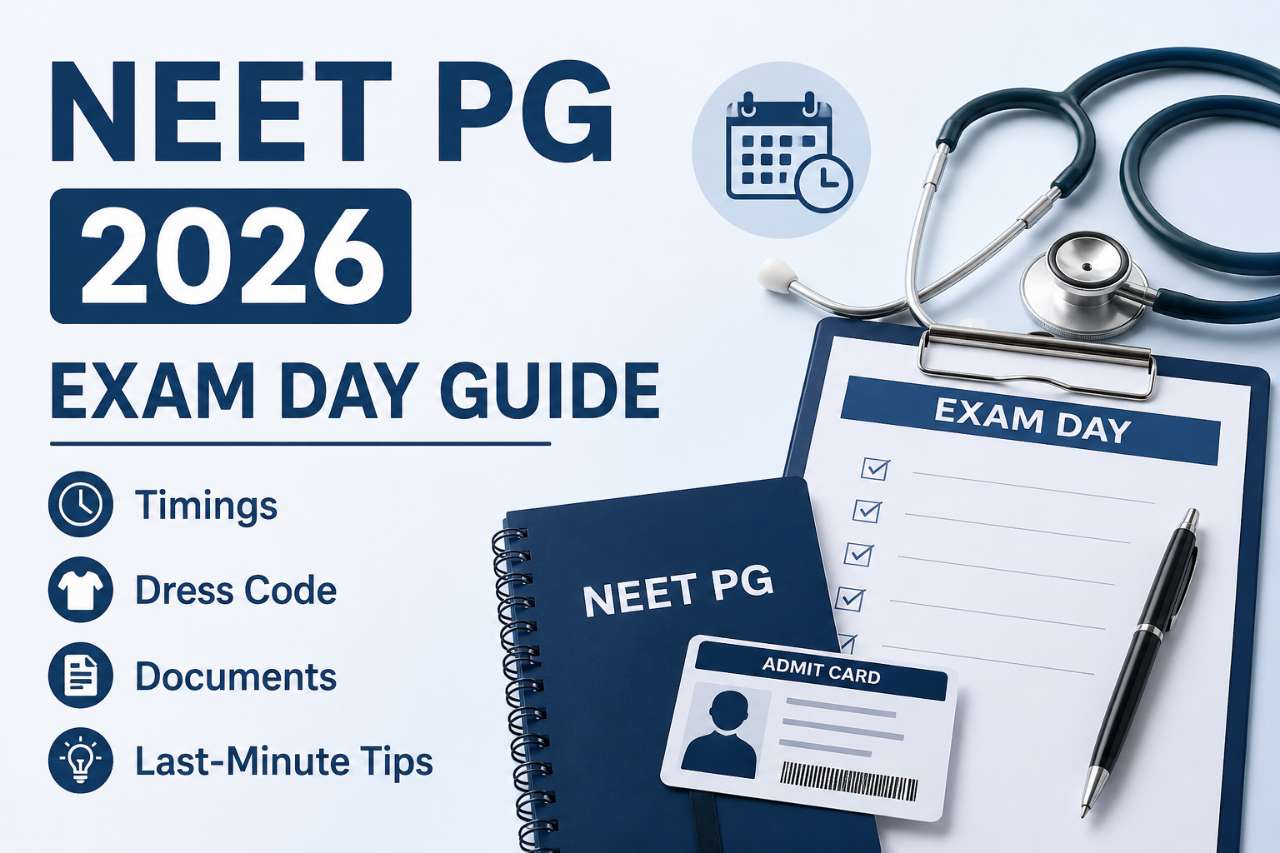
Based on the NEET PG 2026 pattern, subject experts recommend a structured approach for future test days. Arrive at the centre early to avoid CBT login delays, and use the initial minutes to settle into a steady pacing rhythm—roughly 70 seconds per question on average, with flagged questions revisited in a dedicated final pass.
After the exam, avoid panic comparison on social media for at least 24 hours. Instead, note topic areas that felt weak and cross-verify them once memory-based papers appear. When the NBEMS answer key goes live, calculate scores conservatively and identify whether you are competitive for your target specialty in both All India and home-state quotas.
Repeaters should honestly audit whether their previous strategy over-indexed on notes and under-indexed on clinical exposure. Interns appearing alongside fresh graduates often outperform on applied papers precisely because ward experience converts abstract facts into memorable patient stories.
Conclusion
NEET PG 2026 reinforced a clear message for India's postgraduate medical aspirants: the exam rewards practical understanding, clinical application, and disciplined time management over rote memorisation. Student reactions placed the paper in the moderate to difficult band, with roughly 15–20 questions posing serious challenges and the remainder testing standard postgraduate competencies in applied formats.
The absence of video-based questions simplified the interface but did not reduce intellectual demand. With NBEMS set to release the official answer key for the first time, transparency in scoring will improve—and candidates should use that window strategically. As cutoffs may trend upward for popular specialities if the paper favoured well-prepared candidates, aspirants must anchor counselling decisions on official ranks rather than social media speculation.
For ongoing updates on eligibility, syllabus, counselling dates, and college-wise cutoffs, bookmark the comprehensive NEET PG resource page on CollegeDwar and cross-reference your preparation with the broader NEET exam ecosystem that shapes medical careers from undergraduate admission through specialisation.