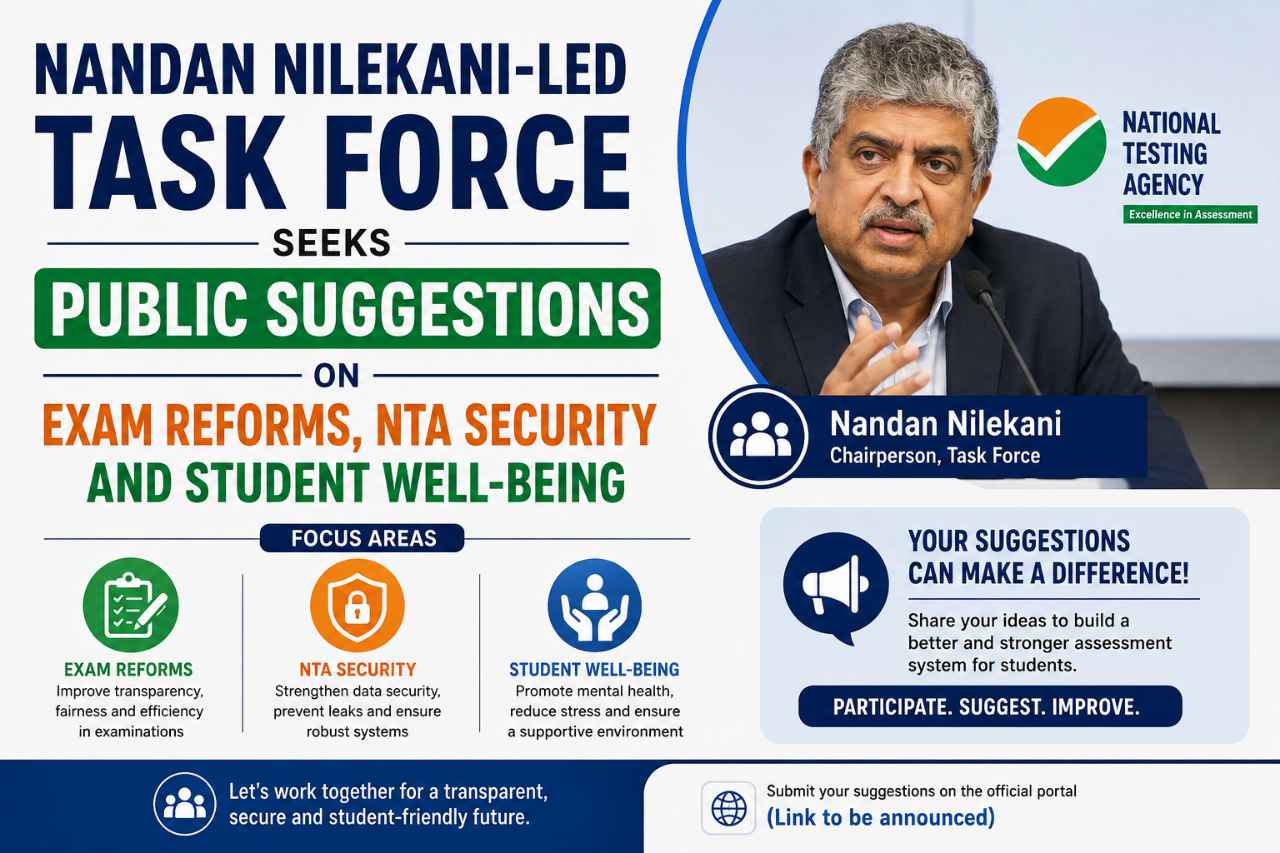

India's public examination system shapes the futures of crores of students every year from medical and engineering aspirants to design, law and civil services candidates. After repeated concerns over paper leaks, delayed results and student stress, the Government of India has opened a rare window for public participation in fixing the system. The High-Powered Task Force on Reforms in Public Examinations (HPTF), chaired by technology leader Nandan Nilekani, is now actively seeking suggestions from students, parents, teachers, institutions and citizens until September 13, 2026.
This consultation matters because entrance exams such as NEET, JEE Main, CUET and other NTA-conducted tests decide admissions to top colleges across India. Whether you are preparing in Kota, Delhi, Chennai or a small town in Uttarakhand, the reforms recommended by this task force could directly affect how exams are conducted, secured and experienced in the coming years. Unlike routine policy announcements that remain confined to government offices, this exercise invites direct citizen input a meaningful step toward rebuilding trust after a turbulent NEET-UG 2026 cycle.
This guide explains what the HPTF is, what it is asking for, how you can submit your views, and what changes students and families should watch for. It is written for India students, parents and educators who want clear, actionable information without legal jargon or political noise.
Why Was the High-Powered Task Force Formed?
Prime Minister Narendra Modi announced the constitution of the six-member HPTF on July 26, 2026, with a three-month mandate to recommend comprehensive reforms in the conduct, security, design and governance of public examinations including those handled by the National Testing Agency (NTA). The announcement followed widespread protests and public concern over the NEET-UG 2026 paper leak, a re-examination, and broader questions about whether India's testing infrastructure is secure, fair and trustworthy.
In his message, the Prime Minister emphasised that the examination system must become reliable, transparent and technology-driven. The Ministry of Personnel, Public Grievances and Pensions, under which the consultation process is being coordinated, has stated that the objective is to develop a public examination framework that is robust, secure, transparent, equitable and future-ready.
For students currently in Classes 11 and 12, and for repeaters targeting 2027 admissions, the task force's report could influence everything from computer-based testing rollout to grievance redressal timelines. Institutions from a medical university in Uttarakhand such as Hemwati Nandan Bahuguna Medical Education University to engineering campuses like Galgotias College of Engineering and Technology depend on the integrity of these national exams for their intake quality and credibility.
Who Leads the Task Force and What Expertise Does It Bring?
The HPTF is not a routine bureaucratic committee. It brings together leaders from technology, science, education, internal security and public administration a multidisciplinary design meant to address both digital vulnerabilities and on-ground logistics.
Chairman: Nandan Nilekani
Infosys co-founder Nandan Nilekani chairs the panel. He led the Unique Identification Authority of India (UIDAI) and helped build India's digital public infrastructure, including Aadhaar and contributions to the UPI ecosystem. His appointment signals a strong push toward tech-enabled, audit-friendly examination systems secure identity verification, encrypted workflows, and scalable digital platforms.
Interestingly, the name "Nandan" also connects culturally with institutions such as Hemwati Nandan Bahuguna Garhwal University, Srinagar (Garhwal), a reminder that exam reforms must serve aspirants in metros and in Himalayan towns alike.
Other Key Members
- S. Somanath Former ISRO Chairman; brings precision engineering and mission-critical systems thinking.
- Tapan Deka Former Intelligence Bureau Director; expertise in security, intelligence and threat prevention.
- Dr. V. Kamakoti Director, IIT Madras; deep knowledge of academic standards and technical education.
- Anita Karwal Former Union Education Secretary; experience in policy and institutional governance.
- Amrit Lal Meena Retired IAS officer and logistics expert; focuses on supply-chain security for exam materials and centre operations.
This blend of profiles suggests reforms may cover cybersecurity, physical logistics, question-paper chain-of-custody, centre accreditation, and institutional accountability not just superficial procedural changes.
What Areas Is the Task Force Examining?
The HPTF has identified several thematic areas where stakeholder suggestions are welcome. Understanding these themes helps you frame useful, actionable feedback rather than generic complaints.
1. Conduct and Security of Public Examinations
This includes preventing paper leaks, securing printing and storage units, protecting exam materials during transport, monitoring examination centres, and ensuring tamper-proof handling from paper setting to result declaration. Given recent incidents, security is the most urgent priority for millions of NEET and JEE families.
Institutions focused on security studies, such as Sardar Patel University of Police, Security and Criminal Justice, highlight how specialised training in criminal justice and security management could inform centre supervision standards and investigator protocols when malpractices occur.
2. Examination Design and Assessment Methodology
Beyond security, the task force is examining whether current exam patterns truly measure competency. Suggestions may address question quality, syllabus alignment, difficulty calibration, negative marking, multi-stage testing and skill-based assessments. Design entrance exams like the NIFT Entrance Exam already combine creative aptitude with structured evaluation an example of how different disciplines need tailored assessment models rather than one-size-fits-all testing.
3. Governance, Accountability and Institutional Arrangements
Who owns exam integrity when something goes wrong? The HPTF is studying governance structures, accountability mechanisms, independent audits, permanent professional staffing, and whether bodies like the NTA need statutory strengthening. Professional groups have debated replacing the NTA with a statutory National Examination Authority established by an Act of Parliament a major structural reform that stakeholders may support or critique with evidence.
4. Prevention, Detection and Redressal of Malpractices
Reforms here may include whistle-blower channels, digital forensics, fast-track enquiries, student compensation policies, and clear protocols when exams are cancelled or re-conducted. Transparent redressal reduces panic and restores trust especially for aspirants who spend years preparing in hubs like Kota.
5. Technology and Secure Computer-Based Testing (CBT)
Technology-led reforms could expand secure CBT with biometric authentication, AI-assisted proctoring, encrypted item banks, and real-time anomaly detection. IIT-led academic input, similar to the research environment at Jawaharlal Nehru Centre for Advanced Scientific Research, Bengaluru, can help ensure that innovation is backed by rigorous testing before national rollout.
6. Examination Infrastructure
India needs more certified centres, better seating capacity, reliable power and internet backup, accessible facilities, and standardised SOPs across states. Logistics expert Amrit Lal Meena's presence underscores that even the best software fails without strong physical infrastructure particularly in tier-2 and tier-3 cities.
7. Accessibility, Inclusion and Regional Equity
An inclusive framework must address students with disabilities, language barriers, rural connectivity gaps, and socio-economic disparities. Exams should not favour only those who can afford expensive coaching. Students in cities like Chennai or Delhi often access strong support systems seen in institutions such as Bharathidasan Government College for Women, Chennai or Lady Shri Ram College for Women (LSR), Delhi but reforms must uplift learners everywhere, including coaching towns like Kota where institutes such as International Academy for Certification and Training, Kota serve large aspirant populations.
8. Transparency, Grievance Redressal and Communication
Students deserve clear timelines, official single-source communication, and responsive helplines. Mixed signals during NEET and UGC NET controversies increased anxiety. A standard public communication protocol perhaps modelled on best practices from digital public infrastructure projects could prevent misinformation from dominating exam cycles.
9. Student Well-Being Throughout the Examination Process
Exam reforms are not only about papers and servers. The HPTF explicitly includes student well-being mental health support before, during and after exams; fair re-test policies; counselling after cancellations; and reducing unnecessary uncertainty in admissions. Public health institutions like the Indian Institute of Public Health, Gandhinagar and PHFI Institute of Public Health Sciences remind us that student stress during competitive exams is a public health concern, not a private struggle alone.
Who Can Submit Suggestions to the HPTF?
The government has invited inputs from a wide cross-section of stakeholders, including:
- Students and exam candidates (NEET, JEE, CUET, UGC NET, SSC, UPSC and others)
- Parents and guardians
- Teachers, professors and academic institutions
- Examination-conducting and test-indenting bodies
- Subject-matter and technology professionals
- Industry associations and civil society organisations
- Any citizen with constructive, evidence-based suggestions
You do not need to be an expert to participate. A well-written student experience such as facing centre cancellations, confusing admit cards, or poor grievance response can be as valuable as a technical note on encryption.
How to Submit Your Suggestions: Step-by-Step Guide
The consultation is open until September 13, 2026. Submissions are accepted in English, Hindi and regional languages. Use any of the official channels below.
| Channel | Details |
|---|---|
| Official Website | examreforms-taskforce.dopt.gov.in |
| Toll-Free Phone | 1800-180-4747 |
| Send "hptf" to +91 78270 42830 | |
| ExamReformsTaskforce@dopt.gov.in | |
| Last Date | September 13, 2026 |
Tips for Writing Effective Suggestions
- Be specific: Mention the exam (NEET, JEE, CUET, etc.) and the problem clearly.
- Propose solutions: Don't stop at criticism offer practical fixes.
- Share evidence: Dates, centre codes, screenshots (without sharing personal passwords) strengthen credibility.
- Think nationally: Recommendations should work for rural and urban students alike.
- Include well-being: Suggest counselling helplines, clear re-exam policies, and trauma-sensitive communication.
- Keep language respectful: Constructive tone increases the chance your input is considered seriously.
What Reforms Are Students and Experts Already Discussing?
Although the task force has not finalised recommendations, public discourse and professional bodies have highlighted recurring themes worth considering.
Leak-Proof Paper Handling
Proposals include blockchain-style audit trails, GPS-tracked transport, dual-key access to question banks, and independent third-party security audits. Former ISRO and IB leadership on the panel suggests these are not fantasy ideas they are operational standards adapted from mission-critical sectors.
Statutory Exam Authority
Some medical and academic groups advocate a statutory National Examination Authority with clear parliamentary oversight, dedicated funding, and permanent technical staff rather than ad-hoc fixes after each crisis.
Hybrid and CBT Rollout
Engineering aspirants targeting campuses like Krishna Institute of Engineering and Technology, SRM Institute of Science and Technology, Chennai, or University of Petroleum and Energy Studies already encounter online assessments and computer labs in college. Many argue national entrance exams should gradually mirror secure, proctored CBT with pilot phases and equity safeguards for students unfamiliar with digital interfaces.
Reduced Coaching Dependence
Reforms that align school boards, NCERT syllabi and entrance exam content could lower the pressure to migrate to coaching hubs. Yet towns like Kota remain central for lakhs of families colleges such as SRD Modi College for Women, Kota and Shekhawati College for Education, Losal (Sikar) serve local communities whose members also deserve a fair, national-level testing system.
Design, Architecture and Creative Courses
Aspirants for creative fields use specialised exams and portfolio reviews. Institutes like Centre for Design Excellence, Jaipur and Arch College of Design and Business, Jaipur depend on credible, tamper-proof evaluation for fair admissions. Generic entrance reform must not ignore niche disciplines.
Women's Access to Quality Higher Education
Exam stress disproportionately affects young women when safety, travel, and hostel uncertainty accompany test delays. Institutions championing women's education Indraprastha College for Women, Delhi, Indira Gandhi Delhi Technical University for Women, and Avinashilingam Institute for Home Science and Higher Education for Women, Coimbatore benefit when admissions are decided on merit through a trustworthy process, not through chaos and litigation.
Timeline: What Happens After September 13, 2026?
The HPTF was constituted with a three-month timeline from late July 2026, meaning recommendations are expected around October 2026. The typical sequence is:
- Public consultation ongoing until September 13, 2026
- Stakeholder meetings with professional bodies, universities, and tech experts
- Draft recommendations structural, technological and administrative reforms
- Government review and implementation roadmap legislative, regulatory or operational changes
- Impact on 2027 exam cycle possible phased rollout for NTA exams
Students should continue focusing on syllabus preparation while tracking official updates only from government portals not unverified social media forwards.
How Exam Reforms Connect to College Admissions in India
Public exams are the gateway to India's higher education ecosystem. A single NEET result determines entry into MBBS seats nationwide. JEE scores open doors to NITs, IIITs and participating state engineering colleges. CUET simplifies undergraduate admissions to central universities. When the exam layer fails, the entire admissions pipeline from Sree Chitra Tirunal Institute for Medical Sciences and Technology, Thiruvananthapuram to ICFAI Foundation for Higher Education, Hyderabad faces delays, legal disputes and eroded public trust.
From an SEO and student-planning perspective, aspirants should:
- Monitor official NTA and Ministry notifications alongside HPTF updates
- Build flexible admission strategies (backup courses, state quotas, private university options)
- Document personal exam issues and submit them to the task force before the deadline
- Prioritise mental health and structured study plans during policy uncertainty
What Should NEET, JEE and CUET Aspirants Do Right Now?
If you are actively preparing for upcoming entrance exams, exam reform news can feel distracting or even alarming. Here is a balanced approach grounded in what students and families can control today.
Stay Focused on Preparation
Policy changes take months to become operational rules. Until official notifications change exam modes or schedules, continue your planned syllabus coverage, mock tests and revision cycles. Aspirants targeting institutes like Regional Centre for Biotechnology or Mody University of Science and Technology, Lakshmangarh should remember that strong fundamentals remain the best hedge against policy uncertainty.
Follow Only Official Sources
Rely on nta.ac.in, jeemain.nta.nic.in, cuet.nta.nic.in, and the HPTF portal for verified updates. Viral WhatsApp claims about exam cancellations or pattern changes often create unnecessary panic among hostel students and coaching batches.
Submit Your Exam Experience to the HPTF
If you faced admit card errors, centre mismanagement, technical glitches during CBT, or mental health strain during re-examinations, document your experience and submit it before September 13, 2026. Real stories from 2025 and 2026 exam cycles give policymakers data that statistics alone cannot capture.
Build a Backup Admission Plan
Smart aspirants maintain alternative pathways state counselling quotas, private university options such as Fairfield Institute of Management and Technology, or diploma-to-degree routes without diluting their primary goal. Reform conversations should not stop career planning; they should make planning more realistic.
Conclusion: Your Voice Can Shape India's Exam Future
The Nandan Nilekani-led High-Powered Task Force represents one of the most open consultations in recent years on public examination reform in India. With mandates covering NTA security, exam design, technology adoption, inclusion and student well-being, the panel has a brief but critical opportunity to restore faith in a system that affects more than a crore of aspirants annually.
If you are a student, parent, teacher or citizen who has lived through paper leaks, confusing re-tests, inaccessible centres or stress during competitive exams, now is the time to speak up clearly, constructively and before September 13, 2026. Visit examreforms-taskforce.dopt.gov.in, call the toll-free helpline, send your inputs via WhatsApp or email, and share practical ideas that can make exams fairer for every learner from Kota coaching classrooms to government schools in Garhwal.
India's examination system should be worthy of students' hard work. This consultation is your chance to help build exactly that. Reforms that combine Nilekani's digital infrastructure vision with Somanath's precision, Deka's security rigour, Kamakoti's academic standards, Karwal's governance experience and Meena's logistics expertise could finally align India's exam machinery with the aspirations of a young, ambitious nation. Do not let the deadline pass without adding your voice.