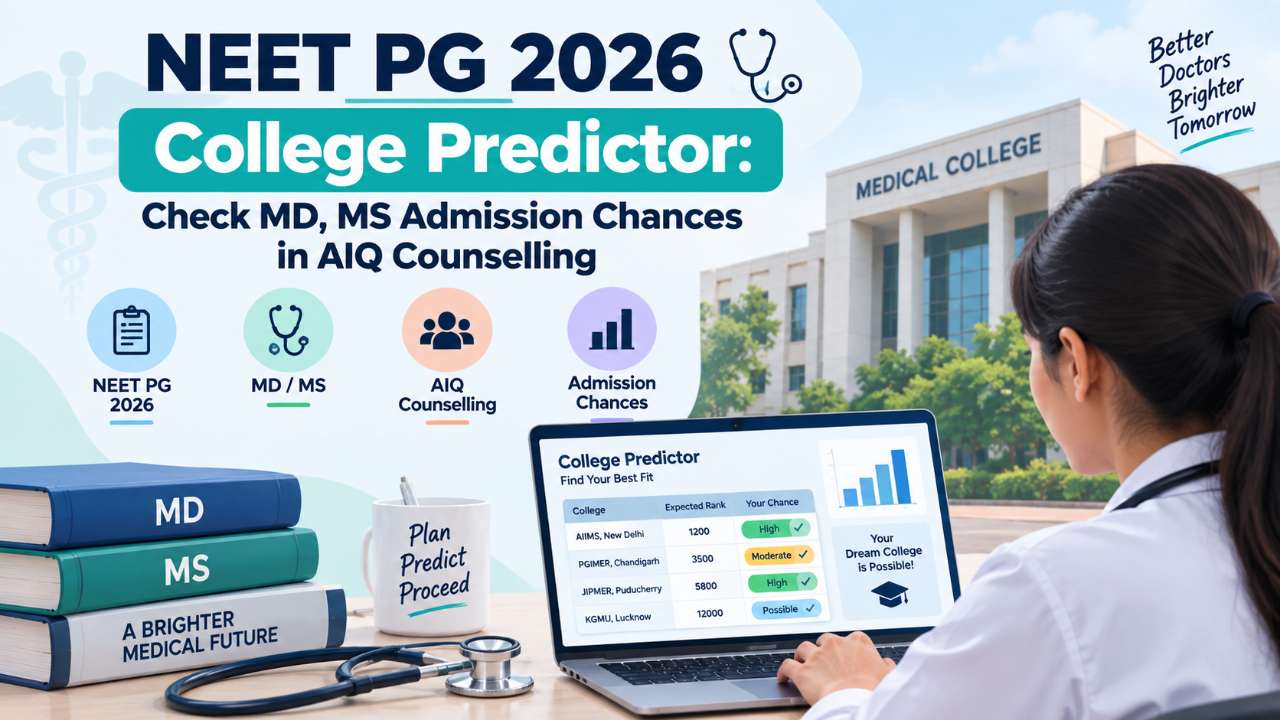
If you have secured a NEET PG 2026 rank under 15,000, you are in a competitive but promising zone for postgraduate admission at government medical colleges in India. While top clinical branches such as Radiology, Dermatology, and Cardiology remain out of reach at this rank band, several high-value MD and MS specialties including General Surgery, Orthopaedics, Obstetrics and Gynaecology, Paediatrics, Psychiatry, ENT, Ophthalmology, and Respiratory Medicine have historically closed within the 10,000–15,000 range in government institutions.
This article is written for Indian medical graduates who want clear, practical guidance on College selection, branch prioritisation, and counselling strategy. We draw on previous-year cutoff trends not fixed promises to help you plan realistically for NEET PG All Indian Quota (AIQ) and state-level counselling rounds in 2026.
Understanding the NEET PG Rank Under 15,000 Landscape
A rank between 10,000 and 15,000 places you in the middle tier of NEET PG aspirants. You are unlikely to secure ultra-competitive branches at premier institutes like AIIMS Delhi or top-tier Radiology seats, but you remain well positioned for clinical and para-clinical specialties at established government medical colleges across states.
Key factors that shape your admission chances include:
- Category: General, EWS, OBC, SC, ST, and PwBD categories have separate closing ranks.
- Quota: All India Quota (50% through MCC) and state quota (50% through state counselling) follow different cutoffs.
- Counselling round: Closing ranks typically rise from Round 1 to Round 2 and mop-up rounds.
- Seat increase: New government medical colleges and expanded PG intake improve options each year.
- Branch popularity: Surgical and clinical branches close earlier; para-clinical branches often remain open longer.
NEET PG 2026 Tie-Breaking Criteria
When two candidates score identical marks, NBE applies the following tie-breakers in order:
- Candidate with fewer incorrect answers overall
- Fewer incorrect answers in Section A
- Fewer incorrect answers in Sections B, C, D, and E (in that order)
- Higher aggregate marks in MBBS professional examinations
- Older candidate by date of birth
Understanding tie-breakers matters when your rank sits near a branch cutoff every correct answer can shift your position by several ranks.
Expected Increase in Government PG Medical Seats for 2026
India's postgraduate medical seat capacity has expanded steadily. More government medical colleges, ESIC institutes, and newly recognised PG departments mean broader opportunities for candidates in the 10,000–15,000 rank band.
Projected PG Seat Matrix (Reference Trends)
| Year | MD Seats | MS Seats | Diploma | MD/MS Combined | Total PG Seats (Approx.) |
|---|---|---|---|---|---|
| 2025 | 39,559 | 18,414 | 370 | 57 | Around 58,400 |
| 2026 (Expected) | Expanding | Expanding | Stable | Stable | Around 64,000 |
More seats generally mean slightly relaxed closing ranks for mid-tier branches, though demand for popular surgical specialties continues to push cutoffs upward. Treat seat projections as planning indicators, not guarantees.
Branch-wise Maximum Closing Ranks Under 15,000 (Previous Year Reference)
The table below shows the highest government college closing ranks observed in the 10,000–15,000 band during recent counselling. These figures represent the outer limit meaning some colleges closed much earlier for the same branch.
| Course / Branch | Maximum Closing Rank (2025 Reference) |
|---|---|
| MD Pulmonary Medicine | 10,164 |
| MD Obstetrics and Gynaecology | 11,051 |
| MD Ophthalmology | 12,802 |
| MD Pharmacology | 12,863 |
| MD Paediatrics | 13,006 |
| MD Pathology | 13,162 |
| MD Preventive and Social Medicine (PSM) | 13,271 |
| MD Tuberculosis and Respiratory Diseases | 13,490 |
| Diploma in Child Health (DCH) | 13,571 |
| MD Emergency Medicine | 13,752 |
| MD Radiation Oncology | 13,778 |
| MD Respiratory Medicine | 13,810 |
| MD Geriatrics | 13,867 |
| MS Obstetrics and Gynaecology | 14,217 |
| MD Psychiatry | 14,785 |
| MS General Surgery | 14,849 |
| MD Social and Preventive Medicine | 14,873 |
| MS Orthopaedics | 14,883 |
| MS ENT | 14,988 |
Actionable tip: If your rank is near 14,900, prioritise MS ENT, MS Orthopaedics, and MS General Surgery in Round 1, but keep para-clinical branches as safe backups for later rounds.
Government Medical Colleges You Can Target: Rank 10,000 to 10,100
Candidates around rank 10,000 historically secured the following government college seats. These examples illustrate what is achievable at the lower end of the 10,000–15,000 band.
| College | Course | Closing Rank |
|---|---|---|
| Government Medical College, Ratlam | MS Obstetrics and Gynaecology | 10,029 |
| Gulbarga Institute of Medical Sciences | MD Paediatrics | 10,035 |
| Tirunelveli Medical College | MS Orthopaedics | 10,071 |
| North Bengal Medical College | MS General Surgery | 10,092 |
| Bankura Sammilani Medical College | MS General Surgery | 10,093 |
| Patna Medical College | MD Tuberculosis and Respiratory Diseases | 10,100 |
At this rank, you can also explore well-regarded institutes such as Maulana Azad Medical College (MAMC), Delhi for certain para-clinical branches, though clinical seats at central Delhi colleges typically require much higher ranks.
Government Medical Colleges for Rank 14,800 to 15,000
If your rank falls at the upper edge of this band, these colleges and branches represent realistic targets based on previous closing trends.
| College | Course | Closing Rank |
|---|---|---|
| Jawaharlal Nehru Medical College, Ajmer | MS Ophthalmology | Around 14,800+ |
| Indira Gandhi Institute of Medical Sciences, Patna | MS Ophthalmology | Around 14,800+ |
| Bangalore Medical College and Research Institute | Various branches | Around 14,800+ |
| Sher-i-Kashmir Institute of Medical Sciences, Srinagar | Various branches | Around 14,800+ |
| Belagavi Institute of Medical Sciences | MS Orthopaedics | 14,831 |
| Shri Lal Bahadur Shastri Government Medical College | MS General Surgery | 14,849 |
| Sri Venkateswara Institute of Medical Sciences, Tirupati | MD Radiotherapy | 14,861 |
| King George's Medical University (KGMU), Lucknow | MD Social and Preventive Medicine | 14,873 |
| Autonomous State Medical College | MS Orthopaedics | 14,880 |
| Government Medical College, Nandurbar | MS Orthopaedics | 14,883 |
| MKCG Medical College, Berhampur | MD Anaesthesiology | 14,974 |
| ESIC Medical College | MS ENT | 14,988 |
Rajasthan candidates should note that Shri Kalyan Government Medical College, Sikar and institutions linked to the Jaipur medical cluster including Sawai Man Singh Government College, Jaipur participate in state counselling with cutoffs that may differ from AIQ trends. Similarly, Government Medical College, Kota offers PG options worth tracking during Rajasthan state rounds.
State-wise Government College Options for NEET PG Rank Under 15,000
North India
Delhi NCR remains highly competitive for clinical branches at ranks under 15,000. While Vardhman Mahavir Medical College (VMMC), Delhi and University College of Medical Sciences (UCMS), Delhi typically require top ranks for MD/MS clinical seats, para-clinical and certain diploma options may appear in later rounds.
In Uttar Pradesh, institutes such as SGPGIMS Lucknow and Dr Ram Manohar Lohia Institute of Medical Sciences attract high demand. KGMU Lucknow offers PSM and other branches within the 14,000+ range. Haryana's PGIMS Rohtak and Punjab's GMC Patiala are solid options for candidates open to relocating.
West and Central India
Maharashtra's Seth GS Medical College (KEM), Mumbai, and Gujarat's NHL Municipal Medical College, Ahmedabad, are popular choices. Chhattisgarh institutes like Pt Jawahar Lal Nehru Memorial Medical College, Raipur, and Chhattisgarh Institute of Medical Sciences, Bilaspur, often show more accessible cutoffs for mid-tier ranks.
South India
Bangalore Medical College, St John's Medical College, and Sri Venkateswara Medical College, Tirupati, regularly feature in the 10,000–15,000 closing rank range for select branches. Tamil Nadu and Karnataka state counselling can offer additional seats beyond AIQ.
East India
West Bengal's IPGMER Kolkata and NRS Medical College, Kolkata, are established PG destinations. Patna Medical College and IGIMS Patna serve Bihar candidates, while North Bengal Medical College offers surgical branches at ranks around 10,000.
Clinical vs Para-Clinical: Smart Branch Strategy for Rank 10,000–15,000
High-Demand Clinical Branches
- MS General Surgery: Closing ranks near 14,849; strong career scope but competitive.
- MS Orthopaedics: Closes around 14,883; popular among surgical aspirants.
- MS ENT: Among the last surgical branches to close near 14,988.
- MD Paediatrics: Closes around 13,006; excellent for those interested in child healthcare.
- MD Psychiatry: Growing demand; closes near 14,785.
Para-Clinical and Non-Surgical Options
- MD Pathology: Stable career in diagnostics; closes around 13,162.
- MD Pharmacology: Ideal for academic and research-oriented doctors; closes around 12,863.
- MD PSM / Community Medicine: Public health focus; closes around 13,271–14,873.
- MD Respiratory Medicine: Closes around 13,810; relevant post-COVID demand.
Expert advice: List branches in three tiers dream, realistic, and safe and never fill all choices with dream branches alone. Candidates from Rajasthan planning to stay in-state should compare AIQ options with state quota seats at colleges like Government Ayurved Mahavidyalaya, Sikar only if pursuing AYUSH PG through separate counselling not NEET PG MD/MS.
AIQ vs State Counselling: Where Should You Apply?
NEET PG counselling operates on two parallel tracks:
- MCC AIQ (50% seats): Centralised counselling at mcc.nic.in for all government colleges except IP universities and some autonomous institutes.
- State counselling (50% seats): Conducted by respective state authorities; domicile rules vary.
Candidates with rank 10,000–15,000 should register for both AIQ and their home state counselling. A seat secured in AIQ Round 1 can be upgraded in Round 2, but leaving a allotted seat without proper resignation may attract penalties. Always read the latest MCC and state information bulletins before each round.
Important NEET PG 2026 Dates and Counselling Milestones
While exact 2026 dates are announced by NBE and MCC, the typical timeline follows this pattern:
- NEET PG exam: Usually conducted in June or July
- Result declaration: Expected around September 2026
- MCC Round 1 registration and choice filling: Shortly after result
- Round 2 and mop-up rounds: September–October
- State counselling: Runs parallel to or after AIQ Round 1
Mark your calendar early. Late registration is one of the most common and most avoidable reasons candidates miss government college seats despite a qualifying rank.
Common Mistakes to Avoid During NEET PG Counselling
- Ignoring mop-up and stray vacancy rounds: Many government seats remain vacant and reopen in later rounds.
- Not researching college accreditation: Verify that the college and branch are MCI/NMC recognised.
- Choosing branch over location blindly: A less preferred branch at a strong teaching hospital may outweigh a dream branch at a weaker centre.
- Missing documentation deadlines: Keep MBBS degree, internship completion certificate, registration, category certificate, and PwBD certificate ready.
- Skipping security deposit rules: Understand refund timelines before accepting a seat.
How to Maximise Your Chances at Government Colleges Under Rank 15,000
- Start with previous three years' cutoff PDFs from MCC and your state authority.
- Use a college predictor tool to simulate rank-to-college mapping.
- Join aspirant forums for real-time vacancy updates during mop-up rounds.
- Be flexible on state and city colleges in tier-2 cities often close at higher ranks.
- Consider diploma courses (DCH, DGO) as entry points; many allow later conversion to MD/MS.
- For Delhi aspirants, explore whether para-clinical seats at central institutes fit your long-term goals even if clinical branches are out of reach.
Category-wise Cutoff Expectations for Rank Under 15,000
Closing ranks vary significantly across reservation categories. General and EWS candidates face the highest cutoffs, while OBC, SC, ST, and PwBD categories benefit from relaxed closing ranks in both AIQ and state quota.
As a practical benchmark, if a branch closes at rank 14,900 for General category in AIQ Round 1, reserved category candidates may access the same branch at ranks 2,000 to 5,000 higher depending on seat distribution and state. Always check category-specific cutoff PDFs rather than relying on General category data alone.
Estimated Category Advantage (Planning Reference)
| Category | Typical Rank Relaxation vs General (Indicative) |
|---|---|
| EWS | Similar to General in many branches |
| OBC (NCL) | 1,500–3,500 ranks higher closing |
| SC | 3,000–6,000 ranks higher closing |
| ST | 4,000–8,000 ranks higher closing |
| PwBD | Varies by disability type and seat pool |
These ranges are illustrative. Download the official MCC AIQ cutoff brochure for your category before finalising choices.
Government Medical College Fees, Stipend, and Service Bonds
One of the biggest advantages of securing a government MD or MS seat is affordability. Tuition fees at most government medical colleges range from Rs 20,000 to Rs 1,50,000 per year depending on the state a fraction of private medical college PG fees that can exceed Rs 50 lakh for the entire course.
PG residents at government colleges typically receive a monthly stipend between Rs 50,000 and Rs 70,000 during the three-year course, which helps offset living expenses. Stipend amounts vary by state and are revised periodically.
Many states impose a mandatory service bond requiring graduates to serve in rural or underserved areas for one to five years after completing PG. Rajasthan, Uttar Pradesh, Maharashtra, and several southern states have bond policies with financial penalties for non-compliance. Before accepting a seat, read the bond terms on the state medical education department website.
Rajasthan State Counselling: Options for NEET PG Aspirants
Rajasthan is home to a growing network of government medical colleges that participate in NEET PG counselling. SMS Medical College Jaipur remains the most sought-after institute in the state, but newer colleges offer accessible cutoffs for candidates in the 10,000–15,000 rank range during state quota rounds.
Key Rajasthan government medical institutions to monitor include:
- Shri Kalyan Government Medical College, Sikar a newer institute gaining PG seat capacity
- Government Medical College, Kota established teaching hospital with expanding PG departments
- JLN Medical College, Ajmer MS Ophthalmology and other branches near the 14,800 rank mark in AIQ
- RUHS College of Medical Sciences, Jaipur state quota seats with separate cutoff trends
Rajasthan domicile candidates should register on the state medical education portal in addition to MCC. The state quota often provides better branch access for home-state students compared to AIQ alone. Cities like Jaipur, Kota, and Sikar also host strong undergraduate ecosystems institutions such as Government College, Jaipur and Govind Guru Government College, Jaipur reflect the region's broader educational infrastructure, though NEET PG MD/MS admission is handled exclusively through medical college PG departments.
Diploma vs MD/MS: Should You Consider a PG Diploma?
PG Diploma courses such as DCH (Diploma in Child Health), DGO (Diploma in Obstetrics and Gynaecology), and DVD (Diploma in Dermatology) require two years of training compared to three years for MD or MS degrees. Diploma closing ranks are often higher (more accessible) than equivalent degree programmes.
For candidates ranked near 15,000, a diploma can be a strategic entry point:
- DCH: Closed around rank 13,571 in government colleges; suitable for paediatric-focused careers
- DGO: Often accessible when MS OBG is out of reach
- Conversion pathway: Some states allow diploma holders to pursue a reduced-duration MD after completing the diploma
Evaluate diploma options during mop-up rounds if degree seats in your preferred branch are exhausted. A diploma from a government teaching hospital still carries strong clinical training value.
Round-wise Counselling Strategy for Maximum Seat Advantage
Round 1: Aim Realistically
In Round 1, fill choices that match your rank based on previous cutoffs. Do not waste top slots on branches that historically close below rank 5,000. Target branches where your rank falls within the middle of the previous closing range not at the extreme edge.
Round 2: Upgrade or Hold
If Round 1 gives you a para-clinical seat but you want clinical, participate in Round 2 with upgraded choices. You may retain your Round 1 seat until Round 2 allotment is confirmed, subject to MCC rules for the current year.
Mop-up and Stray Vacancy Rounds
These rounds are where rank-15,000 candidates often achieve their best outcomes. Vacant MS ENT, MS Orthopaedics, and MD Anaesthesiology seats frequently appear. Monitor the MCC vacancy list daily and be prepared to fill choices within hours of publication.
State Counselling Parallel Track
If AIQ rounds close without your preferred branch, state counselling may still offer government seats with state-specific cutoffs. Candidates from Tamil Nadu, Karnataka, Rajasthan, and West Bengal particularly benefit from robust state quota seat pools.
Building Your Personalised College-Branch Matrix
Before counselling begins, create a spreadsheet with columns for college name, branch, state, previous Round 1 closing rank, Round 2 closing rank, fees, bond requirement, and hospital bed strength. Sort by closing rank and highlight entries within 500 ranks above your current rank.
Include colleges from at least eight to ten states to avoid over-concentrating choices in competitive regions like Delhi and Mumbai. Institutes in Madhya Pradesh, Chhattisgarh, Odisha, and the North-East often provide surgical and clinical branches at ranks above 12,000.
For students who completed MBBS near major educational hubs, remember that postgraduate training quality depends on hospital patient load and faculty strength not just city size. A government medical college in Bundi or tier-2 locations may offer excellent hands-on surgical exposure compared to an overcrowded metro institute where residents compete for procedures.
Conclusion
A NEET PG 2026 rank under 15,000 opens meaningful pathways to government MD and MS seats across India especially in General Surgery, Orthopaedics, ENT, Paediatrics, Psychiatry, Ophthalmology, and several para-clinical specialties. Success depends less on rank alone and more on informed choice filling, dual registration in AIQ and state counselling, and willingness to participate in all rounds including mop-up.
Treat every cutoff in this guide as a historical reference point. Seat matrices expand each year, and closing ranks shift with competition and category. Start your college research now, prepare documents in advance, and approach counselling with a clear tiered strategy. With disciplined planning, candidates in the 10,000–15,000 band can secure rewarding postgraduate training at respected government medical institutions and build strong clinical careers across India.