
Every year, thousands of NEET UG qualifiers celebrate an MBBS seat at a private medical college only to discover that the advertised tuition fee is just the starting point. In 2026, the National Medical Commission (NMC) has again warned students and parents about hidden charges at private medical institutions: hostel deposits, mess bills, security amounts, universityh registration, and miscellaneous heads that can push the real cost of an MBBS degree far beyond brochure figures.
If you are comparing colleges in Rajasthan, Delhi, Uttar Pradesh, or any other state, understanding these non-tuition expenses is not optional—it is essential financial planning. This guide explains what private medical colleges can legally charge, what counts as a hidden fee, how the total bill adds up over 5.5 years, and exactly what to verify before you pay a single rupee.
Why Private Medical College Fees Look Lower Than They Really Are
Private medical colleges in India typically publish a headline tuition figure during NEET counselling. That number often reflects only the academic fee for classroom and clinical training. What brochures rarely highlight upfront are the mandatory parallel expenses that accompany campus life, hospital training, and university affiliation.
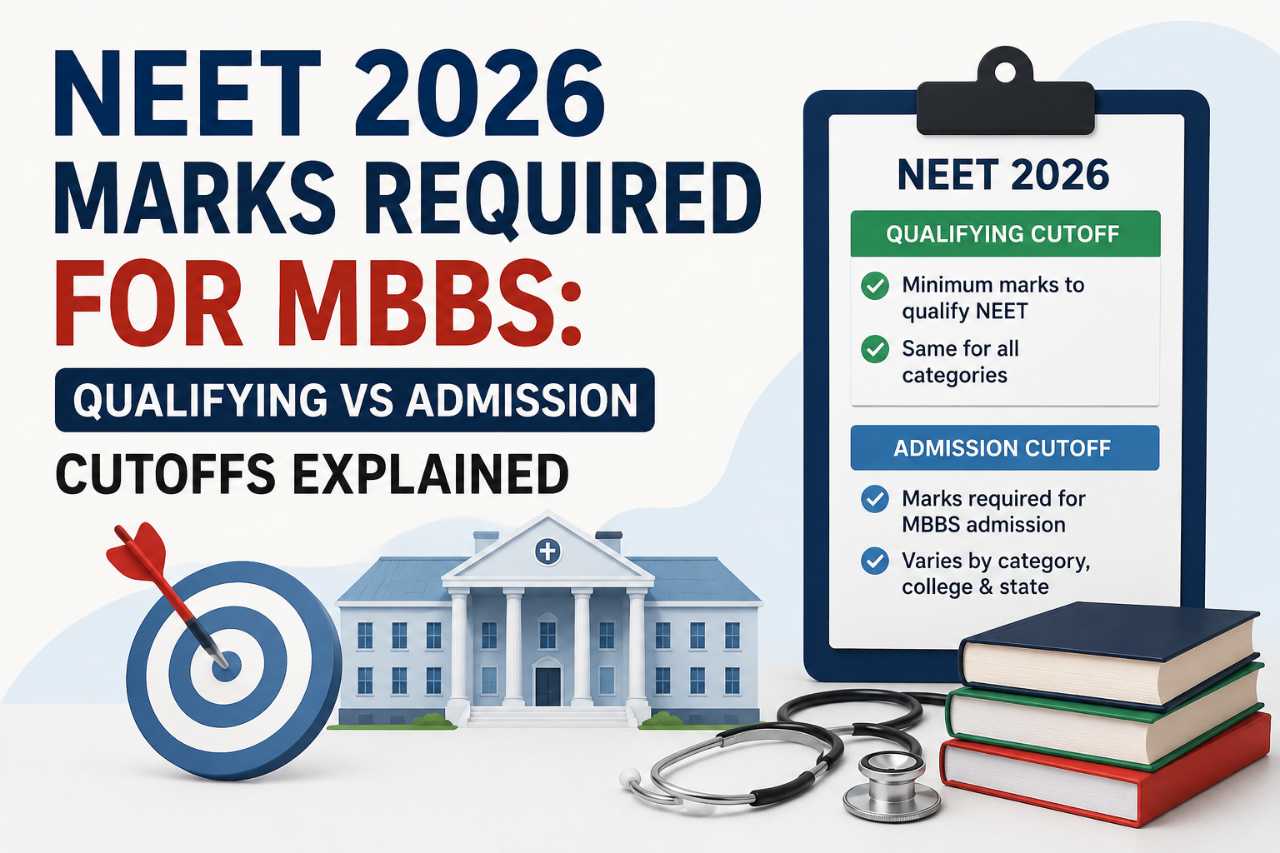
The NMC Act, 2019 introduced a tuition fee cap on 50 percent of seats in private medical colleges, aligning those seats with government medical college rates in the respective state. The remaining seats management quota, NRI quota, or institutional quota can carry significantly higher tuition. Even on capped seats, however, non-tuition heads are fixed separately by the state fee fixation committee and are not included in the tuition cap.
This split structure creates confusion. A family budgeting ₹12 lakh per year for tuition may still owe ₹2–3 lakh annually for hostel and mess, plus one-time deposits and exam fees. Over 5.5 years, the gap between expected and actual spending can exceed ₹20–40 lakh—enough to derail a carefully planned education loan.
Government vs Private: A Useful Comparison
Understanding government college fee structures helps set realistic expectations. At institutions like All India Institute of Medical Sciences Delhi (AIIMS Delhi), Maulana Azad Medical College (MAMC Delhi), and Vardhman Mahavir Medical College (VMMC Delhi), annual tuition remains heavily subsidised. Hostel charges exist but are modest compared with most private campuses.
In Rajasthan, Government Medical College Kota and Shri Kalyan Government Medical College Sikar offer a similar pattern: lower tuition, transparent state-regulated fee sheets, and limited surprise heads. Private counterparts such as Sudha Medical College and Hospital Kota or Noida International Institute of Medical Sciences may show higher base tuition and larger non-tuition stacks—making side-by-side comparison critical before seat acceptance.
Common Hidden Charges at Private Medical Colleges in 2026
The NMC prohibits charging any fee that is not disclosed in the official fee notification approved by the state fee fixation committee. Despite this, students routinely encounter heads that feel "hidden" because they appear only at admission, in fine print, or through verbal assurances from agents. Below are the most frequent categories.
1. Hostel Accommodation Fee
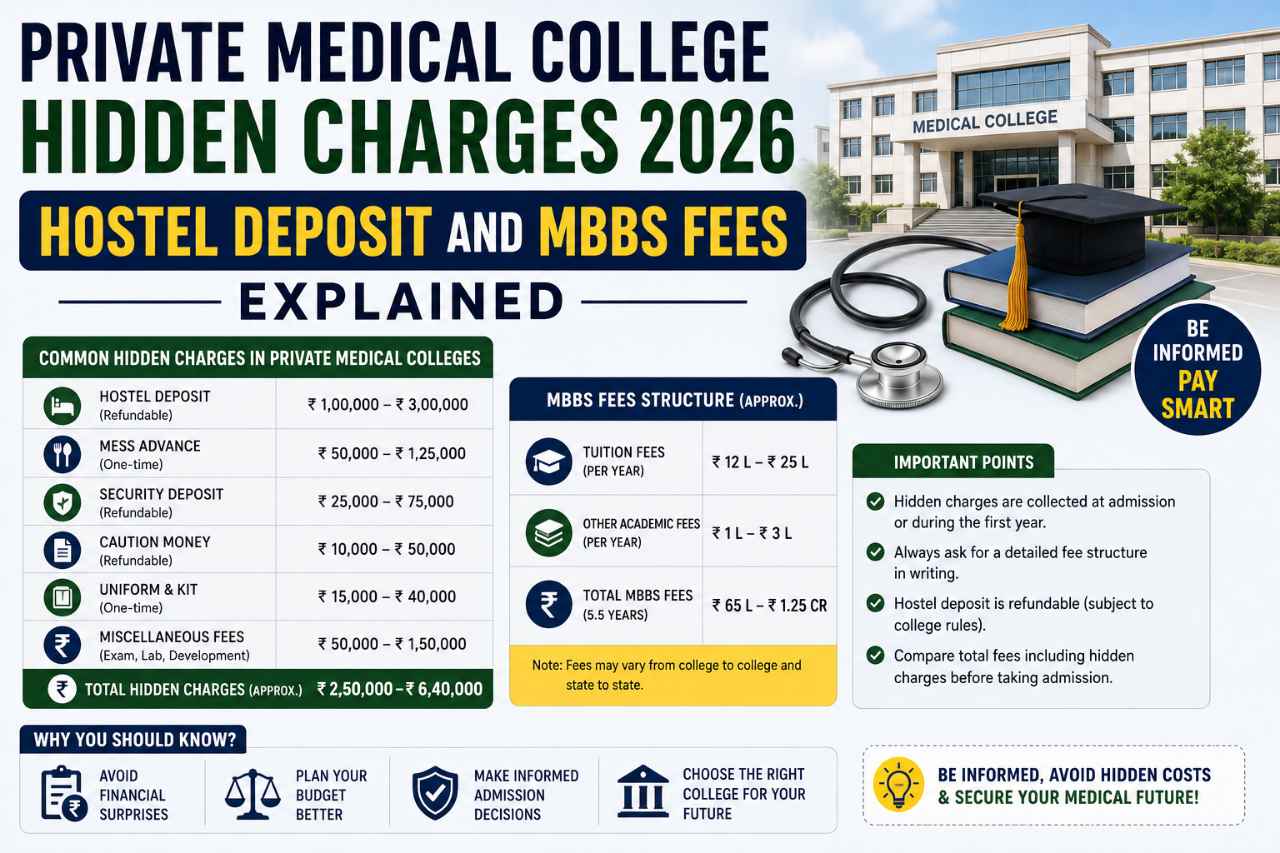
Most private medical colleges require outstation students to stay in campus hostels for all or part of the MBBS course. Hostel fees are billed annually or semester-wise and are not part of the tuition cap. Annual hostel charges at private institutions commonly range from ₹1,00,000 to ₹3,00,000 depending on city, room type (AC vs non-AC), and meal inclusion.
Some colleges treat hostel occupancy as mandatory even for local students, citing attendance or security rules. Always ask whether day-scholar status is permitted and whether fees differ for single, double, or triple occupancy rooms.
2. Mess and Dining Charges
Mess fees are often listed separately from hostel rent. Colleges may charge monthly mess bills (₹3,000–₹8,000 per month is typical in metro and tier-2 cities) or bundle food into a composite hostel-mess package. Check whether mess withdrawal is allowed after the first year and whether unused meal credits are refunded.
3. Security or Caution Deposit
One of the largest upfront shocks for families is the refundable security deposit, often ranging from ₹1,00,000 to ₹3,00,000. This is usually collected at admission against potential damage to hostel property, library books, or laboratory equipment. Confirm in writing:
- Whether the deposit is fully refundable
- The timeline for refund after course completion or withdrawal
- Whether interest is paid on the deposit amount
- Conditions under which partial deductions are applied
4. University Registration and Examination Fees
Affiliated universities charge registration, enrolment, and semester examination fees. These may appear as annual or one-time heads and can collectively reach ₹1,00,000 to ₹2,00,000 over the course. Professional exam fees for university-supplementary assessments are sometimes billed separately from college tuition.
5. Laboratory, Library, and Clinical Training Charges
Practical training in anatomy dissection halls, pathology labs, and clinical postings involves consumables, specimens, and simulation equipment. Some colleges itemise these under "development fees," "skill lab charges," or "clinical posting fees." While legitimate when disclosed, they are frequently omitted from marketing materials shown to NEET aspirants.
6. Books, Uniforms, Instruments, and Kits
First-year MBBS students typically purchase white coats, dissection kits, stethoscopes, ophthalmoscopes, and textbook sets. Colleges may sell mandatory instrument packages costing ₹50,000 to ₹1,00,000. Ask whether purchasing from external vendors is allowed or if the college mandates in-campus procurement at fixed rates.
7. Health Insurance, ID Cards, and Alumni Contributions
Smaller annual heads—health insurance (₹5,000–₹15,000), ID card reissuance, alumni fund contributions, and annual day/event charges—add up quietly. Individually modest, together they can mean ₹10,000 to ₹50,000 per year in miscellaneous outgo.
Typical Non-Tuition Charges: Quick Reference Table
The figures below reflect disclosed private medical college fee notifications for the 2026 admission cycle. Actual amounts vary by state, city, and institution tier.
| Charge Head | Typical Range (INR) | Frequency |
|---|---|---|
| Hostel and mess combined | ₹1,00,000 – ₹3,00,000 | Annual |
| Security or caution deposit | ₹1,00,000 – ₹3,00,000 | One-time (refundable) |
| University and exam fees | ₹1,00,000 – ₹2,00,000 | Annual or one-time |
| Books, instruments, and uniform | ₹50,000 – ₹1,00,000 | One-time (mostly Year 1) |
| Miscellaneous and health insurance | ₹10,000 – ₹50,000 | Annual |
Action tip: Request the complete fee notification PDF—not a screenshot from WhatsApp—and match every row in this table against the official document before counselling registration.
How the Total MBBS Cost Adds Up Over 5.5 Years
An MBBS programme in India spans 4.5 years of academic study plus a one-year compulsory rotatory internship. Tuition is charged for the study period only; the NMC's April 2026 public notice clarified that colleges cannot collect tuition during the internship year. Hostel, mess, and living expenses, however, may still apply depending on college policy.
When projecting your budget, never multiply the brochure tuition by five and stop. Build a line-item model covering every year.
| Cost Head (5.5 Years) | Estimated Total (INR) |
|---|---|
| Tuition (private college, 4.5 years) | ₹45,00,000 – ₹1,12,50,000 |
| Hostel and mess (5.5 years) | ₹5,50,000 – ₹16,50,000 |
| Security deposit (one-time, refundable) | ₹1,00,000 – ₹3,00,000 |
| University, exam, and miscellaneous | ₹3,00,000 – ₹6,00,000 |
| Estimated total outgo | ₹55,00,000 – ₹1,38,00,000 |
Real-World Scenario: Rajasthan and NCR Examples
A student allotted a management-quota seat at a private college near Kota might see ₹18–25 lakh annual tuition. Adding ₹2 lakh hostel-mess and ₹1.5 lakh in first-year deposits and kits pushes Year 1 spending above ₹20 lakh even before travel and personal expenses. Compare this with a government-quota seat at the same institution—where tuition aligns with Government Medical College Kota rates—and the tuition slice alone may drop by 60–80 percent, though hostel charges often remain similar.
In the NCR region, colleges like University College of Medical Sciences (UCMS Delhi) represent the government benchmark against which private NCR institutions price their capped seats. Private colleges in Noida and Greater Noida frequently carry higher living costs, making hostel-mess verification especially important for middle-income families.
What NMC Rules Say About Private Medical College Fees
The National Medical Commission is the primary regulator for medical education in India. Its fee-related directives carry legal weight and should be your first reference during NEET UG counselling 2026.
Tuition Cap on 50 Percent of Seats
Under the NMC Act, 2019, private medical colleges must fix tuition for at least half their MBBS seats at rates equivalent to government medical colleges in the same state or Union Territory. This applies to seats filled through state counselling under the government or state quota—not typically to management or NRI seats.
State Fee Fixation Committee
Each state constitutes a fee fixation committee comprising a retired High Court judge, a chartered accountant, and a senior IAS officer, among other members. This committee approves the complete fee structure—including non-tuition heads—for every private medical college operating in that state. No charge outside the approved notification is permitted.
Capitation Fee Ban
The NMC strictly prohibits capitation fees under any label: "donation," "building fund," "development contribution," or cash payments to agents. Demands for unaccounted cash should be reported immediately to the NMC and state counselling authorities. Legitimate fees must be paid through bank channels with proper receipts naming each head.
No Tuition During Internship
The NMC's April 7, 2026 public notice reinforced that tuition fees may be collected only for the 4.5-year academic period. Colleges cannot bill tuition during the compulsory internship. Students should watch for colleges that rebrand internship-period charges under alternative heads to circumvent this rule—that practice should be flagged to regulators.
Disclosure Requirement
Every fee the college intends to collect must appear in the published fee notification on the college website and in state counselling portals. If an admission officer mentions a charge not listed on the approved sheet, treat it as a red flag and seek written clarification before payment.
Red Flags: When a Fee Is Likely Illegal or Hidden
Not every expensive head is illegal—many are genuinely approved by the fee committee. However, certain patterns signal trouble:
- Cash-only payments with no fee head mentioned on the receipt
- Verbal quotes that differ from the published fee notification
- Agent commissions framed as "counselling charges" or "seat confirmation fees"
- Mid-course fee hikes not backed by a revised committee notification
- Forced bundled packages combining tuition with undisclosed services
- Conditional refunds tied to academic performance or arbitrary disciplinary grounds
- Separate NRI or management quota invoices with no regulatory reference number
Institutions like United Medical College and other private campuses across India operate under the same NMC framework. Regardless of brand reputation, verify the approved fee sheet for that specific college and admission year—policies change annually.
How to Verify the Full Fee Structure Before You Pay
Verification is a step-by-step process best completed before accepting a seat in NEET UG counselling Round 1, Round 2, or mop-up rounds. Rushing payment to "block" a seat is how families lose leverage.
Step 1: Download the State Fee Committee Notification
Visit your state medical counselling authority website and locate the fee fixation order for your target college. Save the PDF with the committee's seal, date, and academic year clearly visible.
Step 2: Cross-Check the College Website and Brochure
Open the college's official admissions page—not third-party listing sites. Compare tuition, hostel, mess, deposit, and exam heads line by line against the committee notification. Discrepancies warrant an email to the college registrar before payment.
Step 3: Request a Written Fee Breakdown
Send a formal email asking for the total first-year outgo, refund policy on deposits, and internship-year charges. A transparent institution responds with documented answers; evasive replies are informative in their own way.
Step 4: Inspect Hostel and Mess Policies
Ask whether hostel is mandatory for all five and a half years, whether mess opt-out is allowed, and whether fees escalate in senior years. Some colleges increase hostel rates after Year 2 without prominent disclosure.
Step 5: Confirm Payment Mode and Receipt Format
Pay only through demand draft, NEFT, or the counselling portal's payment gateway. Each receipt should state the fee head (tuition, hostel, deposit, etc.). Never hand cash to individuals, including "college representatives" at coaching centres.
Step 6: Report Violations
If you encounter capitation demands or undisclosed charges, file a complaint on the NMC portal (nmc.org.in) and notify your state counselling cell. Document every interaction—screenshots, emails, and call logs strengthen your case.
Smart Budget Planning for MBBS Families
Financial preparedness reduces the shock of hidden charges. Use these practical strategies during NEET result season and counselling.
Build a Five-Year Cash-Flow Model
Spreadsheet every year from admission through internship. Include tuition (4.5 years), hostel-mess (5.5 years), one-time deposits, annual exam fees, and a 10–15 percent contingency buffer for inflation and unexpected heads.
Understand Education Loan Limits
Banks typically finance tuition and hostel but may exclude deposits, mess, or instrument kits from the sanctioned amount. Confirm with your lender which heads are eligible and whether the loan disburses directly to the college or to your account.
Compare Quota Types Honestly
A government-quota seat at a private college can dramatically reduce tuition while keeping the same campus facilities. During state counselling, explore government-quota fee lists before assuming a private college is unaffordable—or affordable—based on tuition alone.
Factor in Opportunity Cost
Even with hidden charges accounted for, weigh clinical exposure, hospital bed strength, faculty ratio, and NMC recognition status. A slightly costlier college with strong teaching hospitals may justify the premium; an opaque fee structure combined with weak infrastructure rarely does.
NEET Counselling Timeline and Fee Deadlines
During MCC and state counselling rounds, seat acceptance windows are short—often 24 to 72 hours. Prepare your fee verification checklist before results are declared so you are not forced into hasty payments. Keep scanned copies of the committee notification, college fee sheet, and email correspondence ready for each college on your preference list.
State-Wise Variations Students Should Know
Fee regulation is state-specific. What applies in Karnataka may differ in Tamil Nadu, Maharashtra, or Rajasthan.
- Rajasthan: Private medical colleges in Jaipur, Kota, and Sikar cluster compete for NEET students from across North India. Cross-check committee orders on the Rajasthan Medical Counselling portal. Government benchmarks from Shri Kalyan Government Medical College Sikar and Government Yoga and Naturopathy Medical College Sikar help contextualise capped-seat tuition in the region.
- Delhi NCR: High cost of living amplifies hostel-mess expenses. Use government colleges like MAMC Delhi and AIIMS Delhi as tuition reference points—not as direct alternatives if you hold a private seat elsewhere.
- Uttar Pradesh: Large number of private medical colleges means wide fee variance. Always verify the UP state fee committee notification for the specific college and year.
- Deemed universities: Deemed medical institutions follow a parallel fee approval route but remain bound by NMC disclosure norms and capitation bans.
Conclusion: Pay Smart, Not in Haste
Private medical college hidden charges in 2026 are not mysterious—they are documented, regulatable, and verifiable. The problem is information asymmetry: families focus on tuition because it is advertised loudest, while hostel deposits, mess bills, and miscellaneous heads accumulate quietly until admission day.
Before you pay, download the state fee committee notification, compare it with the college brochure, demand written answers on deposits and refunds, and refuse any cash payment outside the approved fee sheet. The NMC's tuition cap protects half your batchmates on capped seats; your job is to ensure every rupee beyond that is equally transparent.
An MBBS seat is life-changing. Making the financial decision with open eyes—using official documents, not agent promises—protects both your career and your family's savings. Start your verification today, before counselling deadlines pressure you into a payment you cannot unwind.