The Office of the Chairman, NEET UG Medical and Dental Admission Counselling Board 2026, Rajasthan, has officially published the Round 1 seat matrix for undergraduate medical and dental admissions in the state. For lakhs of NEET UG aspirants who cleared the national eligibility test and registered for state counselling, this document is the most important reference before choice filling begins.
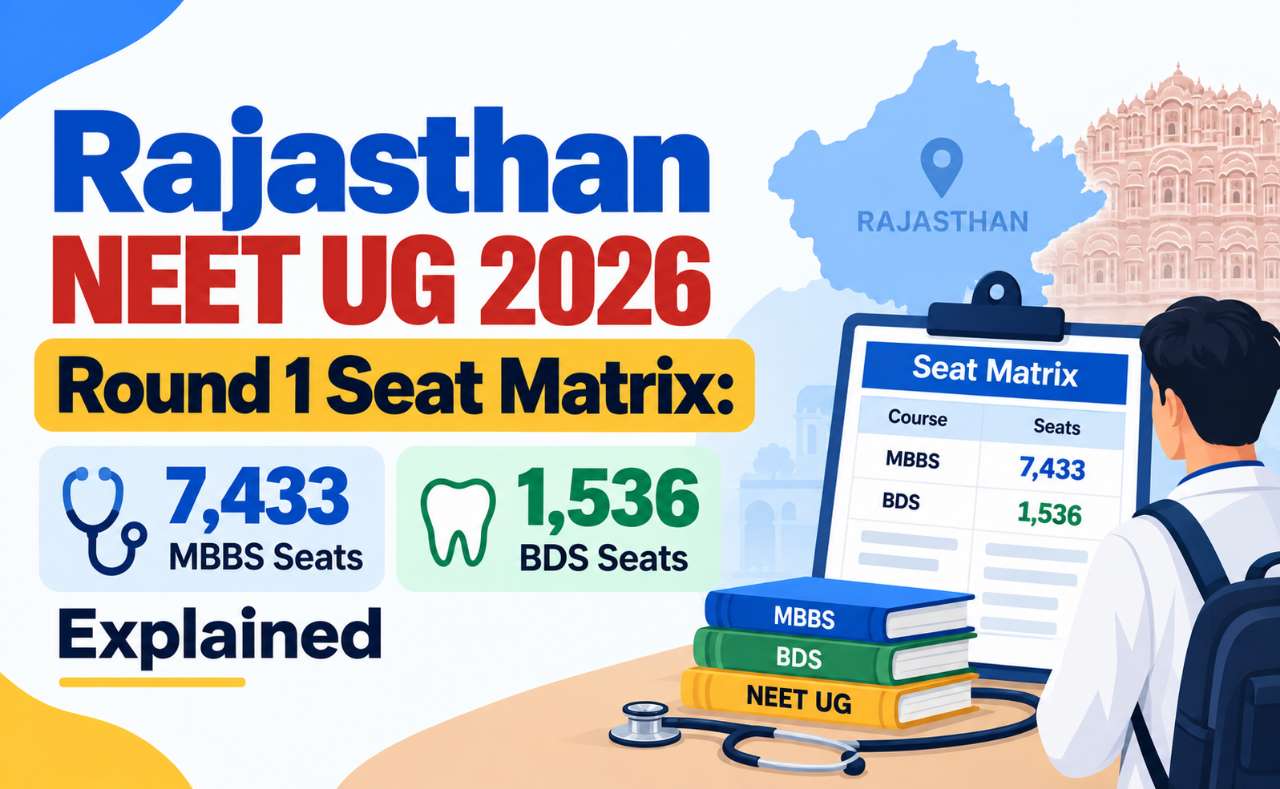
According to the provisional matrix released on the official portal ug.neetrajasthan.com, Rajasthan is offering 7,433 MBBS seats and 1,536 BDS seats in Round 1 counselling for the 2026–27 academic session. These numbers cover government medical colleges, RUHS-CMS institutions, RajMES society colleges, ESIC-linked seats, private medical and dental colleges, management quota seats, and NRI quota seats across the state.
Whether you are targeting a government seat at SMS Medical College Jaipur, a management seat at an RUHS-affiliated institution, or a private MBBS college, the seat matrix tells you exactly how many seats exist in each category, college, gender, and reservation group. This guide explains the full breakdown, how to read the official PDF, what changed this year, and how to use the matrix strategically during Rajasthan NEET UG 2026 Round 1 counselling.
What Is the Rajasthan NEET UG 2026 Round 1 Seat Matrix?
The seat matrix is an official tabular document published by the Rajasthan NEET counselling board before each counselling round. It lists every participating college and the number of seats available under different quota types—government, private general, private management, NRI, and institution-specific categories such as RUHS-CMS and RajMES.
Unlike the merit list, which ranks candidates, the seat matrix ranks opportunities. It does not tell you which college you will get; instead, it shows the total pool of seats that will be allotted in Round 1 based on your category, gender, domicile status, and the choices you submit during online counselling.
For 2026, the matrix was released alongside Round 1 registration and choice filling on the portal managed by the board at SMS Medical College, Jaipur. Candidates registered for state quota counselling under the 85% state reservation must download and study this document before locking their college preferences. The matrix is also linked to fee structures, security deposit rules, and reporting requirements published on the same website.
Why the Seat Matrix Matters for Every NEET Aspirant
Many students fill choices based on college reputation alone and later discover that their category has zero or very few seats in preferred institutes. The seat matrix prevents this mistake. It helps you answer questions such as:
- How many government MBBS seats are available for OBC candidates in my district?
- Does a private college I like have management quota seats for my category?
- Are there enough BDS seats if I miss MBBS cutoff by a small margin?
- Should I include a dental college as a safe backup in Round 1?
Because Rajasthan offers one of the largest medical seat pools in North India, even small differences in seat distribution can change allotment outcomes for thousands of candidates. Treat the matrix as your counselling blueprint, not a formality.
Total MBBS and BDS Seats in Rajasthan NEET UG 2026 Round 1
The Round 1 seat matrix confirms the following overall seat counts for the 2026–27 session:
- Total MBBS seats: 7,433
- Total BDS seats: 1,536
- Combined UG medical and dental seats: 8,969
These figures represent seats under Rajasthan state counselling for Round 1. All India quota seats, deemed university seats filled through MCC counselling, and seats in institutions outside the state matrix are not included in this count. Always cross-check whether your target college appears in the Rajasthan matrix PDF before adding it to your choice list.
MBBS Seat Distribution by Quota Type
The 7,433 MBBS seats are distributed across five major quota categories. The following table summarises the provisional Round 1 allocation:
- Government quota MBBS seats: 2,274
- Management quota seats (RUHS-CMS and RajMES): 991
- Private general quota MBBS seats: 3,252
- Private management quota MBBS seats: 448
- NRI quota MBBS seats: 468
When management seats from RUHS and RajMES institutions are combined with private management seats, the total management-linked MBBS capacity crosses 1,400 seats. Government seats remain the most competitive segment because of lower tuition fees and strong institutional reputation, but private and management quotas significantly expand access for candidates who meet eligibility and can afford higher fees.
BDS Seat Distribution by Quota Type
Dental admissions follow a separate but parallel matrix. The 1,536 BDS seats break down as follows:
- Government BDS seats (RUHS-CDS): 86
- Private general BDS seats: 1,270
- Private management BDS seats: 180
Government dental seats are limited compared with MBBS, which makes private dental colleges the primary route for most BDS aspirants in Rajasthan. Candidates who want a clinical career but rank below MBBS cutoffs often use BDS as a strong alternative, especially when they plan postgraduate specialisation later through NEET PG.
Category-Wise Seat Breakup: Reservation and Quota Details
Beyond quota type, the seat matrix also shows reservation-wise distribution for Unreserved (General), EWS, MBC, OBC, SC, ST, and Special Area (SA) categories. These numbers apply within each quota pool, meaning a government SC seat and a private general SC seat are counted separately.
MBBS Reservation-Wise Overview
For MBBS, the matrix typically displays two components for several reserved categories—Component 1 and Component 2—reflecting seats allocated across different college groups or quota structures. At the aggregate level reported in the Round 1 matrix, reserved category MBBS seats include approximately:
- Unreserved (General): 1,880 seats
- EWS: 802 seats
- MBC (OBC): 348 seats
- OBC: 1,374 seats
- SC: 1,056 seats
- ST: 528 seats
- Special Area (SA): 346 seats
These totals span all MBBS quota types combined. Your effective seat count depends on both your social category certificate and the quota you are applying under. For example, an OBC candidate competing for government seats will be ranked only against OBC seats in government colleges, not against the entire 7,433-seat pool.
BDS Reservation-Wise Overview
The BDS matrix shows a similar reservation structure. Approximate category totals include:
- Unreserved: 414 seats
- EWS: 175 seats
- MBC (OBC): 77 seats
- OBC: 324 seats
- SC: 246 seats
- ST: 101 seats
- Special Area (SA): 83 seats
Because BDS seat numbers are smaller, cutoffs can fluctuate more sharply between rounds. Candidates should monitor revised matrices after seat surrender, NDC updates, and vacancy rounds.
Participating Institutions Covered in the Matrix
The Rajasthan NEET UG 2026 seat matrix covers a wide network of medical and dental institutions. Understanding institution types helps you build a realistic choice list.
Government Medical Colleges
Rajasthan government medical colleges include flagship institutes such as SMS Medical College Jaipur, Sardar Patel Medical College Bikaner, RNT Medical College Udaipur, SN Medical College Jodhpur, and several newer government colleges across districts. These colleges account for the 2,274 government MBBS seats and are typically the first preference for high-ranking state candidates due to affordable fees and strong clinical exposure.
RUHS-CMS and RajMES Institutions
Institutions affiliated with the Rajasthan University of Health Sciences (RUHS) Jaipur and RajMES society colleges appear under management and society quota categories. The Rajasthan University of Health Sciences Jaipur oversees curriculum, examinations, and academic standards for many of these programmes. Management seats here often have different fee slabs compared with pure private colleges, so read the fee notification alongside the matrix.
Private Medical and Dental Colleges
Private MBBS colleges contribute the largest single block—3,252 general seats plus 448 management seats. Private dental colleges dominate BDS with 1,270 general and 180 management seats. Well-known private health sciences campuses in Rajasthan include institutions such as NIMS University Rajasthan Jaipur, along with multiple standalone medical and dental colleges listed college-wise in the official PDF.
Allied health programmes in the state—such as nursing—are outside this NEET UG matrix but remain relevant for students exploring healthcare careers. Institutions like Rajasthan College of Nursing Jaipur represent parallel pathways for candidates who want hospital-based careers without pursuing MBBS or BDS.
Important NDC Update on Jaipur Dental College
Candidates must note that the National Dental Commission (NDC) issued revised orders regarding BDS admissions at Jaipur Dental College, Jaipur, during August 2026. The official counselling portal updated the college seat matrix accordingly. Before finalising BDS choices, download the latest matrix version from ug.neetrajasthan.com and verify whether the college shows revised intake or zero seats for 2026–27. Relying on outdated screenshots or third-party summaries can lead to invalid preferences.
Rajasthan NEET UG 2026 Round 1 Counselling Schedule
The seat matrix release is timed with Round 1 counselling activities. Based on the official schedule published alongside the matrix, key Round 1 events are as follows:
- Registration (Part 1 and Part 2): 12 to 17 August 2026
- Security deposit submission: 12 to 20 August 2026
- Provisional seat matrix release: 13 August 2026
- Choice filling and locking: 14 to 20 August 2026
- Provisional merit list: 18 August 2026
- Certificate verification: 19 August 2026
- Revised merit list: 20 August 2026
- Round 1 seat allotment result: 22 August 2026
- Reporting at allotted college: 23 to 27 August 2026
Dates may be extended or revised through official notices. Always confirm the live schedule on the counselling homepage before planning travel, document verification, or fee payment.
How Seat Allotment Uses the Matrix
During allotment, the counselling software matches candidates in merit order against available seats listed in the matrix. Your highest eligible locked choice where seats remain open in your category and gender is allotted. If your first choice is unavailable, the system moves to your next choice, and so on. This is why mixing unrealistic top choices with sensible backups is essential.
How to Read the Official Seat Matrix PDF
The matrix PDF is detailed and can look overwhelming at first glance. Use this reading method to extract actionable information quickly.
Step-by-Step Matrix Reading Tips
- Identify your course: Open the MBBS or BDS section first; do not mix dental and medical rows.
- Filter by quota type: Separate government, management, NRI, and private general blocks.
- Match your category column: Locate UR, EWS, OBC, MBC, SC, ST, or SA columns that match your certificate.
- Check gender codes: Some rows show Boys (B), Girls (G), or combined counts—verify gender-specific seats if applicable.
- Cross-check college codes: Each college has a unique code; match it with the fee and eligibility annexures.
- Compare multiple colleges: Note seat counts side by side to rank preferences logically.
- Save the latest version: Re-download before locking choices if the portal shows an updated matrix link.
Print or annotate a copy with your expected rank range and category cutoff trends from previous years. While cutoffs change every year, historical data still helps you avoid choices that are far out of reach.
Strategic Choice Filling Tips Using the Seat Matrix
Smart choice filling is the bridge between a good NEET rank and a satisfactory allotment. Use these practical strategies after studying the matrix.
Build a Tiered Choice List
Divide preferences into three tiers. Tier 1 should include colleges you genuinely want and may reach based on expected rank. Tier 2 should include realistic matches with moderate seat counts in your category. Tier 3 should include safe options you would still accept to avoid blank allotment. Never leave choices empty if you intend to participate in Round 1.
Do Not Ignore Seat Count Versus Competition
A famous college with only one seat in your category is riskier than a slightly lower-profile college with twenty seats at a similar cutoff band. The matrix seat count is as important as college brand value.
Factor in Fees and Bond Conditions Early
Private and management seats come with higher tuition, hostel, and security costs. Government seats may include service bonds in certain categories or institutions. Read the official fee circular before locking a costly preference you cannot afford after allotment.
Keep BDS Backups If You Are Flexible
If your primary goal is a clinical degree and you rank outside the top government MBBS range, include strong BDS options. With 1,536 seats, dental counselling can offer better allotment probability for mid-rank candidates.
Understand Freezing, Upgrading, and Further Rounds
Round 1 allotment may not be your final seat if you participate in subsequent rounds. However, reporting rules, security deposit adjustments, and seat surrender penalties apply. Read the information brochure on ug.neetrajasthan.com before deciding whether to accept Round 1 allotment or opt for upgradation in Round 2.
Eligibility and Documents Required for Round 1 Counselling
Publishing the seat matrix does not automatically qualify every NEET candidate for Rajasthan state counselling. You must meet domicile, registration, and documentation requirements.
- Valid NEET UG 2026 score and qualifying percentile
- Rajasthan domicile or applicable eligibility as per state rules
- Completed Part 1 and Part 2 registration on ug.neetrajasthan.com
- Security deposit payment within the notified window
- Category, income, or special area certificates in prescribed formats
- Class 10 and 12 mark sheets, NEET admit card and scorecard, ID proof, and photographs
Certificate verification before the revised merit list is critical. Discrepancies in category or domicile documents can shift your eligible seat pool and invalidate choices tied to incorrect reservation claims.
Rajasthan NEET UG Counselling in Context: Why Seat Numbers Matter
Rajasthan's 7,433 MBBS seats place the state among the leading medical education destinations in North India. For context, students often compare Rajasthan with neighbouring states and central counselling routes. State quota counselling through RUHS and the medical board remains the primary pathway for resident candidates seeking affordable government seats.
The state's health sciences ecosystem extends beyond undergraduate medicine. Universities such as the University of Rajasthan and multiple specialised health institutions support allied programmes, research, and postgraduate pathways. After completing MBBS, graduates typically pursue internship, licensing, and specialisation through NEET PG or INI CET routes.
For students still preparing for future attempts, understanding how seat matrices translate into cutoffs can sharpen long-term preparation strategy. High government seat volume does not mean low competition—it means more opportunities, but only for candidates who combine strong scores with disciplined counselling choices.
Common Mistakes to Avoid After the Seat Matrix Release
- Using outdated matrix copies after NDC or board revisions
- Choosing colleges without category-level seat checks
- Ignoring gender-specific seat rows where applicable
- Locking choices without verifying fee and bond rules
- Missing security deposit or registration deadlines
- Uploading incorrect reservation certificates
- Filling only premium colleges with no safe backups
- Confusing MCC All India Quota choices with Rajasthan state choices
Avoiding these errors can matter as much as your NEET score in determining where you actually study for the next five years.
What Happens After Round 1 Seat Allotment?
Once Round 1 results are declared on 22 August 2026, allotted candidates must report to their colleges between 23 and 27 August 2026 with original documents, admission fees, and required undertakings. Failure to report within the window may lead to cancellation and forfeiture of deposit under counselling rules.
Candidates who receive no allotment or reject their seat may become eligible for Round 2, subject to vacancy updates and fresh choice filling. A new or revised seat matrix is typically published for subsequent rounds reflecting surrendered, vacant, and updated seats.
Conclusion
The Rajasthan NEET UG 2026 Round 1 seat matrix is the foundation of informed counselling for thousands of medical and dental aspirants. With 7,433 MBBS seats and 1,536 BDS seats spread across government, RUHS, RajMES, private, management, and NRI categories, the state offers substantial opportunity—but only for candidates who read the matrix carefully, align choices with category-wise availability, and follow the official schedule on ug.neetrajasthan.com.
Download the latest college-wise PDF, verify any NDC-related updates for dental colleges, tier your preferences realistically, and complete registration, deposit payment, and certificate verification on time. Round 1 is often the best chance to secure government and high-demand management seats before vacancies shrink in later rounds. Treat the seat matrix not as a notification to skim, but as the document that turns your NEET rank into a confirmed college seat.