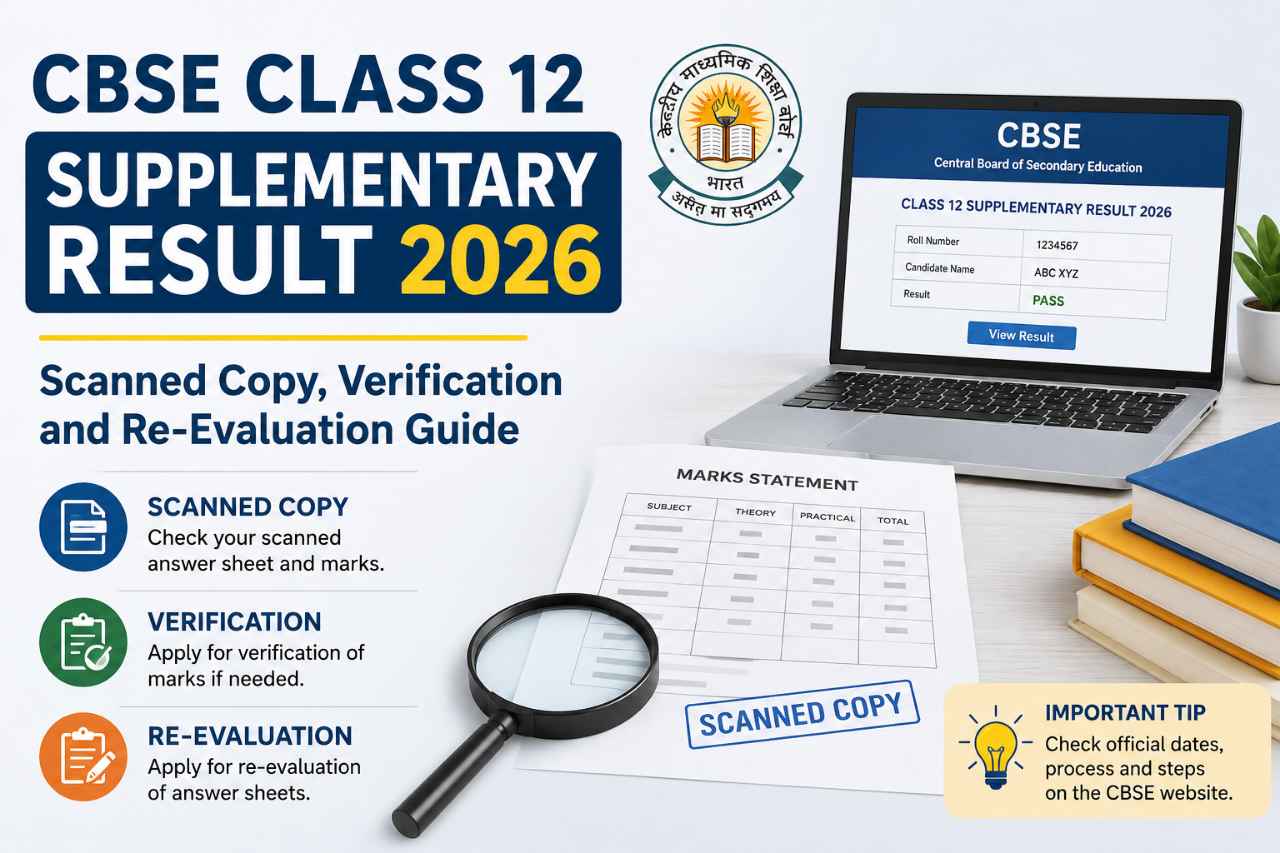

The Central Board of Secondary Education (CBSE) has released the complete post-result schedule for students who appeared in the Class 12 supplementary examination 2026. If you wrote compartment or improvement papers and want to confirm that your marks were calculated correctly, this is your window to request a scanned copy of your evaluated answer book, apply for verification of marks, or seek re-evaluation of specific theory questions.
For lakhs of students across India, board results are not just numbers on a marksheet they decide eligibility for undergraduate programmes, professional courses, and competitive entrance tests. A single-mark discrepancy can affect cut-offs, scholarship criteria, or admission to institutions ranging from local degree colleges to premier B-schools that accept exams like the CAT. That is why CBSE’s transparent post-result process matters, and why knowing the exact dates, fees, and sequence of steps is essential.
This guide explains everything announced for supplementary exam takers in clear, actionable language dates, fees, eligibility, what to check in your answer book, and how outcomes may affect your next academic move.
CBSE Class 12 Supplementary Result 2026: What Has Been Announced?
After declaring supplementary results, CBSE typically opens a short, strictly timed window for post-result services. For the 2026 cycle, the board has confirmed three linked facilities:
- Scanned copy of the evaluated answer book a digital image of your marked script
- Verification of marks a check that marks were totalled and transferred correctly
- Re-evaluation a fresh assessment of specific theory questions you identify
The most important rule CBSE has emphasised is sequential eligibility: you must first obtain the scanned copy through the official online process. Only candidates who complete that step will be allowed to apply for verification or re-evaluation in the next window. Applications submitted offline or after the deadline will not be accepted.
The entire workflow application, fee payment, and processing is online. Accepted payment modes are UPI, credit card, debit card, and net banking only. Students and parents should rely on official CBSE channels and avoid unverified social media posts that often spread wrong dates or fake portals.
Important Dates and Fees at a Glance
Missing a CBSE post-result deadline usually means losing the option entirely for that cycle. Mark these dates on your calendar and complete payment early to avoid last-minute gateway failures.
| Facility | Application Window (2026) | Fee |
|---|---|---|
| Scanned copy of evaluated answer book | August 31 – September 1 | Rs 100 per subject |
| Verification of marks | September 7 – September 8 | Rs 100 per answer book |
| Re-evaluation (theory only) | September 7 – September 8 | Rs 100 per question |
Action tip: Keep your roll number, school code, subject codes, and a working email ID ready before the window opens. Screenshot your payment confirmation immediately after a successful transaction.
Why Request a Scanned Copy of Your Answer Book?
A scanned copy lets you see exactly how the examiner marked each response ticks, partial marks, comments, and totals written on the script. This is the foundation for deciding whether verification or re-evaluation is worth pursuing.
What you can review in the scanned copy
- Whether every attempted question was evaluated
- Whether marks match the marking scheme for steps shown
- Whether arithmetic totals on the answer book are correct
- Whether marks on the script align with what appears on your result or DigiLocker
Many students discover simple transfer errors during this review for example, a correctly written total on the last page that was entered differently in the online result. Verification addresses such clerical issues. Re-evaluation addresses whether the academic judgment on a particular answer was fair.
Who should apply for a scanned copy?
Apply if your supplementary subject score is close to a passing or improvement threshold, if the result seems unexpectedly low compared to your performance, or if you need documentary clarity before approaching your school for further guidance. Even students satisfied with their marks sometimes request a copy for personal records, though the fee applies per subject.
Verification of Marks: Scope and Limits
Verification is not the same as re-checking whether your answers were academically correct. CBSE defines verification as a process to confirm that:
- All questions have been evaluated
- Marks have been correctly posted and totalled
- The marks on the answer book match those reflected in the result
Think of verification as an audit of calculation and data entry. Examiners do not re-read your explanations for better marks during verification. If you believe a long answer was under-marked despite being logically correct, re-evaluation not verification is the appropriate route, subject to theory-only rules described below.
The fee is Rs 100 per answer book. Because the scanned-copy step is mandatory first, use those two days (August 31 – September 1) to download and study your script before choosing verification on September 7–8.
Re-Evaluation: Rules Every Student Must Know
Re-evaluation carries higher stakes than verification because a fresh examiner assesses the academic merit of selected questions. CBSE has set clear boundaries:
Theory portion only
Re-evaluation applies to the theory component of the supplementary paper. Practical or internal assessment marks follow separate board rules and are not part of this re-evaluation window.
Full question, not partial sub-parts
You must request re-evaluation for an entire question, not for one sub-part (for example, part (b) alone) within a multi-part question. Plan your requests carefully: each question costs Rs 100, and you should prioritise questions where you have strong evidence of under-marking.
Refer to the marking scheme
When submitting a re-evaluation request, CBSE advises students to consult the official marking scheme for that subject and year. Your application should be grounded in how marks are allocated for steps, keywords, diagrams, and format not merely on feeling that the score is low.
Marks can go up or down
This is critical: after verification or re-evaluation, your marks may increase or decrease. Even a one-mark reduction will stand. The re-evaluation outcome is final, and no further appeal or review will be entertained. Apply only when you have reviewed the scanned copy and can justify the request with reference to the marking scheme.
Step-by-Step: How to Apply Online
Although the exact portal URL is published on CBSE’s official website at the time of the window, the general process follows a consistent pattern each year. Use only links from cbse.gov.in or authenticated CBSE result portals not third-party websites.
- Visit the official CBSE portal for post-result services when the window opens.
- Log in using credentials specified in the board notice (often roll number, school number, and other identifiers).
- Select “Scanned copy” for the relevant supplementary subject(s) during August 31 – September 1.
- Pay Rs 100 per subject via UPI, debit card, credit card, or net banking; save the receipt.
- Download the scanned answer book when CBSE makes it available and review it thoroughly.
- Return during September 7–8 to apply for verification and/or re-evaluation if needed, paying the applicable fees.
- Track status through the same portal until updated marks, if any, are reflected.
If payment succeeds but the application does not show as submitted, do not panic take a screenshot, note the transaction ID, and contact your school’s examination coordinator immediately while the window is still open.
Checklist: What to Compare After You Receive the Scanned Copy
Use this checklist before spending on verification or re-evaluation:
- Question coverage: Count attempted questions versus evaluated questions.
- Page totals: Add marks written on each page and compare with the grand total on the script.
- Result portal match: Cross-check subject-wise marks on CBSE result/DigiLocker with the answer book total.
- Marking scheme alignment: For theory answers you want re-evaluated, list step-wise marks you expected versus marks awarded.
- Priority ranking: Rank questions by likely gain minus risk of mark reduction.
Discuss borderline cases with a subject teacher who knows the current marking pattern. An experienced teacher can often tell quickly whether a re-evaluation request is realistic or likely to yield no change.
How Supplementary Results Affect college Admissions and Entrance Exams
Clearing or improving supplementary papers can unlock undergraduate pathways that were temporarily on hold. Once your updated CBSE marks are confirmed, you can proceed with admission formalities at colleges where you already hold a provisional seat, or explore fresh options in the ongoing admission season.
Board marks and eligibility
Most universities require minimum aggregate or subject-wise percentages for B.A., B.Com., B.Sc., BBA, and professional programmes. Management institutes affiliated to universities such as those under groups like CBS Group of Management often publish cut-offs based on Class 12 performance alongside entrance scores. Ensuring your supplementary result is accurate protects your eligibility claim.
Institution choice beyond cut-offs
Students exploring broader campus options may also look at multi-disciplinary institutions such as CBS Group of Institutions, where programme fit, location, fees, and placement support matter as much as the percentage on your marksheet. Correct board data helps you apply confidently without last-minute document mismatches.
Entrance exams after Class 12
Many national-level tests require you to enter Class 12 marks during registration or counselling. Design aspirants preparing for the NID DAT and management aspirants targeting the CAT in future cycles should ensure board records on portals match physical marksheets. Discrepancies discovered late can complicate verification during admission or interview stages.
Practical advice: After any post-result revision, download an updated marksheet from DigiLocker, inform colleges where you have submitted documents, and keep both old and revised score proofs until admissions close.
Common Mistakes Students and Parents Should Avoid
- Skipping the scanned-copy step and applying directly for re-evaluation such applications will not be accepted.
- Waiting until the last hour on September 1 or September 8 when payment servers are busiest.
- Using unofficial websites that mimic CBSE portals to collect fees or personal data.
- Requesting re-evaluation for every question without marking-scheme analysis, increasing cost and risk of mark reduction.
- Confusing verification with re-evaluation and expecting academic re-marking during verification.
- Ignoring partial re-evaluation limits by trying to submit only one sub-part of a question.
- Not informing the school when updated marks arrive, leaving admission records outdated.
Understanding Outcomes and Timelines
CBSE processes verification and re-evaluation requests in batches after the application window closes. Updated marks, when applicable, are reflected through official channels. Treat the re-evaluation result as binding: plan your academic next steps college reporting, migration certificates, entrance exam form corrections only after you receive the final revised score.
Students who gain marks may become eligible for programmes previously out of reach; those whose marks decrease must accept the revised total for all official purposes. Either way, acting within the announced windows is the only way to seek redressal for supplementary exam 2026.
Who Is Eligible for Post-Result Services?
Post-result facilities apply to candidates who appeared in the CBSE Class 12 supplementary examination 2026 and received a declared result in the subjects for which they seek review. Typically, this includes students who:
- Appeared in compartment or improvement papers after the main board exam
- Need clarity on marks in one or more supplementary subjects
- Believe there may be evaluation, totalling, or data-entry discrepancies
Eligibility is subject-specific. If you wrote supplementary exams in multiple subjects, you can request scanned copies for each subject separately, paying Rs 100 per subject. There is no shortcut to combine subjects into a single application at a lower fee the board processes each answer book independently.
DigiLocker, Marksheet Updates, and Document Management
CBSE encourages students to cross-check supplementary results on official result portals and through DigiLocker, where digital marksheets are often issued. When you receive a scanned answer book, compare three sources side by side:
- Marks written on the evaluated script
- Marks shown on the online result page
- Marks displayed on your DigiLocker marksheet
Any mismatch between the script total and the digital record strengthens the case for verification rather than re-evaluation. If the script and online result agree but you still feel a particular answer was under-marked academically, re-evaluation is the relevant option again, for full theory questions only.
After post-result processing concludes, download a fresh marksheet if CBSE updates your score. Store PDF copies in cloud storage and share revised documents with colleges, scholarship offices, and entrance exam authorities promptly. Delays in updating records can create problems during document verification at the time of admission.
How to Use the Marking Scheme Before Applying for Re-Evaluation
CBSE publishes subject-wise marking schemes that break down how examiners award marks for steps, keywords, diagrams, and format. Before paying Rs 100 per question for re-evaluation, work through this practical review:
- Download the official marking scheme for your subject and examination year from CBSE’s academic website.
- Match question numbers on your scanned copy with the scheme’s expected value points.
- Identify gaps where your answer includes value points listed in the scheme but received zero or partial credit.
- Estimate realistic gain re-evaluation may confirm the original marking if your answer missed key steps.
For example, in a long-form theory answer worth ten marks, the scheme might allocate two marks for definition, four for explanation with diagram, and four for examples. If you wrote all components clearly visible in the scanned copy but received only four marks total, that question may warrant re-evaluation. Conversely, if your answer omitted mandatory keywords the scheme lists, re-evaluation may not change the outcome.
Real-World Scenarios: Verification vs Re-Evaluation
Understanding the difference through examples helps you choose wisely and save money:
Scenario A Verification is enough: Your answer book shows a total of 58 marks on the last page, but your online result displays 52. The individual question marks on the script add up to 58. Here, marks were likely transferred incorrectly a classic verification case.
Scenario B Re-evaluation may help: Question 7 shows 4 out of 10 on the script. You wrote a complete answer with labelled diagram and examples matching the marking scheme’s value points, yet received low credit. After teacher review, you apply for re-evaluation of the full Question 7.
Scenario C Neither may be needed: Your score matches the script totals, and lower marks reflect incomplete answers or missing steps per the scheme. Accepting the result and focusing on admission or skill-building may be the better path.
Planning Your Academic Path After Supplementary Results
While post-result services run, continue planning your undergraduate journey in parallel. Research programmes, shortlist colleges, and note entrance exam calendars so you lose no time once marks are finalised.
Students interested in management may explore institutes under the CBS Group of Management while verifying board scores. Those seeking broader programme options can compare facilities at the CBS Group of Institutions alongside other universities. Creative fields may require portfolio preparation alongside exams like the NID DAT, while long-term MBA goals often begin with strong fundamentals and later preparation for the CAT.
Accurate board marks strengthen every application merit lists, category certificates, sports quotas, and scholarship forms all depend on verified Class 12 data. Treat the supplementary post-result window as part of your overall admission strategy, not an isolated formality.
Expert Tips for a Smooth Post-Result Process
- Act on day one of the scanned-copy window to maximise review time before September 7.
- Work with your school examination in-charges often help with portal navigation and fee receipt issues.
- Maintain a decision log listing question numbers, marks awarded, expected marks, and marking-scheme references.
- Budget fees realistically: scanned copy (per subject) + verification (per book) + re-evaluation (per question) can add up quickly.
- Stay calm and evidence-based post-result services are a formal remedy, not a guarantee of higher marks.
- Set phone reminders for both windows August 31 and September 7 so you do not miss the narrow deadlines.
- Avoid duplicate applications or multiple payments for the same subject; confirm submission status on the portal before paying again.
Conclusion
The CBSE Class 12 supplementary result 2026 post-result schedule gives students a fair, time-bound opportunity to verify how their answer books were marked. With scanned-copy applications open from August 31 to September 1, 2026, and verification and re-evaluation on September 7–8, 2026, timely action is non-negotiable. Obtain your scanned script first, review it against the marking scheme and your online result, then choose verification or re-evaluation only where evidence supports your case.
Remember that marks can rise or fall, re-evaluation covers full theory questions only, and the board’s decision after re-evaluation is final. Use official CBSE communication, protect your payment receipts, and align updated scores with college admissions and entrance exam records. A careful, deadline-driven approach today can prevent regret during undergraduate admission season tomorrow.