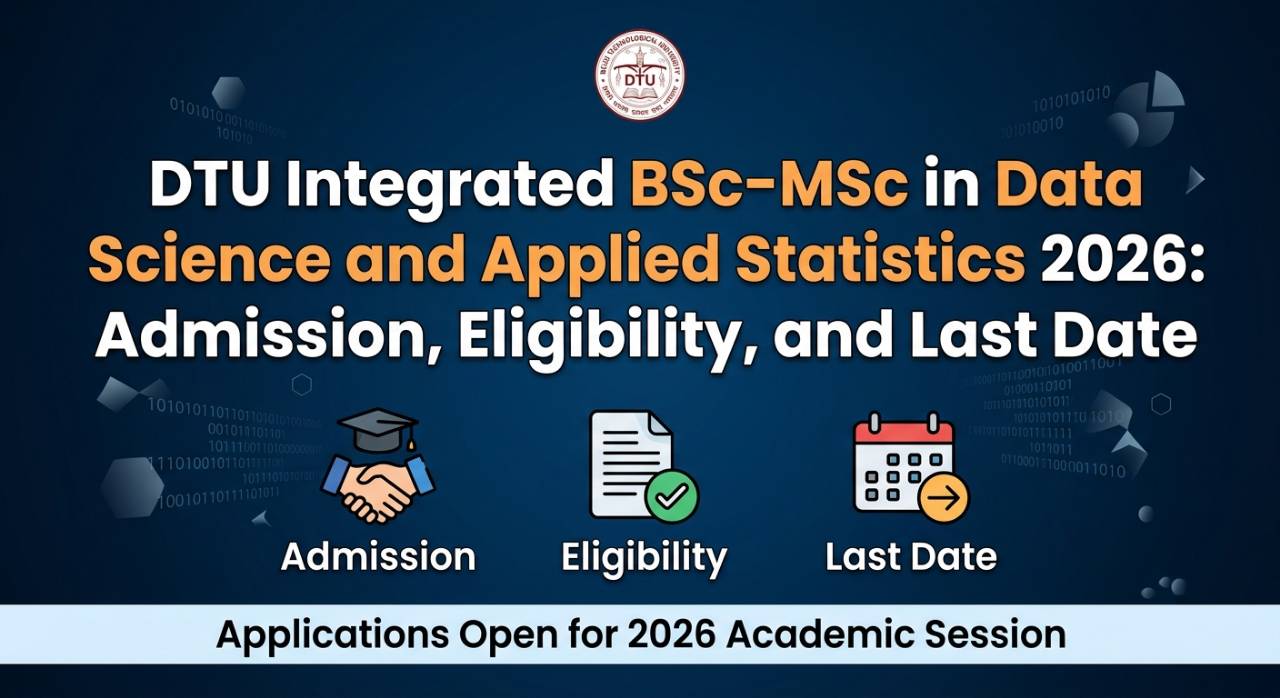
Delhi Technological University (DTU) has expanded its science portfolio for the 2026-27 academic session with two new five-year integrated BSc–MSc programmes: Data Science and Applied Statistics. Announced during the university's 85th-anniversary celebrations, these courses are designed for students who want deep training in analytics, computing, and statistical modelling without switching institutions after graduation. Admissions will be based on CUET UG 2026 scores, followed by separate registration on the official DTU portal. If you are a Class 12 student exploring future-ready science degrees in Delhi, this guide explains eligibility, deadlines, programme differences, career scope, and the step-by-step application process in simple language.
What Has DTU Launched for 2026-27?
Delhi Technological University (DTU), formerly Delhi College of Engineering, is one of india's most respected state technical universities. While it is widely known for engineering, DTU also runs several integrated science programmes that allow students to earn both bachelor's and master's degrees in a single academic track.
For 2026-27, DTU has added:
- Integrated BSc–MSc in Data Science — developed with academic input linked to an international collaboration with the University of Houston, United States
- Integrated BSc–MSc in Applied Statistics — focused on probability, inference, modelling, and computational statistics for real-world decision-making
These programmes join DTU's existing integrated offerings in Biotechnology, Chemistry, Economics, Mathematics, and Physics. Together, they signal DTU's shift toward interdisciplinary, industry-aligned education beyond traditional engineering pathways.
Why These Programmes Matter Now
India's job market is rapidly absorbing professionals who can work with data. From banks and e-commerce firms to hospitals, government agencies, and research labs, organisations need people who can collect data, analyse patterns, build models, and communicate insights clearly. A standalone three-year BSc may provide foundations, but a five-year integrated route helps students gain advanced skills early—including machine learning, statistical computing, and domain applications—without the uncertainty of postgraduate admission later.
For Delhi and NCR students, studying at DTU also means access to a strong peer network, established campus infrastructure, and proximity to internships in the National Capital Region's technology and analytics ecosystem.
Integrated BSc–MSc in Data Science: Programme Overview
The Integrated BSc–MSc in Data Science is aimed at students interested in analytics, artificial intelligence, machine learning, and data-driven problem solving. The curriculum is expected to blend mathematics, statistics, programming, and applied project work so that graduates can move into roles such as data analyst, business analyst, ML engineer, or research associate.
Key areas students can expect to study over five years include:
- Core mathematics and statistical foundations
- Programming and data structures for analytical workflows
- Database management and data engineering basics
- Machine learning, predictive modelling, and AI fundamentals
- Data visualisation, communication, and ethics in data use
- Capstone projects and industry-oriented applications
DTU has stated that the Data Science programme has been developed with involvement connected to its collaboration with the University of Houston. While the full degree is awarded by DTU in India, the partnership is intended to strengthen academic exposure, curriculum design, and opportunities for international engagement—an advantage for students planning global careers or higher studies abroad.
Who Should Choose Data Science at DTU?
This track suits students who enjoy coding, logical reasoning, and working with large datasets. If you liked Mathematics and Computer Science in school, or if you want to build chatbots, recommendation systems, fraud detection tools, or business dashboards, Data Science is a strong fit. It is also a practical choice for students who want a postgraduate qualification without appearing for a separate MSc entrance exam after graduation.
Integrated BSc–MSc in Applied Statistics: Programme Overview
While Data Science emphasises computing and AI applications, Applied Statistics focuses on the science of uncertainty, variation, and evidence-based inference. This programme is designed for students who want rigorous training in statistical theory and its use across sectors such as finance, healthcare, public policy, market research, and technology.
Expected learning themes include:
- Probability theory and stochastic processes
- Statistical inference, regression, and multivariate methods
- Design of experiments and sampling techniques
- Time series, econometrics, and risk modelling
- Computational statistics using modern software tools
- Applied projects in actuarial science, biostatistics, and policy analytics
If you are strong in Mathematics and enjoy solving numerical problems, Applied Statistics can open doors to careers in actuarial firms, banks, insurance, pharmaceutical research, government statistical offices, and academia. Institutions such as Bhaskaracharya College of Applied Sciences and Government Science College Sikar also reflect growing demand for applied science education across India, but DTU's integrated postgraduate pathway offers a distinct advantage for students targeting advanced roles early.
Data Science vs Applied Statistics: Quick Comparison
| Factor | Integrated BSc–MSc Data Science | Integrated BSc–MSc Applied Statistics |
|---|---|---|
| Primary focus | Data pipelines, ML, AI, analytics systems | Statistical modelling, inference, probability |
| Ideal student profile | Interested in coding + business/tech applications | Interested in mathematics + quantitative research |
| Typical career paths | Data analyst, ML engineer, AI specialist | Statistician, actuary, biostatistician, risk analyst |
| International link | Curriculum connected to University of Houston collaboration | Strong quantitative foundation for global higher studies |
| Admission route | CUET UG 2026 + DTU registration | CUET UG 2026 + DTU registration |
Admission Process: CUET UG 2026 and DTU Registration
Admissions to both new integrated programmes will be conducted through CUET UG 2026, organised by the National Testing Agency (NTA). However, qualifying in CUET alone does not guarantee a DTU seat. Candidates must also complete a separate registration on DTU's online admission portal for counselling and seat allocation after CUET results are declared.
This two-step process is common for centralised university admissions in India. Think of CUET as the national eligibility and ranking exam, and DTU registration as the institute-specific application where you confirm programme preferences, upload documents, and participate in seat allotment.
Eligibility Criteria (Expected Framework)
DTU's integrated science admissions historically follow consistent rules, and the 2026 brochure is expected to align with the patterns used for existing integrated BSc–MSc programmes. Applicants should verify the latest notice on dtu.ac.in, but the usual requirements include:
- Passed Class 12 or equivalent from a recognised board
- Minimum aggregate marks, typically 50% for general category candidates and 45% for SC/ST candidates as per Delhi government norms
- English in Class 12 with at least 35% marks
- Mandatory appearance in CUET UG 2026 in subjects relevant to the programme
- Age limit as prescribed in the admission brochure (DTU usually specifies an upper age limit for undergraduate admissions)
For merit calculation, DTU generally considers CUET scores in three subjects, including one compulsory domain paper and two related subjects. For science programmes, Mathematics is commonly compulsory, along with subjects such as Physics, Chemistry, Biology, or Computer Science/Information Practices depending on the course. Since Data Science and Applied Statistics are new entries, candidates must check Table 1 of the official DTU admission brochure for the exact subject combination and paper codes.
Important Dates and Deadlines
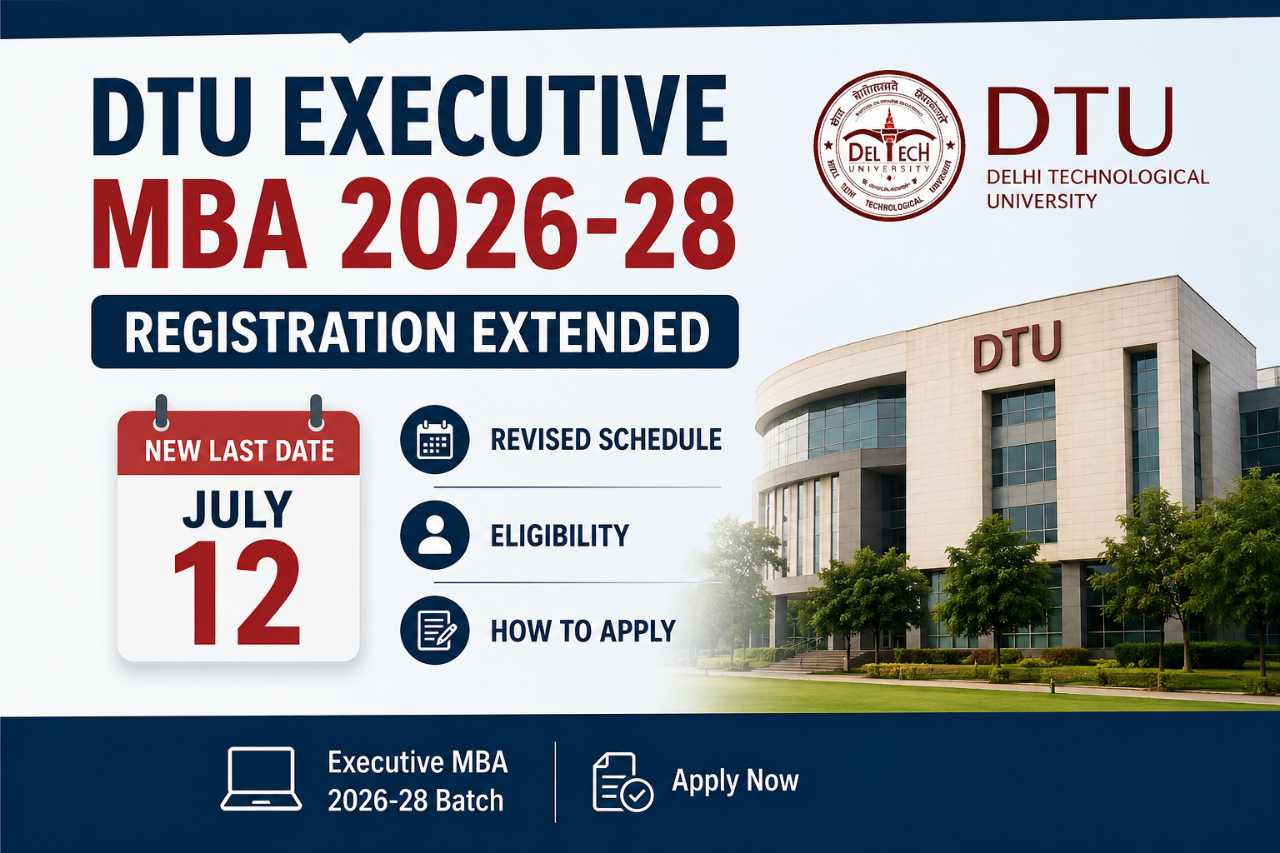
According to admission updates for the 2026-27 session, DTU registration for integrated science programmes is open, with the application window reported to close on 31 July 2026. CUET UG timelines are announced separately by NTA. Missing either deadline can disqualify an otherwise strong applicant, so students should track both calendars closely.
- CUET UG 2026: Register and appear as per NTA schedule on cuet.samarth.ac.in
- DTU portal registration: Complete after meeting eligibility; last date reported as 31 July 2026
- Counselling and seat allotment: Conducted on DTU admission portal after CUET results
- Document verification and fee payment: As per counselling rounds
Actionable tip: Create a simple checklist with exam dates, portal login credentials, scanned documents, and fee payment modes. Students in Delhi should also keep domicile or category certificates ready if applicable.
NEP 2020 Features: Multiple Entry and Exit Options
DTU has stated that the new programmes are aligned with the National Education Policy (NEP) 2020, which promotes flexible degree structures. Integrated programmes typically allow students to exit with a certificate, diploma, or degree at designated milestones, depending on credits completed, instead of being locked into a rigid five-year path without recognition.
This flexibility is especially useful if a student needs to pause studies, switch to employment early, or return later to complete the remaining portion. Before applying, read the programme's credit structure in the official brochure to understand exit points and re-entry conditions.
University of Houston Collaboration: What Students Gain
One of the headline announcements alongside the new science programmes is DTU's academic collaboration with the University of Houston. For Data Science students, this partnership is positioned to improve curriculum quality and global perspective. DTU has also introduced a 4+1 Accelerated BTech–MS pathway with the same US university, allowing engineering students to pursue a master's abroad with eligible credit transfer subject to partner university policies.
For science aspirants, the collaboration signals that DTU is investing in internationally benchmarked content—not merely adding a trendy programme title. Students interested in semester exchanges, joint research, or overseas postgraduate study should monitor official announcements from DTU's international relations office.
Campus Life, Faculty, and Learning Environment at DTU
DTU's main campus in Rohini, Delhi, offers engineering and science students access to laboratories, libraries, computing facilities, and student clubs. Although the new programmes are science-oriented, students benefit from being on a campus where technology, entrepreneurship, and research culture are already established.
When comparing DTU with other institutions, students often evaluate:
- Faculty expertise in mathematics, computing, and analytics
- Industry projects, internships, and placement support
- Research exposure through dissertations and labs
- Affordability as a Delhi state university compared with many private colleges
Private universities such as SRM Institute of Science and Technology Chennai, Sathyabama Institute of Science and Technology Chennai, Mody University of Science and Technology Lakshmangarh, and University of Petroleum and Energy Studies also offer science and technology degrees, but DTU's integrated postgraduate model and public university status make it especially attractive for merit-focused students in North India.
Career Scope After Data Science and Applied Statistics
Both programmes address sectors where demand continues to outpace supply of trained graduates. With a combined BSc–MSc qualification from a recognised technical university, students can compete for roles that often prefer postgraduate credentials.
Career Options After Data Science
- Data Analyst and Business Intelligence Analyst
- Machine Learning Engineer and AI Associate
- Data Engineer and Analytics Consultant
- Product Analyst in technology companies
- Research roles in academia or think tanks
Career Options After Applied Statistics
- Statistician in government and private surveys
- Actuarial and risk analyst in insurance and banking
- Biostatistician in clinical research organisations
- Quantitative analyst in finance and consulting
- Data scientist with strong theoretical statistics base
Graduates may also pursue PhD programmes, MBA with analytics specialisation, or certifications such as actuarial papers and cloud data engineering credentials. Delhi's location helps students access internships across Gurgaon, Noida, and central government institutions.
How Does DTU Compare With Other Science and Analytics Pathways?
Indian students today can choose from multiple routes into analytics:
- Three-year BSc + two-year MSc: Common in universities such as Delhi University colleges including Jesus and Mary College Delhi, followed by MSc entrance exams.
- BSc in Computer Science or Mathematics: Available widely, but may lack integrated advanced analytics training.
- BTech in Computer Science: Engineering-focused; institutes like Krishna Institute of Engineering and Technology, Galgotias College of Engineering and Technology, and Fairfield Institute of Management and Technology offer strong engineering pathways, though with a different curriculum emphasis.
- Five-year integrated BSc–MSc at DTU: Direct postgraduate completion with CUET-based admission at a top Delhi institution.
Students who want pure engineering may still prefer BTech through JEE Main. Those who want deep quantitative science without the engineering core may find DTU's new integrated programmes more aligned with their goals. There is no single best option—your choice should depend on interest in mathematics, coding appetite, budget, and location.
Fees, Scholarships, and Financial Planning
DTU publishes detailed fee structures in its annual admission brochure. As a state university, it is generally more affordable than many private institutions offering data science degrees. Students should budget for tuition fees, examination charges, hostel fees if applicable, and personal expenses in Delhi.
Scholarships may be available for economically weaker sections, merit holders, and reserved category students as per Delhi government and university rules. Apply for financial assistance early, since some schemes require separate forms and income documentation.
Preparation Tips for CUET UG 2026 Aspirants
Since admission merit is tied to CUET performance, preparation quality directly affects your chances. Here are practical tips:
- Master NCERT basics: CUET undergraduate papers are largely aligned with Class 12 syllabus.
- Prioritise Mathematics: For both programmes, mathematical ability is central. Practice calculus, algebra, probability, and statistics daily.
- Choose domain subjects wisely: Pick CUET papers that match DTU's required subject combination for your preferred programme.
- Take mock tests: Simulate exam timing and analyse weak chapters weekly.
- Stay updated on DTU notices: Bookmark the admission section of dtu.ac.in and verify cut-off trends for integrated science programmes once released.
Students from Rajasthan College of Arts and Science Sikar, Pratap Institute of Technology and Science Sikar, and Lords Institute of Engineering and Technology Jaipur can compete for DTU seats through CUET if they meet eligibility—geography is not a barrier in the national entrance system.
Other Notable DTU Announcements for 2026-27
The launch of Data Science and Applied Statistics was part of a broader academic expansion during DTU's 85th-year milestone. Other initiatives announced include:
- Economics double major track for BTech students, combining engineering with subjects such as game theory, economics of AI, and machine learning for economics
- 4+1 BTech–MS programme with University of Houston for engineering students seeking an accelerated international master's pathway
- Continued focus on research, patents, and interdisciplinary labs, including plans linked to emerging areas such as quantum technology
These additions show DTU's strategy to blend engineering, economics, and data skills—reflecting how modern workplaces expect graduates to understand both technology and context.
Documents Required for DTU Admission
While the final list appears in the counselling notification, applicants should generally keep these documents ready:
- Class 10 and Class 12 mark sheets and certificates
- CUET UG 2026 scorecard and application details
- Category certificate (if applicable)
- Character and transfer certificates
- Passport-size photographs and valid ID proof
- Domicile or relevant certificates as required by Delhi state university norms
Upload clear scanned copies in the prescribed format and file size. Errors in document mismatch are a common reason for admission delays during verification rounds.
Conclusion
DTU's Integrated BSc–MSc programmes in Data Science and Applied Statistics offer a timely, merit-based pathway for students who want advanced analytics education at a reputed Delhi institution. With admissions through CUET UG 2026, separate DTU portal registration, and a reported last date of 31 July 2026, applicants should act early and verify every detail in the official brochure on dtu.ac.in. The Data Science programme's connection with the University of Houston, NEP-aligned flexibility, and five-year integrated structure make these courses especially relevant for careers in AI, data analytics, finance, healthcare, and research. If you are a Class 12 science student looking beyond conventional degrees, DTU's new offerings deserve a serious place on your shortlist.