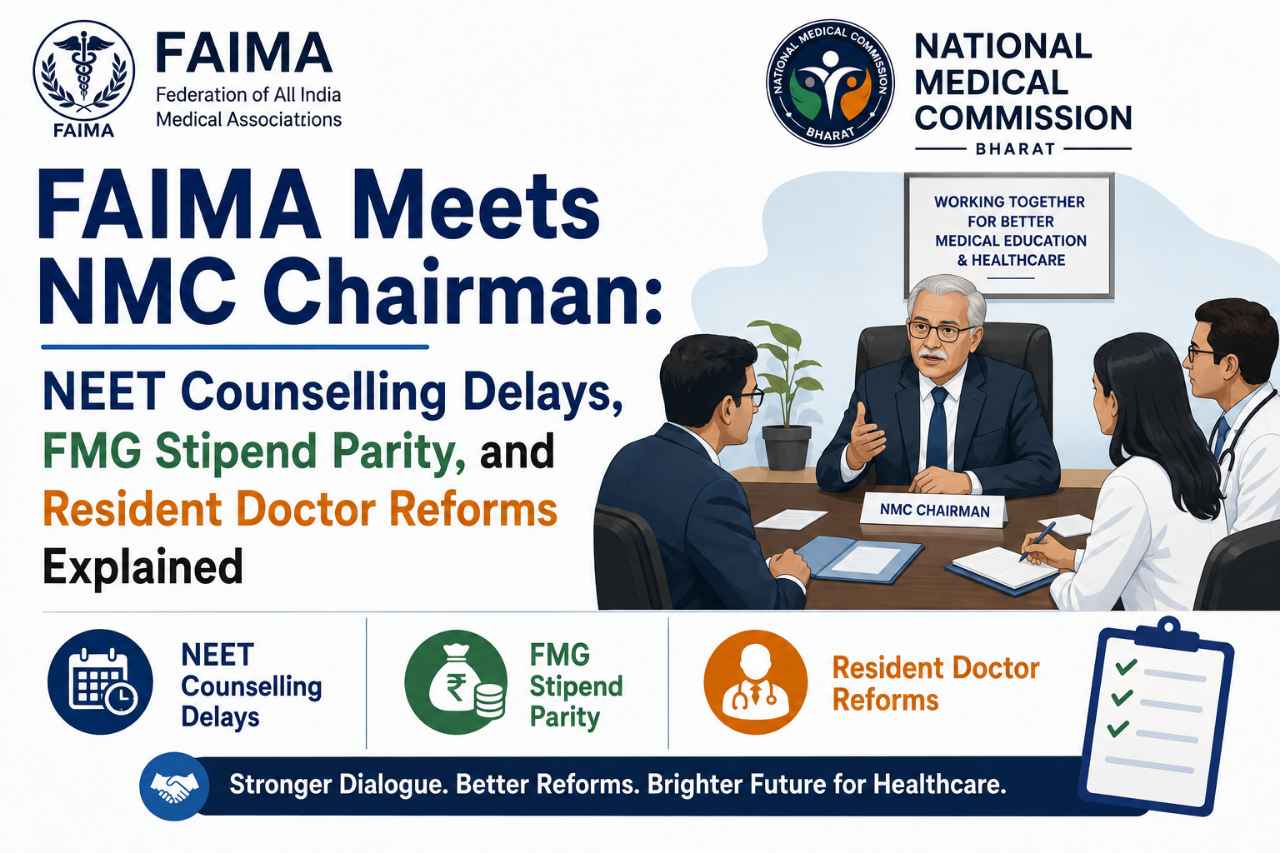

In September 2026, the Federation of All India Medical Association (FAIMA) held an hour-long meeting with the chairman of the National Medical Commission (NMC), raising issues that directly affect lakhs of medical aspirants, resident doctors, and foreign medical graduates (FMGs) across India. From delayed NEET counselling timelines to unequal stipends, bond policies, and exhausting duty hours, the discussion touched nearly every stage of the medical education pipeline.
For students planning MBBS or PG admissions, understanding these policy conversations matters. Delays between the NEET exam, result declaration, counselling, and college joining can cost a precious academic year. Uneven pay for FMGs can influence where graduates choose to train. And working-hour norms at institutions like All India Institute Of Medical Sciences Delhi Aiims Delhi or state colleges such as Government Medical College Kota shape the quality of clinical learning. This guide explains what FAIMA flagged, why it matters for Indian higher education, and what aspirants can do while waiting for regulatory action.
What Happened at the FAIMA-NMC Meeting?
FAIMA, one of the prominent doctors' associations in India, submitted a detailed representation to the NMC chairman covering resident doctor welfare, NEET-related delays, FMG stipend parity, postgraduate medical education, bond policies, duty-hour limits, and state-specific concerns. According to FAIMA's official statement, the NMC chairman responded positively to at least one major demand: restoring ENT (Ear, Nose, Throat) and Ophthalmology to NEXT Part 1.
The meeting reflects a broader pattern in Indian medical education governance. Student bodies and professional associations increasingly push the NMC for transparent calendars, uniform national standards, and faster policy clarification. For aspirants, these meetings are early signals of possible rule changes that could affect counselling schedules, internship norms, screening tests for FMGs, and stipend structures at colleges ranging from central institutes to newer campuses like All India Institute Of Medical Sciences Bhopal and All India Institute Of Medical Sciences Patna.
FAIMA also requested what it called "appropriate policy and regulatory interventions" from the NMC, signalling that doctors' groups want faster implementation—not just verbal assurances. In a sector where a single delayed notification can affect an entire admission batch, such meetings carry weight even before formal circulars are issued.
Key Demands at a Glance
- Cap continuous resident duty at 24 hours and weekly hours at 72
- Announce NEET admission calendar well in advance
- Reduce gaps between exam, results, counselling, and joining
- Equal stipend and pay for FMGs doing the same work as Indian graduates
- Mandatory mental health support in every medical college
- Strict infrastructure checks before increasing MBBS or PG seats
- Uniform anti-quackery implementation across states
- Clear NMC guidelines on dermatology and aesthetic procedures
- Policy review on bonds and PG admission-related obligations
Why NEET Counselling Delays Worry Medical Aspirants
Every year, NEET UG and NEET PG results trigger a long chain: central counselling through the Medical Counselling Committee (MCC), state quota rounds, stray vacancy rounds, and finally document verification and admission at allotted colleges. When this chain stretches across months, students face uncertainty about fee payment, hostel booking, relocation, and optional drop-year decisions.
FAIMA has specifically asked the NMC to publish an advance admission calendar and minimise delays between the NEET exam, result declaration, counselling, and joining. This is not merely an administrative preference. Counselling delays can:
- Push back the start of the academic session at government and private colleges
- Create mismatches between internship and PG entrance preparation timelines
- Increase financial pressure on families paying coaching fees while waiting
- Force FMGs to defer screening or registration steps
- Reduce clinical exposure in the first year due to compressed academic schedules
Understanding the NEET Admission Chain in India
The NEET admission process in India operates on multiple parallel tracks. For undergraduate medical seats, students navigate All India Quota counselling, deemed university rounds, central university seats, and state-level counselling. Each track has separate registration windows, choice-filling periods, and seat acceptance deadlines. A delay in any one stage creates a domino effect.
Postgraduate admissions follow a similar multi-layered model. Clinical speciality seats at premier institutes such as All India Institute Of Medical Sciences Rishikesh or Indira Gandhi Institute Of Medical Sciences Patna are filled through MCC, while many state seats are allocated through respective directorates of medical education. Without a published national calendar, students struggle to coordinate leave from internship, plan relocation, or secure education loans on time.
How Counselling Timelines Affect Different Student Groups
Fresh NEET UG qualifiers need clarity on All India Quota (AIQ), deemed university, and state counselling dates. A student aiming for Delhi colleges such as Maulana Azad Medical College Mamc Delhi, Vardhman Mahavir Medical College New Delhi Vmmc Delhi, or University College Of Medical Sciences Ucms Delhi must track both MCC and Delhi state portals.
NEET PG aspirants depend on timely counselling for seat allocation in clinical and non-clinical branches. Delays compress preparation for the next academic cycle and affect bond-service planning in states with mandatory rural service.
FMGs follow a parallel track involving screening tests, provisional registration, and internship postings. Any lag in the domestic admission calendar indirectly disrupts their integration into the Indian healthcare workforce.
Actionable Tips While Waiting for the Official Calendar
- Bookmark official portals: NMC, MCC, NBE (for NEET), and your state counselling authority
- Prepare document folders early: identity proof, category certificates, NEET scorecard, transfer certificate
- Research fee structures and bond conditions for target colleges before choice filling
- Keep two or three realistic college lists: dream, target, and safe options
- Follow verified handles of NMC and MCC; avoid rumours on unverified social media groups
Resident Doctor Working Hours: The 24/72 Demand Explained
One of FAIMA's strongest submissions concerns resident doctors' working hours. The association reported that residents across India often work 24 to 36 hours continuously, far beyond safe limits. It asked the NMC to issue uniform national guidelines capping continuous duty at 24 hours and total weekly hours at 72 hours.
In its written letter to the NMC, FAIMA stated that excessively long shifts adversely affect physical health, mental well-being, academic training, and ultimately patient safety. These are not abstract concerns. Several studies globally link resident fatigue with increased medical errors, needle-stick injuries, and motor vehicle accidents after night duties.
This issue connects directly to patient safety and training quality. Exhausted residents are more prone to clinical errors, slower decision-making, and burnout. Long shifts also reduce time for academic activities, thesis work, and exam preparation for PG students at institutes such as Jawaharlal Institute Of Post Graduate Medical Education Research Puducherry or Post Graduate Institute Of Medical Sciences.
Mental Health and Wellness in Medical Colleges
Alongside duty-hour reform, FAIMA requested mandatory mental health and wellness programmes in all medical institutions. The demand includes:
- Qualified mental health professionals on campus
- Regular awareness sessions to reduce stigma
- Confidential counselling channels for students and residents
- Periodic review of faculty strength, infrastructure, and clinical workload
Medical education carries a well-documented stress burden. Long duty hours, competitive exams, financial pressure, and high-stakes clinical responsibility contribute to anxiety and burnout among students. FAIMA's emphasis on wellness aligns with global best practices where accredited medical schools must demonstrate student support systems.
For prospective students comparing colleges, wellness infrastructure is increasingly as important as hostel quality or hospital bed strength. When evaluating options like Nizam Institute Of Medical Sciences Hyderabad or King George Medical University, ask about resident associations, duty rosters, and existing counselling services during open days or alumni interactions.
Equal Pay for FMGs: Why Stipend Parity Matters
Foreign medical graduates who return to India after studying abroad must clear the FMGE (Foreign Medical Graduate Examination) or the upcoming NExT pathway, complete internship, and often compete for the same junior resident roles as Indian MBBS graduates. FAIMA highlighted that FMGs frequently receive lower stipends despite performing equivalent clinical duties.
Stipend disparity creates two problems. First, it discourages qualified FMGs from joining public-sector training programmes where workforce shortages are acute. Second, it raises fairness concerns within hospital teams, affecting morale in departments that depend on resident labour.
India sends thousands of students abroad each year for MBBS degrees. Countries such as Russia, Ukraine, the Philippines, Georgia, and Kazakhstan remain popular destinations due to lower tuition costs. When these graduates return, they must prove competency through licensing exams and often face scepticism about training quality. Pay discrimination adds another barrier at a stage when FMGs are already navigating complex registration rules.
What FMGs Should Know About Stipends and Registration
Stipend amounts in India vary by state government rules, central institute policies, and whether the hospital is government or private. FMGs should:
- Confirm stipend policy at the college before accepting internship or residency
- Keep NMC and state medical council registration documents updated
- Track NMC notifications on NExT, FMGE, and internship equivalency
- Compare training exposure at central institutes like All India Institute Of Medical Sciences Jodhpur with state options such as Mahatma Gandhi University Medical Sciences Jaipur
FAIMA's push for equal pay aligns with broader NMC goals of standardising medical graduate competencies regardless of where the primary degree was earned, provided the graduate meets Indian licensing requirements.
Medical Stipends, PG Admissions, and Bond Policies
Stipend reform was not limited to FMGs. FAIMA's letter also addressed postgraduate medical education, bond policies, and financial support for trainees. In many states, PG residents receive stipends that have not kept pace with inflation or city living costs, especially in metro postings.
Bond policies add another layer. Several states require MBBS or PG graduates to serve in rural or underserved areas for a fixed period or pay a penalty bond. Unclear or uneven enforcement creates legal disputes and delays joining. Students targeting colleges under universities such as Hemwati Nandan Bahuguna Medical Education University or Atal Bihari Vajpayee Medical University should read bond affidavits carefully before locking counselling choices.
Stipend and Bond Checklist for PG Aspirants
| Factor | What to Verify | Why It Matters |
|---|---|---|
| Monthly stipend | State order or institute circular | Budget for relocation and study materials |
| Bond duration | Admission prospectus | Long-term career location planning |
| Penalty amount | State health department rules | Financial risk if you break the bond |
| Seat leaving policy | MCC or state counselling rules | Impact on future rounds and forfeiture |
| Academic session start | College admission notice | Aligns internship or job commitments |
Central institutes and newer AIIMS branches—including All India Institute Of Medical Science Gorakhpur, All India Institute Of Medical Science Deoghar, and All India Institute Of Medical Sciences Nagpur—often follow central pay scales, but state medical colleges may offer different amounts. Always verify the latest government order rather than relying on last year's figures shared in coaching Telegram groups.
Infrastructure, Intake Expansion, and Quality Control
FAIMA asked the NMC to assess faculty strength, infrastructure, clinical workload, and academic facilities before granting or increasing student intake. The association stressed functional laboratories, libraries, hostels, equipment, and skill labs as non-negotiable prerequisites.
India has expanded MBBS seats rapidly through new colleges and upgraded district hospitals. While wider access is welcome, students should verify whether a newer institution has operational OT complexes, adequate faculty, and sufficient patient load for clinical training. Compare established centres like Sree Chitra Tirunal Institute For Medical Sciences And Technology Thiruvananthapuram with newer private institutes such as Noida International Institute Of Medical Sciences using NMC's list of recognised colleges, college website disclosures, and student forums.
FAIMA also emphasised adequate patient load and clinical exposure as preconditions for seat increases. A college with 150 MBBS seats but limited bedside teaching opportunities produces graduates who struggle during internship. Before choosing a newer institution, ask about faculty-to-student ratio, average daily OPD footfall, and emergency department exposure.
Anti-Quackery and Aesthetic Practice Guidelines
FAIMA also sought strict, uniform implementation of NMC anti-quackery guidelines across all states and union territories. Separately, it requested a public clarification defining who may perform dermatological and aesthetic procedures and with what qualifications.
Unqualified practitioners performing cosmetic injections, laser treatments, or surgical procedures pose serious patient safety risks. For MBBS students, this matters because cosmetic and aesthetic medicine is a growing elective interest. Clear NMC boundaries protect patients and help doctors avoid legal exposure. Until official notices appear, students should rely on NMC ethics modules and departmental teaching rather than informal workshop certificates.
NEXT Part 1: ENT and Ophthalmology Restoration
FAIMA demanded that ENT and Ophthalmology be shifted back to NEXT Part 1. The NMC chairman reportedly responded positively. For final-year MBBS students, subject inclusion in NEXT Part 1 affects study planning, university exam weightage, and coaching focus.
NExT (National Exit Test) is designed to replace FMGE and standardise the final licensing assessment for Indian medical graduates. Changes in subject coverage ripple across university schedules, internal assessment patterns, and coaching institute modules. If confirmed through formal NMC notification, students will need updated syllabus mapping across colleges affiliated to bodies like Dr Ram Manohar Lohia Institute Of Medical Sciences and regional AIIMS campuses including All India Institute Of Medical Sciences Guwahati and All India Institute Of Medical Sciences Raipur. Wait for the official gazette or NMC circular before restructuring preparation solely on media reports.
E-E-A-T Perspective: Why This Meeting Matters for Credible Medical Education News
From an experience, expertise, authoritativeness, and trustworthiness (E-E-A-T) standpoint, the FAIMA-NMC meeting is significant because it comes from a registered doctors' federation raising documented grievances with India's top medical regulator—not anonymous social media claims. Students evaluating such news should cross-check FAIMA's official statement, watch for NMC circulars, and consult primary sources like the MCC website for counselling dates.
CollegeDwar readers comparing institutions should prioritise NMC-recognised colleges with transparent fee disclosure, published stipend orders, and verifiable hospital attachments. Whether you aim for a legacy Delhi campus or a regional institute such as All India Institute Of Medical Sciences Bhubaneswar or All India Institute Of Medical Sciences Madurai, admission decisions should combine rank data with training quality indicators.
What Should NEET Aspirants and Medical Students Do Now?
Policy meetings do not instantly change rules, but they indicate pressure points the NMC may address. Until formal orders arrive, students should focus on what they can control:
- Stay official: Use NMC, MCC, NBE, and state counselling websites as primary sources
- Plan financially: Budget for delayed sessions, relocation, and possible security deposits
- Compare colleges holistically: Stipend, bond, patient load, faculty, and wellness support matter alongside rank cut-offs
- Document everything: Save PDFs of counselling schedules, fee receipts, and allotment letters
- Engage respectfully: Student associations can raise local issues, but national policy follows formal NMC processes
Aspirants exploring options across Rajasthan may evaluate Shri Kalyan Government Medical College Sikar alongside Marwar Medical University-affiliated institutes. Those considering newer private universities such as United Medical College or Pacific Medical University should cross-check recognition status and clinical tie-up hospitals before paying capitation or advance fees.
Conclusion
The FAIMA-NMC meeting underscores recurring friction points in Indian medical education: unpredictable NEET counselling timelines, resident burnout, FMG stipend inequality, and uneven enforcement of quality standards. For students, the practical takeaway is to stay informed, prepare documents early, and evaluate colleges on training quality—not just rank lists.
Regulatory reforms on duty hours, advance calendars, and stipend parity would strengthen the pipeline from NEET to internship to PG specialization. Until then, aspirants should monitor NMC announcements, use trusted college resources, and build flexible admission plans that account for possible delays. Medical education in India is demanding; policy clarity from the NMC can make that journey fairer and safer for every doctor in training.