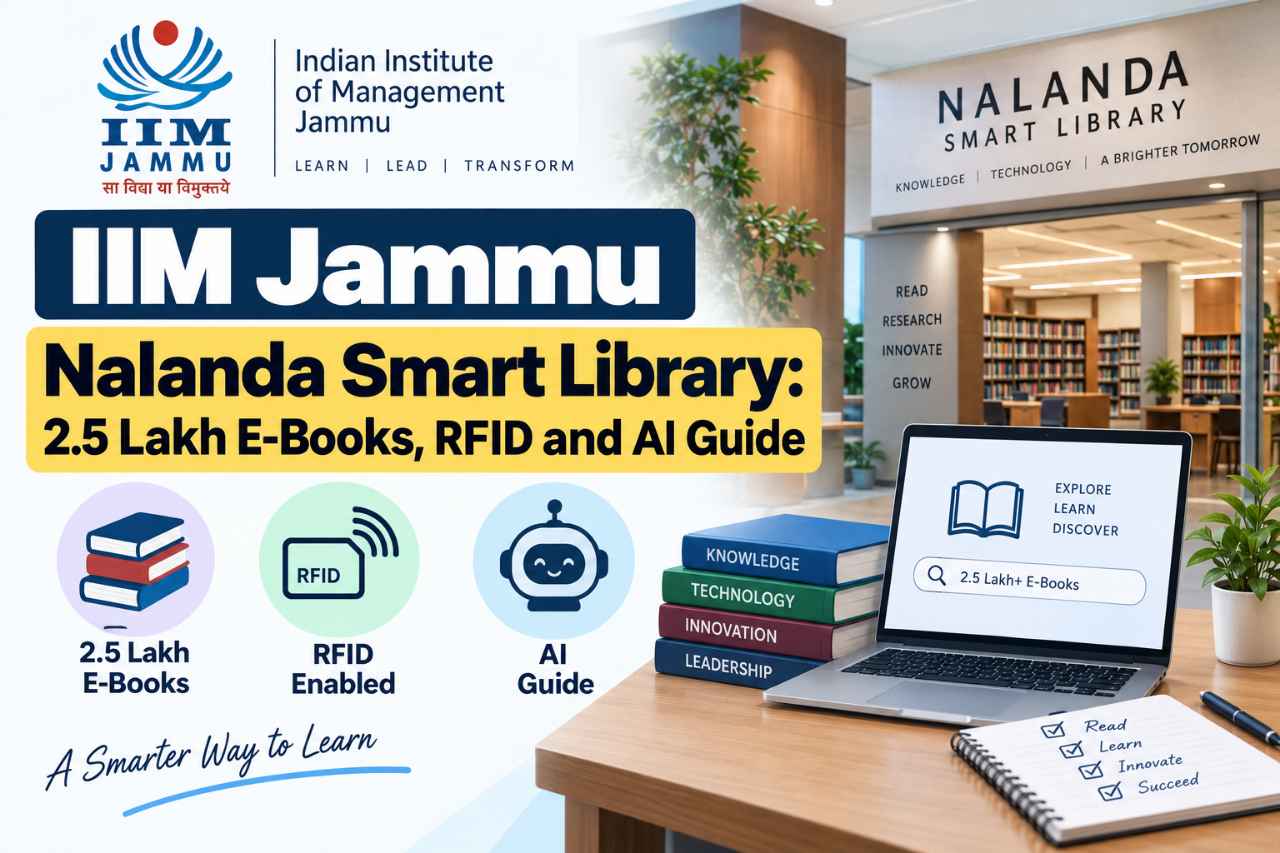
The Indian Institute of Management Jammu and Kashmir has transformed its campus learning hub with a major upgrade: the Nalanda Library is now Jammu's first fully smart library. Equipped with RFID tracking, the open-source KOHA Library Management System, artificial intelligence tools, and round-the-clock digital access, the facility gives MBA students, integrated programme learners, and PhD scholars a research environment that matches what top business schools offer in metro cities.
For students exploring management education in Jammu and Kashmir, this development matters beyond a single building. It signals how premier institutes are investing in technology-driven learning at a time when students expect library resources on their phones, not only on shelves. This guide explains what the smart library offers, why it was built, how it supports admissions-ready academic culture, and what aspirants can learn from IIM Jammu's approach to digital education infrastructure.
What Makes Nalanda Library a Smart Library?
A smart library uses technology to make finding, borrowing, and using academic material faster and more flexible than a traditional reading room. At IIM Jammu, librarian Shailesh K Lohiya has described the Nalanda Library as a fully computerised facility designed to pull students back into a physical learning space while giving them digital convenience.
Unlike older campus libraries that rely mainly on manual issue registers and fixed desk hours, this model combines:
- RFID (Radio Frequency Identification) for automated tracking of print books
- KOHA, an open-source library management platform
- A dedicated web portal for real-time availability, room booking, and digital access
- AI integration within the library's digital ecosystem
- 24/7 remote access to e-resources from hostels, internships, or home
According to Institute officials, roughly 88 to 90 percent of overall library resources are now digital. The remaining share is print, which students still prefer for course textbooks and deep reference reading. That balance reflects a practical reality in Indian higher education: digital-first access with print as a trusted backup.
Smart Library vs Traditional Campus Library
Understanding the difference helps MBA aspirants ask better questions during campus visits. A traditional library typically offers fixed counters, limited database remote access, and manual catalogues. A smart library like Nalanda adds automation, analytics, and mobile reach. The table below summarises common contrasts:
| Feature | Traditional Library | IIM Jammu Smart Library |
|---|---|---|
| Book tracking | Manual registers | RFID automation via KOHA |
| Digital access | Often campus-only | 24/7 from hostel and off-campus |
| Room booking | Walk-in or paper forms | Online portal booking |
| Finance research | Limited or absent | 12-terminal Bloomberg Lab |
| Mobile access | Rare | MyLOFT app integration |
Digital Collection at a Glance: E-Books, E-Journals, and Databases
The scale of IIM Jammu's digital library is one of its strongest talking points for research-focused learners. The facility provides access to approximately:
- 2.5 lakh (250,000) e-books
- More than 23,000 e-journals
- 56+ subscribed databases covering business, management, finance, and allied fields
These numbers place the library among the better-resourced academic information centres in the Jammu region. For context, many universities in smaller cities struggle to offer even a fraction of specialised business databases. PhD scholar Sheikh Junaid Yaqoob, researching economics and the business environment, has noted that platforms such as ProQuest and CMI (Capitaline/Management databases) are available at IIM Jammu but remain unavailable at several local universities a gap that directly affects dissertation quality and publication readiness.
What Types of Databases Are Included?
The subscribed database portfolio is built for MBA coursework, executive education, and doctoral research. Coverage typically spans:
- Academic research and peer-reviewed literature
- Company and sectoral intelligence
- Socio-economic indicators and policy data
- Newspaper and news archives
- Research-support and citation tools
Students working on live projects market sizing, competitive analysis, financial modelling, or policy briefs can pull data from licensed sources rather than relying on unverified web content. That is a core expectation at IIM-level institutions and a skill recruiters quietly test during case interviews and summer internship evaluations.
| Resource Type | Approximate Scale | Primary User Benefit |
|---|---|---|
| E-books | 2.5 lakh titles | Course reading, self-study, exam prep |
| E-journals | 23,000+ publications | Research papers, literature reviews |
| Databases | 56+ subscriptions | Industry data, financial research |
| Print collection | ~10–12% of total | Textbook reference, silent study |
| Bloomberg Finance Lab | 12 terminals | Live markets, finance assignments |
One Nation One Subscription and Specialised Database Access
The Nalanda Library is also linked to the Government of India's One Nation One Subscription (ONOS) initiative, which aims to widen access to international journals and research publications across eligible institutions. For students at IIM Jammu, ONOS adds another layer of journal coverage beyond institute-specific subscriptions.
However, as researchers on campus have pointed out, not every specialised database falls under ONOS. Premium finance, company intelligence, and niche management platforms often require separate institutional licences. That is why access at reputed business schools where annual database budgets are substantial still creates a meaningful advantage for PhD scholars and MBA students preparing data-heavy projects.
If you are comparing institutions in Jammu, look beyond brochure claims and check whether the library portal lists live database access, remote login rules, and Bloomberg or similar finance lab facilities. These details often separate aspirational campuses from research-ready ones.
Bloomberg Finance Lab: Practical Edge for Finance and MBA Students
Among the standout features of the smart library is a dedicated Bloomberg Finance Lab with 12 terminals. Bloomberg Terminal access is expensive for individuals and rarely available at average colleges. At IIM Jammu, finance specialisation students, investment club members, and case-competition teams can practise on the same platform used by analysts and portfolio managers globally.
Why the Bloomberg Lab Matters
- Students learn to navigate real-time market data, not textbook snapshots
- Finance courses, valuation assignments, and sector reports become more applied
- Placement preparation for roles in equity research, banking, and consulting improves
- Faculty can design simulations aligned with industry workflows
For MBA aspirants nationwide, finance lab infrastructure is a useful filter when shortlisting campuses. Institutes affiliated with strong management programmes such as the University of Petroleum and Energy Studies Management or other technology-forward business schools often highlight similar labs. In Jammu, IIM Jammu's lab stands out because it is embedded inside a library designed for continuous learning rather than isolated lab slots.
How RFID and KOHA Improve Day-to-Day Library Use
Technology only matters if it saves time. RFID tags on books allow self-check and automated inventory updates, reducing queues at the issue counter. KOHA, being open-source, gives the institute flexibility to customise workflows without heavy proprietary licensing costs an approach other public universities in the region, including institutions like the Central University of Jammu and the University of Jammu Jammu Tawi, are also exploring as they modernise campus libraries.
Student-Facing Benefits of RFID + KOHA
- Real-time book status on the library website no guessing whether a title is on shelf
- Faster issue and return through automated systems
- Online booking for discussion rooms and creative spaces
- Transparent records of borrowing history and due dates
- Better stock management, so popular MBA case books stay available
Integrated student Pushti, enrolled in the five-year integrated programme, shared that she can check book and room availability from her hostel without walking across campus. "All the information is available on the website, so everything is literally at my fingertips," she said, noting that the system saves considerable time during busy academic weeks. That convenience is exactly what Gen Z learners expect and what smart libraries are built to deliver.
Learning Spaces Designed for Focus and Collaboration
IIM Jammu's library leadership recognised a common problem: in the digital age, students skip the library unless the space feels worth visiting. Librarian Lohiya noted that when the institute was at the design stage, the team decided to create an ambience that would attract students who might otherwise study only in their rooms. The Nalanda Library responds with zoning that supports different study modes.
Silent Zone
A dedicated silent area allows uninterrupted reading, assignment completion, and print reference work. For exam-heavy weeks internal assessments, CAT preparation groups on campus, or end-term projects this zone protects deep work.
Discussion Rooms with Interactive Panels
MBA education relies heavily on group case analysis, presentation practice, and placement interview rehearsals. The library offers discussion rooms equipped with interactive panels, not basic whiteboards. Students use them for:
- Case study breakouts
- Online presentation dry runs
- Mock placement interviews
- Cross-functional project meetings
This design mirrors collaborative learning models at leading management institutes and differentiates the campus from traditional libraries that treat conversation as disruption.
Comfortable and Flexible Furniture
Modern seating and adaptable furniture encourage longer, productive stays. When the physical environment matches the digital backend, footfall rises a key metric library teams track when justifying infrastructure spend.
MyLOFT App: Library Access on Mobile
PhD scholar Okar Singh, who joined IIM Jammu in 2023, highlighted the MyLOFT application as a recent upgrade that puts "the library at your fingertips." Through the app, users can reach library services without opening multiple portals or visiting the desk for routine queries.
Mobile-first access is especially valuable when students travel for:
- Summer internships in other cities
- National case competitions
- Exchange programmes or field research
- Home visits during breaks
Because digital resources remain available 24/7, learning continuity does not break when students leave the main campus a significant advantage for residential programmes and doctoral timelines that stretch across years.
Student and Researcher Perspectives: Why Digital Access Changes Outcomes
Official statistics tell one part of the story; daily user experience tells the rest. Third-year integrated programme student Pushti explained that she accesses library resources from her hostel room or even while travelling home on leave. The website centralises availability checks, room bookings, and guidance on obtaining resources not immediately accessible reducing the need to walk across campus for routine queries.
For doctoral researchers, the impact is even sharper. Sheikh Junaid Yaqoob, who completed his master's from the University of Kashmir, contrasted his earlier experience with IIM Jammu today. He noted that while ONOS has expanded national journal access, specialised databases remain concentrated at reputed institutions and IIM Jammu is among them. For his economics and business environment research, that access has been "extremely helpful in advancing research."
Marketing PhD scholar Okar Singh added that the library has evolved significantly since 2023, with MyLOFT representing the latest step toward unified mobile access. Together, these accounts illustrate how infrastructure investment translates into saved time, stronger theses, and better-prepared graduates.
IIM Jammu Smart Library in the Jammu Higher Education Ecosystem
Jammu is steadily building a multi-institutional education hub. Alongside IIM Jammu, the city hosts the Indian Institute of Technology Jammu, All India Institute of Medical Science Jammu, Shri Mata Vaishno Devi University Jammu, and Baba Ghulam Shah Badshah University Jammu, among others. Each campus serves different disciplines, but all face the same student expectation: seamless digital access.
The Nalanda Library upgrade sets a benchmark for management education in the region. While engineering institutes such as Krishna Institute of Engineering and Technology or Galgotias College of Engineering and Technology invest heavily in labs and coding infrastructure, business schools win when they combine data tools, journals, and collaborative spaces under one roof.
The Nalanda Name and Learning Legacy
The library's name evokes India's ancient centre of learning. Institutions across the country from Nalanda University in Bihar to Nalanda Open University Patna and Nava Nalanda Mahavihara Nalanda carry that heritage forward in different ways. At IIM Jammu, the name aligns with a modern mission: combine scholarly depth with contemporary tools so management graduates can compete nationally.
Institute officials have stated that the library is among the best in Jammu and one of the strongest in the wider region for technology integration a claim supported by the combination of AI, RFID, Bloomberg terminals, and expansive e-collections.
What MBA and CAT Aspirants Should Take Away
If you are preparing for CAT, XAT, or other MBA entrance exams, library infrastructure may seem secondary to percentile scores. In practice, the two connect. Top performers in business school often depend on:
- Quality case libraries and industry databases for assignments
- Quiet zones and group rooms for balanced preparation
- Finance terminals and data tools for specialisation credibility
- Remote journal access for research papers and live projects
When you evaluate IIM Jammu or peer institutes like Fairfield Institute of Management and Technology, visit the library portal during open days if possible. Ask current students whether they use discussion rooms, MyLOFT, and Bloomberg terminals in real coursework not only during tours.
Actionable Tips for Aspirants
- Check whether e-journal access works off-campus before accepting admission
- Ask PhD and second-year MBA students about database gaps for your specialisation
- Compare finance lab access if you target banking or equity research roles
- Review how room booking works during peak placement season
- Confirm AI and portal features are actively maintained, not pilot projects
- Explore whether the institute publishes library usage guides or orientation sessions for new batches
Questions to Ask During Campus Visits
Bring a short checklist: How many databases are accessible remotely? Is Bloomberg training offered formally? Can integrated programme students book discussion rooms during exam season? Are AI tools used for search recommendations or citation support? Clear answers reflect an institution that treats the library as academic core, not a side facility.
The Future of Smart Libraries in Indian Business Schools
IIM Jammu's Nalanda Library reflects a wider shift across Indian higher education: libraries are becoming learning experience centres, not storage rooms. Key trends likely to spread to other campuses include:
- Hybrid collections with digital majority and curated print cores
- AI-assisted discovery to help students find relevant papers faster
- Integrated apps like MyLOFT that unify portals, databases, and services
- Industry tools Bloomberg, Reuters, or sector databases inside academic spaces
- ONOS and national subscriptions layered with institute-specific licences
Campuses in art, design, and interdisciplinary fields are making parallel investments. For example, institutes such as MIT Art Design and Technology University Pune, the National Museum Institute of History of Art Conservation and Museology, and the Sir J J School of Art Architecture and Design emphasise studio and digital media infrastructure different tools, same principle: students learn by doing with professional-grade resources.
For Jammu specifically, the smart library strengthens the city's case as a destination for serious management education without relocating to Delhi, Mumbai, or Bangalore. That geographic choice matters to students from Jammu and Kashmir, Punjab, Himachal Pradesh, and Ladakh who want tier-one academic tools closer to home. Nearby institutions such as Cluster University of Jammu and Sher E Kashmir University of Agricultural Science Technology of Jammu serve different academic streams but share the same regional push toward digitised learning support.
Conclusion
The transformation of IIM Jammu's Nalanda Library into Jammu's first smart library is more than a campus upgrade. With 2.5 lakh e-books, 23,000 e-journals, 56-plus databases, RFID-enabled operations, AI-supported discovery, a 12-terminal Bloomberg Finance Lab, and 24/7 digital access through the web portal and MyLOFT app, the institute has built a research environment that supports MBA coursework, doctoral studies, and placement preparation at a national standard.
For students, the lesson is clear: choose institutions that invest in how you will learn, not only what degree name appears on your certificate. For colleges across India, IIM Jammu offers a practical blueprint open-source systems, strategic database spending, collaborative spaces, and mobile access to keep libraries relevant in a digital-first age. As Jammu's higher education ecosystem grows alongside IIT Jammu, AIIMS Jammu, and central universities, the Nalanda Library stands as a model of how tradition and technology can work together for the next generation of business leaders.