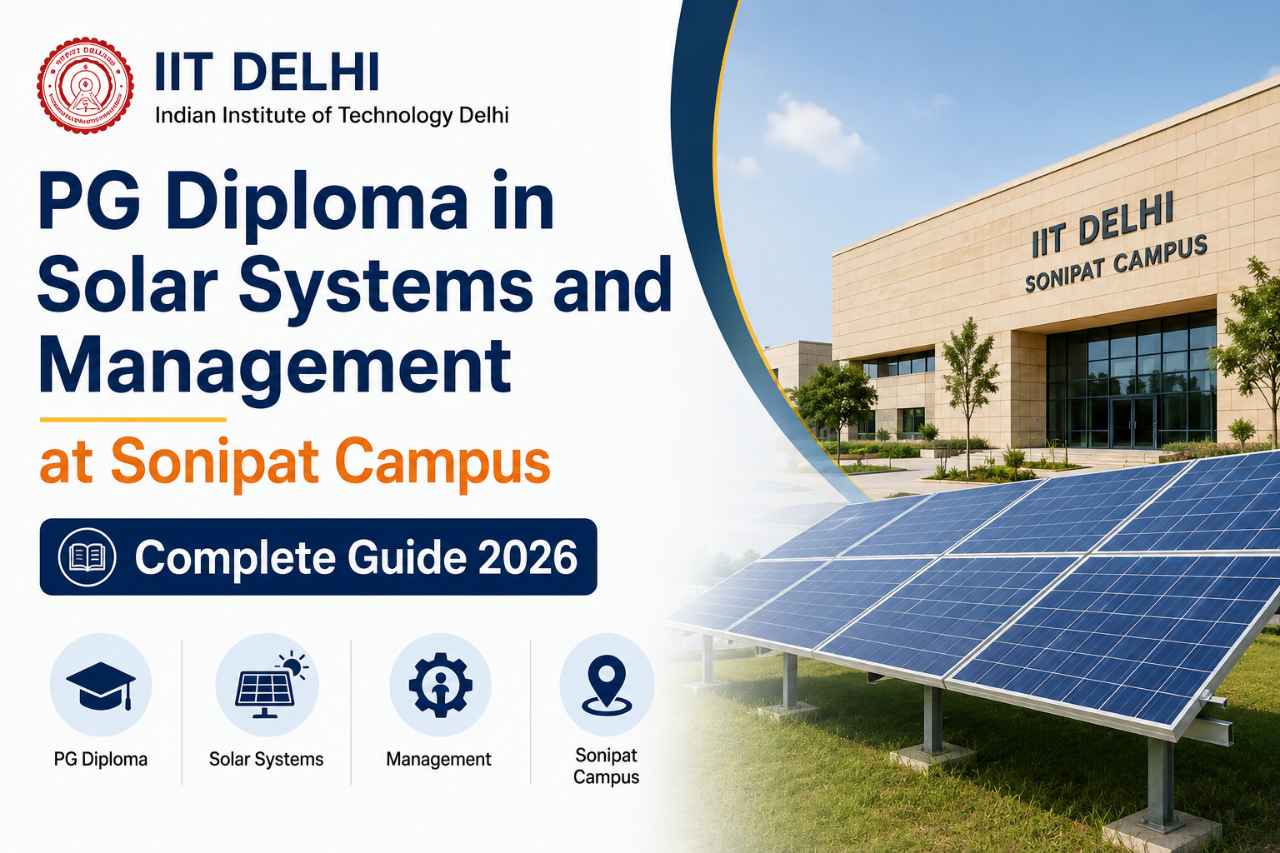
India's push toward clean energy is no longer limited to policy announcements and large solar parks. On September 3, 2026, the Indian institute of Technology Delhi (IIT Delhi) marked a major milestone by commencing its Postgraduate Diploma in Solar Systems and Management at its Sonipat campus. The inaugural batch includes nine international fellows from eight countries, signalling IIT Delhi's growing role in global solar education and capacity building.
For students, working professionals, and education planners across India, this launch matters for three reasons. It opens a new academic hub in the national Capital Region (NCR), strengthens India's leadership through the International Solar Alliance (ISA), and creates a trained pipeline of experts who will support solar deployment in more than 120 ISA member nations. This guide explains the programme structure, partners, career outcomes, and what it means for Indian higher education in renewable energy.
What Is the IIT Delhi PG Diploma in Solar Systems and Management?
The PG Diploma is a one-year, hands-on training programme designed for ISA-nominated fellows. It is offered by IIT Delhi's Department of Energy Science and Engineering (DESE) in collaboration with the International Solar Alliance (ISA) and INES – Institut national de l'Energie Solaire, France. The programme is sponsored by the United Nations Industrial Development Organisation (UNIDO).
Unlike a typical open-admission diploma aimed at domestic students, this course is structured as a capacity-building initiative. Participants receive training from academic experts and industry professionals, with a clear goal: prepare fellows to become trainers and leaders in solar technology application across their home countries.
Key Highlights at a Glance
- Duration: One year of academic training
- Location: IIT Delhi Sonipat campus (first physical teaching programme on this campus)
- Batch profile: Nine international fellows from eight countries in the inaugural cohort
- Focus areas: Solar technology, applications, energy management, and institutional capacity building
- Post-course pathway: One-month internship in Europe, followed by assignment to STAR-C centres
Why IIT Delhi Launched This Programme at Sonipat
The Sonipat campus launch is historically significant for IIT Delhi. According to campus leadership, this is the first teaching programme with physical classes at the Sonipat facility. Professor-in-Charge Somnath Baidya Roy described it as a milestone and indicated that more programmes may follow in the coming years.
From a strategic perspective, Sonipat offers proximity to Delhi while allowing IIT Delhi to expand beyond its main Hauz Khas campus. For renewable-energy education, this is especially relevant because the NCR region already hosts several institutions focused on management, technology, and energy studies. Students comparing options may also explore programmes at institutions such as the University Of Petroleum And Energy Studies Management, which has long focused on energy-sector careers, or the Delhi Technical Campus for technical education pathways in the capital region.
For Indian aspirants interested in energy and management combinations, Delhi-NCR remains one of the strongest education clusters in the country. Programmes at the Management Development Institute, International Management Institute Imi Delhi, and Fore School Of Management Delhi show how the region blends business education with sector-specific skills—an model increasingly relevant as green jobs expand.
Partners Behind the Programme: ISA, INES France, and UNIDO
The credibility of any specialised diploma depends heavily on who designs, funds, and delivers it. IIT Delhi's solar PG Diploma brings together three influential partners alongside the institute's own energy department.
International Solar Alliance (ISA)
The ISA is a coalition of solar-rich countries working to reduce the cost of finance and technology for solar projects. With membership spanning more than 120 nations, the alliance plays a central role in nominating fellows and aligning training outcomes with real deployment needs in member countries.
INES – Institut National de l'Energie Solaire, France
INES is among Europe's leading solar research and training institutions. Its involvement adds depth in applied solar technologies and international best practices—especially valuable for fellows who will later intern in Europe and implement solutions in diverse climatic and economic conditions.
UNIDO Sponsorship
UNIDO's sponsorship underscores the programme's development-oriented mission: build professional capacity, strengthen institutions, and support inclusive economic growth through clean energy. For students researching global energy careers, this partnership signals that the diploma is not merely academic—it is tied to international development and industrial policy goals.
Programme Objectives and Training Model
According to IIT Delhi, the PG Diploma aims to build capacity in solar technology and applications across ISA member countries. The training model combines classroom learning, expert-led sessions, and practical exposure so that fellows can later train others in their home nations.
Ramesh Narayanan, Head of DESE at IIT Delhi, stated that the initiative places the institute at the global forefront of energy education and management. The broader vision is to develop international participants as trainers for Solar Technology Application Resource Centres (STAR-C) in ISA member countries.
What Fellows Typically Learn in Solar Systems Programmes
While the full subject-wise syllabus may be updated over time, programmes of this nature generally cover:
- Solar photovoltaic (PV) systems: Design, installation basics, performance assessment, and maintenance principles
- Solar thermal and hybrid applications: Use cases in industry, agriculture, and urban infrastructure
- Energy management: Load analysis, grid integration concepts, storage overview, and policy frameworks
- Project planning: Feasibility, financing models, risk assessment, and lifecycle costing
- Capacity-building skills: Training delivery, centre operations, and community engagement for solar adoption
Students in India who want a strong foundation in technology and infrastructure may also consider pathways through the Institute Of Infrastructure Technology Research And Management Iitram, which aligns with sectors where solar deployment is accelerating, including power, transport, and urban development.
STAR-C Centres: Career Pathway After the Diploma
One of the most important outcomes of this programme is what happens after graduation. Fellows complete a one-month internship in Europe focused on applied solar technologies. They are then assigned to STAR-C centres in their respective home countries.
STAR-C centres are designed to support ISA member countries by providing:
- Skills development for local technicians and engineers
- Infrastructure for testing, demonstration, and innovation in solar applications
- An ecosystem that connects academia, industry, and policy stakeholders
- Support for green job creation and sustainable economic growth
For international fellows, this creates a defined career arc: global training at IIT Delhi, European exposure, and leadership roles in national solar resource centres. For Indian students watching this space, it also highlights the kind of institutional roles emerging in renewable energy—programme management, technical training, policy implementation, and international collaboration.
Framework for Action: IIT Delhi and ISA Collaboration
The PG Diploma follows a Framework for Action (FFA) formalised between IIT Delhi and the ISA earlier in 2026. The framework focuses on cooperation in renewable energy, especially in:
- Capacity building for solar professionals
- Academic collaboration across member countries
- Human resource development for long-term solar adoption
This type of institutional partnership is becoming common in Indian higher education, where premier institutes align with global bodies to solve sector-specific talent gaps. Similar blended models—technology plus management—are visible at institutions such as the Birla Institute Of Management Technology and the New Delhi Institute Of Management, though those programmes target different industries.
Who Should Consider Solar and Energy Management Careers in India?
Although the IIT Delhi PG Diploma in its current form is aimed at ISA-nominated international fellows, it reflects career directions that Indian students can actively pursue through related qualifications.
Ideal Candidate Profiles
- Engineering graduates in electrical, mechanical, energy, or environmental disciplines
- Working professionals in power, EPC, manufacturing, or sustainability roles seeking upskilling
- Policy and management aspirants interested in renewable energy project leadership
- Researchers and educators aiming to build training centres or academic programmes in solar
Actionable Tips for Indian Aspirants
- Build a strong STEM base: Physics, mathematics, and basic electrical concepts are essential for solar system design and troubleshooting.
- Add management skills early: Project management, finance, and communication matter as much as technical knowledge in deployment roles.
- Follow national policy trends: Track schemes related to rooftop solar, green hydrogen, storage, and grid modernisation.
- Gain practical exposure: Internships with EPC firms, discoms, or renewable startups improve employability significantly.
- Compare programmes carefully: Look at faculty expertise, industry links, lab infrastructure, and placement support—not just course titles.
Aspirants in Delhi can also review management and technology programmes at the Delhi School Of Management, Jagan Institute Of Management Studies Jims Rohini, and Guru Gobind Singh Indraprastha University Management while planning long-term education pathways that complement energy-sector goals.
How This Programme Fits India's Renewable Energy Goals
India has set ambitious renewable energy targets, and solar remains the fastest-growing segment. Large-scale parks, rooftop installations, solar pumps, and industrial decarbonisation projects all require skilled professionals who understand both technology and implementation on the ground.
Programmes like IIT Delhi's PG Diploma support this transition by creating a multiplier effect: each trained fellow can later train dozens of local professionals through STAR-C centres. That model is especially useful for countries that need rapid skill development but lack enough specialised trainers.
Solar Education vs General Management Programmes
| Parameter | Solar Systems & Management Diploma (IIT Delhi Sonipat) | General Management Programmes (Delhi-NCR) |
|---|---|---|
| Primary focus | Solar technology, applications, and trainer capacity building | Business administration, finance, marketing, HR |
| Typical audience | ISA-nominated international fellows | Domestic graduates and working professionals |
| Career outcome | STAR-C leadership, solar training roles, international deployment | Corporate roles across sectors |
| Best for | Global solar capacity-building careers | Broad management careers with optional sector specialisation |
If your goal is a mainstream MBA or management degree, institutions such as the Lal Bahadur Shastri Institute Of Management or Asia Pacific Institute Of Management may be more directly aligned. If your goal is energy transition leadership, specialised solar and energy programmes—along with engineering foundations—are the better route.
Future of IIT Delhi Sonipat Campus
Campus officials have indicated plans to introduce more programmes at Sonipat in the coming years. The first physical batch in solar systems and management sets a precedent for location-specific expansion without overburdening the main IIT Delhi campus.
For prospective students, this is worth monitoring. New campuses often start with niche, high-impact programmes before scaling to broader undergraduate or postgraduate offerings. Early programmes tend to set the academic culture, industry partnerships, and infrastructure standards for everything that follows.
Students exploring technology-management blend outside Delhi may also review options such as the Centurion University Of Technology And Management, the Global Institute Of Technology And Management Sikar, or the Atal Bihari Vajpayee Indian Institute Of Information Technology And Management Gwalior to understand how regional institutes are aligning with India's skill needs.
European Internship: Why It Matters for Solar Fellows
A distinctive feature of the IIT Delhi PG Diploma pathway is the one-month internship in Europe that follows the academic year. This is not a ceremonial add-on—it is designed to expose fellows to applied solar technologies in mature markets where research, manufacturing, and deployment ecosystems are deeply integrated.
During the internship, participants typically observe advanced testing protocols, quality standards, and integration techniques that may not yet be widespread in their home countries. Exposure to European solar labs, demonstration projects, and industry workflows helps fellows translate global best practices into locally adapted solutions. For ISA member nations with varied climates—from tropical coasts to arid interiors—this comparative learning is especially valuable.
Indian students considering international exposure in energy should note that fellowships and institutional tie-ups often provide structured pathways that individual applicants may not easily replicate. However, the underlying lesson remains useful: combine domestic technical training with short international immersions to understand how policy, finance, and innovation ecosystems interact in leading solar markets.
Eligibility, Nomination, and How the Selection Model Works
Because the inaugural batch consists of ISA-nominated fellows, admission does not follow the typical Indian entrance-exam pattern seen in IIT MTech or MBA programmes. Instead, participating countries and ISA channels identify candidates whose professional backgrounds align with solar deployment priorities at home.
Although official public brochures may release more detail over time, fellowship-driven programmes generally evaluate candidates on prior education in engineering or related sciences, relevant work experience in energy or development sectors, language readiness for international training, and commitment to serve at STAR-C centres after completion. UNIDO sponsorship further suggests that candidates are expected to contribute to institutional strengthening and job creation—not only personal career advancement.
Indian readers should treat this as a reference model for high-impact solar education rather than an immediately open admissions window. If IIT Delhi Sonipat expands offerings later, eligibility criteria could evolve. Until then, monitor announcements on the IIT Delhi website, ISA portals, and trusted education news sources for updates on future batches or related certificate programmes.
Solar Energy Job Market in India: Roles and Growth Areas
India's solar sector continues to create roles across the value chain. Understanding these pathways helps students align education choices with real hiring trends—even when they are not applying to the IIT Delhi diploma directly.
High-Demand Role Categories
- Project engineering and EPC: Site surveys, BOQ preparation, installation supervision, and commissioning of solar plants
- Operations and maintenance (O&M): Performance monitoring, fault diagnosis, module cleaning schedules, and inverter maintenance
- Design and consultancy: PV system modelling, shadow analysis, financial modelling, and tender support
- Policy and regulatory affairs: Compliance with state discom rules, open access frameworks, and renewable purchase obligations
- Training and capacity building: Instructor roles at skill centres, corporate upskilling programmes, and community awareness projects
- Research and product development: Work on efficiency improvements, storage integration, and agrivoltaics in labs and startups
Metro cities remain hubs for corporate and policy roles, while tier-2 and tier-3 regions see strong field-level hiring as rooftop and utility-scale projects expand. Institutes such as the Modi Institute Of Management And Technology Kota, the Om Kothari Institute Of Management And Research Kota, and the Maharaja Agrasen Institute Of Management Studies illustrate how regional management education can complement local industrial growth—including renewable supply chains and service firms that hire nearby graduates.
Skills Employers Value Most
Recruiters consistently look for a mix of technical competence and execution ability. Graduates who can read single-line diagrams, use basic simulation tools, prepare project reports, and communicate with vendors and clients tend to progress faster. Soft skills—team coordination, safety awareness, and documentation discipline—matter on live project sites where timelines and compliance standards are strict.
Students still in school should prioritise physics and mathematics, participate in science fairs or robotics clubs, and seek factory or site visits when possible. Undergraduate students should add mini-projects on energy audit, solar sizing, or sustainability reporting to their portfolios. These steps mirror the practical orientation of IIT Delhi's fellowship programme, even outside formal ISA nomination channels.
Conclusion
The launch of IIT Delhi's PG Diploma in Solar Systems and Management at the Sonipat campus is more than a new course announcement—it is a signal of how India's premier institutes are contributing to global clean-energy education. With backing from ISA, INES France, and UNIDO, the programme trains international fellows to become solar trainers and leaders at STAR-C centres worldwide.
For Indian students and professionals, the takeaway is clear: solar energy careers are expanding quickly, and the skills in demand combine technical depth with management and training ability. Even if this specific diploma is fellowship-driven and ISA-nominated, it points toward the kind of specialised, industry-linked education that will define the next decade of higher education in energy and sustainability. Keep track of IIT Delhi Sonipat announcements, build relevant skills early, and compare allied programmes across Delhi and India to create a career plan that matches your goals.