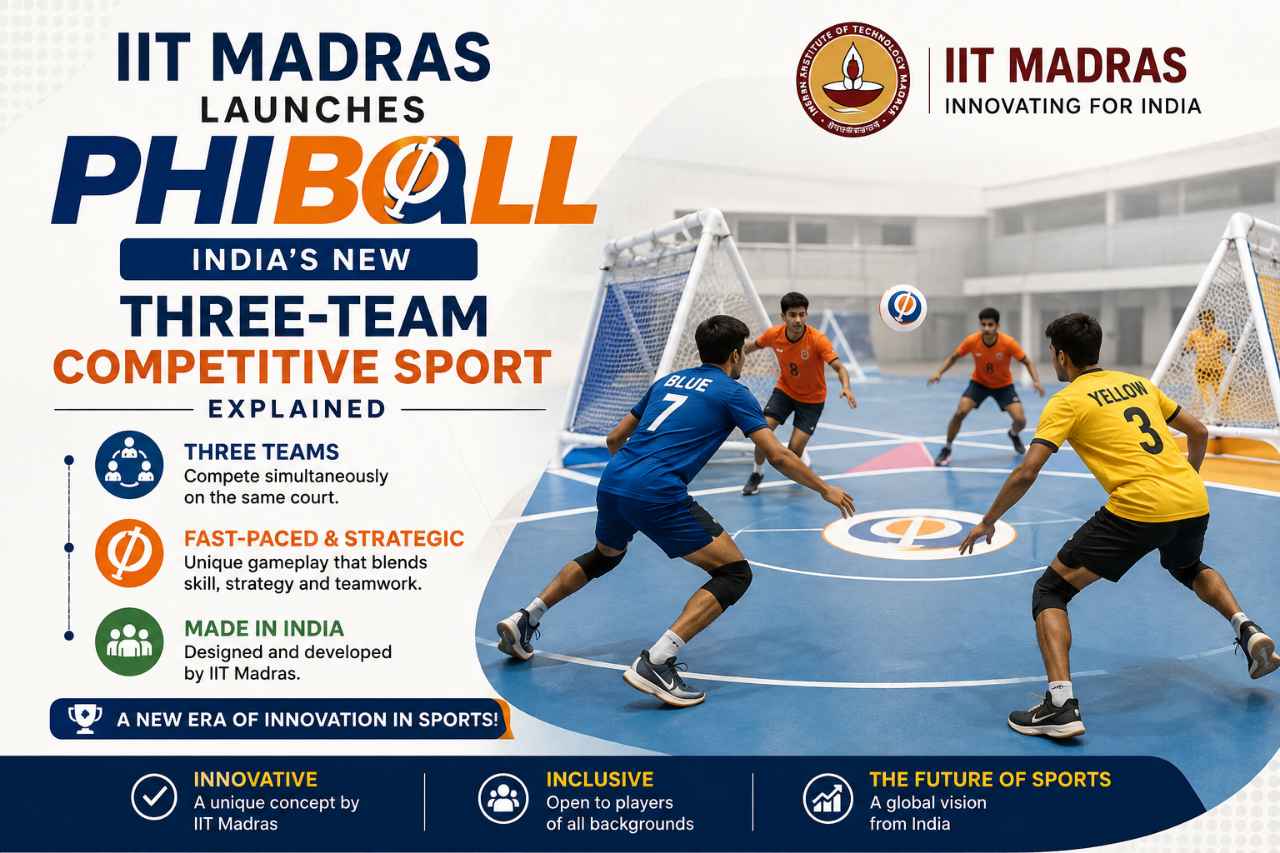

Indian higher education campuses are increasingly blending academics with innovation beyond the classroom and sport is no exception. In a notable development ahead of National Sports Day 2026, the Indian Institute of Technology (IIT) Madras has unveiled Phiball, a brand-new three-team competitive invasion sport that challenges conventional two-sided games. Unlike football, basketball, or kabaddi, Phiball places three squads on one circular court at the same time, forcing players to attack two baskets while defending a third.
For students exploring engineering colleges, sports universities, or holistic campus life in Tamil Nadu and across India, Phiball signals how premier institutes are investing in physical education, teamwork, and creative problem-solving. This guide explains what Phiball is, how it is played, why it matters for Indian college sports, and what aspiring athletes and admissions seekers should know when comparing campuses after board exams, entrance tests, and counselling rounds.
What Is Phiball? Understanding IIT Madras's New Three-Team Sport
Phiball is a three-team invasion sport developed at IIT Madras Chennai. It was officially launched on August 28, 2026, one day before National Sports Day, which India observes every year on August 29 to honour hockey icon Major Dhyan Chand. The sport is designed around speed, strategy, skill, and continuous tactical adaptation rather than raw physical dominance alone.
At its core, Phiball breaks the traditional model of one team versus another. Three teams compete simultaneously on a shared circular court. Each team tries to score in two opponent baskets while protecting its own basket. Players must track multiple opponents, switch between attack and defence quickly, and communicate under constant pressure skills that mirror real-world teamwork in engineering projects, research labs, and leadership roles on busy campuses.
Key Features That Make Phiball Unique
- Three teams, one court: All squads play at the same time rather than in sequential knockout rounds.
- Dual attacking lanes: Each team targets two baskets belonging to rival teams during live play.
- Single defensive focus: Each team guards one assigned basket throughout a quarter before rotation.
- Rotating defence: Teams shift the basket they defend after every quarter in clockwise order.
- Mathematically defined court: The playing area uses precise geometric divisions for fairness and safety.
- Shot clock pressure: A 24-second possession timer keeps the game fast, watchable, and competitive.
According to IIT Madras leadership, Phiball combines physical fitness with presence of mind, accuracy, and collaborative decision-making qualities that align with the broader mission of India's top technical institutes to produce well-rounded graduates who excel beyond textbooks and coding assignments.
Why IIT Madras Launched Phiball Before National Sports Day
National Sports Day is more than a calendar event for Indian colleges. It reminds institutions to promote fitness, fair play, and sporting excellence among students while paying tribute to legendary athletes. Launching Phiball on the eve of this occasion connects the new sport to a national movement that celebrates champions and encourages everyday campus participation.
Sathyanarayana N Gummadi, Dean (Students) at IIT Madras, emphasised that Phiball was built on values such as teamwork, speed, communication, tactical decision-making, fairness, and safety. Director V. Kamakoti noted that winning requires accuracy, alertness, teamwork, and physical health attributes that support both academic rigour and personal wellbeing on demanding campuses where stress management is a growing concern.
For students comparing institutes, this launch also reflects IIT Madras's active sports culture. Alongside research breakthroughs, strong placements, and entrepreneurship cells, the institute continues to expand student life through structured physical activity a factor worth considering when shortlisting colleges after exams like JEE Advanced, JoSAA counselling, and state-level engineering entrances.
Campus Wellness and Student Life at Top Institutes
Engineering and technology colleges across India from IITs to NITs are recognising that mental health and physical activity go hand in hand. Regular sport participation helps students manage long study hours, build peer networks, and develop discipline. Phiball adds a fresh option to intramural calendars that traditionally feature cricket, football, volleyball, and athletics. Its novelty may attract students who might otherwise skip organised sport, thereby widening participation across batches and departments.
Phiball Court Layout: Dimensions, Zones, and Equipment
Understanding the court helps players, coaches, and college sports coordinators visualise how Phiball works in practice. The layout is deliberately geometric so that each team occupies an equal sector without permanent territorial advantage.
Court Specifications
- Shape: Circular court with a 26-metre diameter.
- Sector division: Three equal 120-degree sectors one primary zone per team.
- Baskets: Three hoops positioned around the playing area, one associated with each team's defensive assignment.
- Centre free zone: A four-metre central area where shooting is not permitted.
- No-offence zone: A restricted area beneath each basket designed to improve player safety near the hoop.
The geometric design ensures that no team enjoys a lasting positional edge. Because defence rotates each quarter, players experience different angles, distances, and match-ups similar to rotating field positions in multi-format training used at institutions like the Tamilnadu Physical Education and Sports University Chennai and the Lakshmibai National Institute of Physical Education Gwalior, which train coaches and physical educators nationwide.
Team Composition and Substitutions
Each Phiball team registers seven players in total:
- 4 active players on court during live play.
- 3 substitutes available for rotation and tactical changes.
Substitutions are permitted during dead-ball situations with referee approval, allowing coaches to manage fatigue, injuries, and match-ups across three fast-paced quarters. Smaller rosters keep the game accessible for colleges that may struggle to field large squads for traditional eleven-a-side sports.
Phiball Rules and Match Format Explained
Phiball follows a structured match procedure designed for clarity, fairness, and spectator engagement. While it draws inspiration from 3×3 basketball principles, it includes modifications suited to its three-team format and circular court.
Match Duration and Structure
- Three quarters of eight minutes each, totalling 24 minutes of live play.
- Three-minute intervals between quarters for coaching adjustments and hydration.
- Clockwise defensive-basket rotation after every quarter so no team defends the same hoop throughout.
The rotating defence rule is central to Phiball strategy. A team may begin a quarter protecting one basket, then rotate clockwise to defend another in the next quarter, and the third basket in the final quarter. This exposes players to varied offensive and defensive scenarios within a single match, testing adaptability rather than repetitive patterns.
Shot Clock and Possession Rules
- 24-second shot clock for new possessions to prevent time-wasting.
- 14-second reset in applicable situations after certain events such as offensive rebounds or change of possession.
- No shooting from the centre free zone players must move out of the central four-metre circle before attempting a field goal.
These timing rules prevent stalling and keep all three teams involved throughout the match. For college athletes accustomed to basketball or handball, the shot clock adds familiar urgency while the three-team dynamic creates new passing lanes, defensive traps, and scoring opportunities that do not exist in conventional formats.
Violations, Officiating, and Fair Play
Phiball defines standard violations including travelling, double dribbling, fouls, and other infractions adapted from applicable 3×3 basketball guidelines. Three floor referees oversee the three court sectors, supported by a scorekeeper, timekeeper, and shot-clock operator. This officiating structure helps maintain safety and consistency across simultaneous multi-team play a logistical challenge that the rulebook addresses explicitly.
Phiball Scoring System: Points, Free Throws, and Arc Values
Scoring in Phiball follows a tiered point system that rewards shot difficulty and placement while remaining easy for spectators to follow:
| Shot Type | Points Awarded |
|---|---|
| Successful free throw | 1 point |
| Field goal inside the 6.75-metre arc | 2 points |
| Field goal beyond the 6.75-metre arc | 3 points |
Because each team attacks two baskets, scoring opportunities are abundant but so are defensive challenges. A team leading against one opponent may still trail overall if the third squad capitalises on open lanes. This multi-directional scoring model makes comebacks possible and keeps spectators engaged until the final buzzer, which is ideal for college fest audiences and inter-institute tournaments.
Tactical Tips for New Phiball Players
- Communicate constantly: Call out which basket is threatened and when to switch coverage between attackers.
- Prioritise transition speed: Quick shifts from defence to attack exploit gaps before opponents reset their shape.
- Use the arc wisely: Three-pointers can shift momentum, but high-percentage two-point shots build steady leads over eight-minute quarters.
- Respect the centre zone rule: Set up plays that draw defenders out before taking open shots from legal areas.
- Plan for rotation: Study which basket your team will defend in each quarter during pre-match briefing and walk-throughs.
- Manage fouls: Aggressive defence is valuable, but foul trouble reduces on-court numbers in a already compact four-player format.
National Sports Day Connection and India's Sports Education Landscape
National Sports Day, observed on August 29, marks the birth anniversary of Major Dhyan Chand the legendary hockey player whose career inspires generations of Indian athletes. Colleges and universities across the country organise tournaments, fitness drives, awareness programmes, and award ceremonies on this day to encourage students to view sport as part of a balanced education.
Phiball's launch timing aligns with this national observance and highlights how technical institutes contribute to India's sporting ecosystem alongside dedicated sports universities. While IIT Madras leads the innovation, specialised institutions such as the National Sports University, Major Dhyan Chand Sports University, Bihar Sports University, and the Sports University of Haryana continue to train coaches, physical educators, and elite athletes who may eventually adapt, teach, or officiate new formats like Phiball at state and national levels.
State-level universities including Swarnim Gujarat Sports University, Sri Sri Aniruddhadeva Sports University, The Maharaja Bhupinder Singh Punjab Sports University, and Uttarakhand State Sports University USSU play a vital role in curriculum design, sports science, biomechanics, and grassroots development that complements campus innovations at IITs, NITs, and private universities.
Nine Institutions Join the Phiball Global Launch
The initial Phiball global launch involves participants from nine Chennai-area and Tamil Nadu institutions, reflecting a collaborative rather than isolated rollout led by a single campus:
- IIT Madras
- A M Jain College of Arts and Science
- Patrician College of Arts and Science
- Presidency College of Arts and Science
- Sathyabama University
- Tamil Nadu Dr. Ambedkar Law University
- The New College of Arts and Science
- VIT Chennai
- YMCA College of Physical Education
This diverse mix spanning IITs, private universities, arts and science colleges, a law university, and a physical education institute demonstrates Phiball's potential as an inter-collegiate sport. Students from non-engineering backgrounds can participate equally, making it accessible beyond JEE-qualified cohorts and appealing to arts, commerce, and law students who want competitive sport without elite prior training.
The launch event on the IIT Madras campus was attended by Dean (Students) Sathyanarayana N Gummadi along with students, faculty members, teams from city colleges, and other stakeholders. It marks the beginning of a broader initiative to introduce, develop, and promote Phiball as a distinctive sporting format with defined rules, match procedures, and emphasis on safety, teamwork, and fair play.
What Phiball Means for Indian College Sports and Admissions Seekers
For students researching colleges, campus sports facilities and culture often influence final decisions alongside NIRF rankings, fees, scholarships, and placement records. A novel sport like Phiball offers several benefits that extend beyond entertainment.
Physical and Mental Development
Three-team play demands split-second decisions, spatial awareness, cardiovascular endurance, and cooperative problem-solving. Research consistently links regular physical activity with improved concentration, stress management, and sleep quality especially important at high-pressure institutes where academic workload and competitive peer groups can affect wellbeing.
Inclusivity Across Disciplines
Because Phiball does not require years of specialised training in a single sport, colleges can field mixed teams from engineering, law, arts, commerce, and physical education programmes. This inclusivity strengthens inter-department bonding and gives non-athletes a structured pathway into competitive sport.
Portfolio Value for Sports Enthusiasts
Students aiming for careers in coaching, sports management, fitness training, or physical education pathways commonly pursued through universities like Tamil Nadu Physical Education and Sports University or Lakshmibai National Institute of Physical Education may find early exposure to emerging formats professionally valuable when applying for internships, certifications, or postgraduate programmes.
Inter-Institute Networking and Fest Culture
Multi-college launch events create relationships between campuses, paving the way for leagues, sports festivals, and exchange tournaments that enrich student life beyond academics. For Chennai-based students comparing VIT Chennai, Sathyabama University, and IIT Madras, shared sporting platforms can foster community ties that last beyond graduation.
Safety, Officiating, and Long-Term Promotion Plans
IIT Madras has emphasised that safety and fair play remain central to Phiball. Dedicated no-offence zones beneath baskets reduce collision risk near the hoop where injuries are most common in court sports. The four-metre centre free zone prevents congested shooting situations that could lead to contact injuries. Three sector-based floor referees ensure localised oversight, while support officials manage scoring, time, and shot-clock compliance with clear accountability.
Rules covering fouls, travelling, and double dribbling provide a transparent framework for disciplined play. As Phiball expands beyond the initial nine institutions, standardised referee training, coach certification, and equipment guidelines will be essential an area where collaboration with established sports universities and YMCA physical education programmes can accelerate responsible adoption nationwide.
How College Students Can Prepare for Phiball
Whether you study at IIT Madras, a nearby arts college, or a sports university elsewhere in India, you can start building Phiball-ready skills today even before formal leagues reach your campus:
- Improve cardiovascular fitness: Eight-minute quarters with minimal stoppage require sustained effort and recovery capacity.
- Practice quick passing drills: Three-team defence collapses passing lanes; fast ball movement and off-ball screens create openings.
- Study 3×3 basketball fundamentals: Dribbling under pressure, shot selection, and foul discipline transfer directly to Phiball.
- Train defensive communication: Verbal cues prevent open shots when guarding rotating baskets across quarters.
- Learn shot-clock decision-making: Use drills that force shots or passes within 24 seconds to build game intelligence.
- Join campus sports clubs: Institutes like IIT Madras and peer technical universities often run intramural programmes where new formats are tested before wider rollout.
Admissions aspirants should note that active sports participation can complement holistic profile building for scholarships and campus interviews, though elite engineering entrance exams like JEE Main and JEE Advanced remain the primary selection criteria for IITs. Sports achievement rarely substitutes for academic cutoffs but can distinguish candidates for cultural quotas, institute teams, and leadership roles after admission.
Phiball vs Traditional Two-Team Sports: A Quick Comparison
Understanding how Phiball differs from familiar formats helps coaches and PE departments decide whether to add it to their calendar:
- Football or hockey: Two teams, rectangular pitch, single goal per side; Phiball uses three teams and two scoring targets per side simultaneously.
- Basketball: Two teams, one basket each; Phiball adds a third squad and rotating defensive assignments.
- 3×3 basketball: Similar roster size and shot-clock concepts, but Phiball's circular court and triple-team logic create unique spatial puzzles.
- Kabaddi: Raid-based contact sport with alternating offence; Phiball is continuous invasion with simultaneous three-way competition.
This distinct identity may help Phiball carve its own niche in college sports weeks rather than competing directly with established favourites.
Conclusion: Phiball and the Future of Campus Sport in India
Phiball represents a bold step by IIT Madras to reimagine competitive sport for Indian college campuses. By introducing a three-team invasion format with precise court geometry, rotating defence, structured scoring, and professional officiating, the institute has created a game that rewards teamwork, adaptability, and athletic skill in equal measure.
Launched ahead of National Sports Day 2026, Phiball connects local innovation to a national celebration of fitness and fair play rooted in the legacy of Major Dhyan Chand. With nine institutions joining the initial rollout from IIT Madras and VIT Chennai to law, arts, and physical education colleges and clear rules already documented, the sport is positioned for wider adoption across Tamil Nadu and potentially other states where sports universities and technical institutes collaborate on student development.
For students, parents, educators, and college counsellors following Indian higher education trends, Phiball is a reminder that premier colleges invest not only in laboratories and lecture halls but also in creative platforms that build character, health, and community. Whether you aspire to study at IIT Madras, pursue a B.P.Ed. or M.P.Ed. at a specialised sports university, or simply seek a campus with vibrant extracurricular life, tracking initiatives like Phiball helps you choose institutions that nurture the whole student not just the rank card.