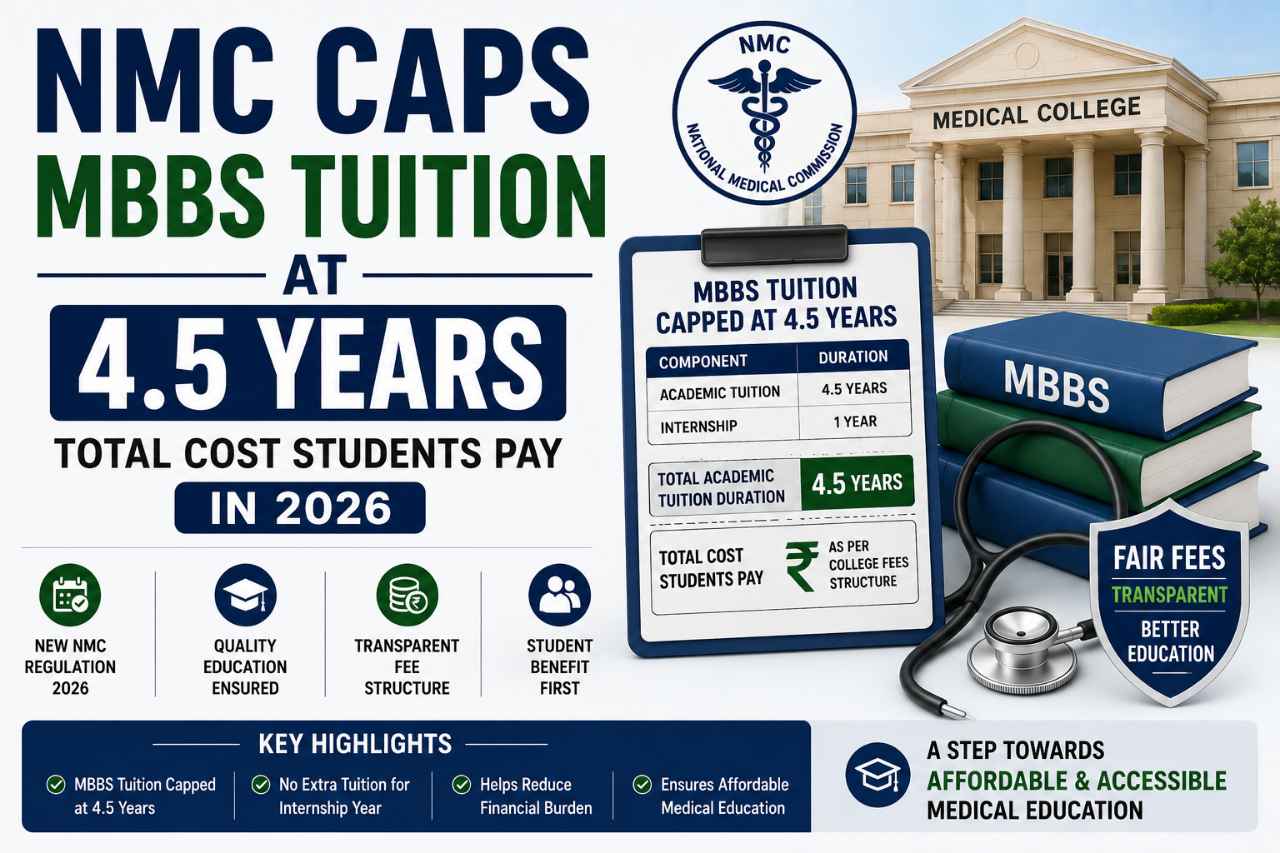

If you are planning to pursue medicine in India in 2026, the fee figure printed on a college brochure is rarely the amount you will actually spend. The National Medical Commission (NMC) has clarified that MBBS tuition can be charged only for 4.5 years, not for the full 5.5-year programme that includes the one-year Compulsory Rotating Medical Internship (CRMI). That single rule has changed how families budget for medical education but it has also created confusion, because hostel, mess, caution deposit, and university charges still apply across all 5.5 years.
For lakhs of NEET UG aspirants and their parents, understanding the gap between tuition fees and total course cost is no longer optional. A Government medical college seat may cost under Rs 2 lakh in tuition over 4.5 years, yet the all-in figure can touch Rs 10 lakh once living expenses are added. At the other end, a private or deemed university seat can cross Rs 1 crore even after the tuition cap. This guide breaks down every charge head, shows realistic 2026 cost ranges, and gives you a step-by-step method to calculate what you will truly pay before accepting any allotment.
What the NMC Tuition Cap Means for MBBS in 2026
On 7 April 2026, the NMC issued a public notice confirming that medical colleges across India Government, private, and deemed—must stop charging tuition during the internship year. The MBBS programme is structured as 4.5 years of academic and clinical training followed by 1 year of CRMI, during which interns work in hospital departments under supervision.
Previously, some institutions continued billing tuition for all 5.5 years. The 2026 order ends that practice. Tuition now covers classroom instruction, laboratory work, and clinical postings during the academic phase only. Internship is treated as a service-learning period, and charging academic fees for it is not permitted under NMC regulations.
Who Does the Rule Apply To?
The cap applies uniformly to:
- Central and state Government medical colleges
- Private medical colleges under state fee-fixation committees
- Deemed universities with MBBS programmes
- All institutions listed on the NMC website with recognised MBBS intake
Students who secured seats through NEET UG counselling—whether via the All India Quota, state quota, or management quota—are covered. If a college still lists a fifth-year tuition line item in its 2026 fee structure, you should flag it immediately and cross-check with the official NMC notice.
Why Tuition Fees Never Equal Total MBBS Cost
Tuition is the most visible number on any fee receipt, but it represents only one slice of the financial picture. Think of tuition as payment for teaching. Everything else—where you live, what you eat, what you read, and what the university administers—is billed separately and often for the full 5.5 years, including the internship year when tuition drops to zero.
This is the core reason two students at colleges with identical tuition can end up paying very different totals. One may live at home and skip hostel; another may pay Rs 3 lakh per year for a private hostel and mess in a metro city. Both see the same tuition line on paper. Their real expenses diverge sharply.
Academic Phase vs Internship Year: A Cost Split
| Cost Head | Years 1–4.5 (Academic) | Year 5–5.5 (CRMI Internship) |
|---|---|---|
| Tuition fee | Charged as per NMC/state norms | Rs 0 (not permitted) |
| Hostel rent | Charged annually | Usually charged |
| Mess/food charges | Charged annually | Usually charged |
| Books and equipment | High in early years | Moderate |
| Exam/university fees | Per semester or year | May apply for final exams |
| Personal and transport | Variable | Variable |
During CRMI, interns often work long hospital shifts. They still need accommodation near the campus or hospital. Mess charges continue because the college or hostel still provides food services. Caution deposits paid at admission remain locked until course completion. None of these costs disappear just because tuition does.
MBBS Tuition Fee Ranges in India for 2026
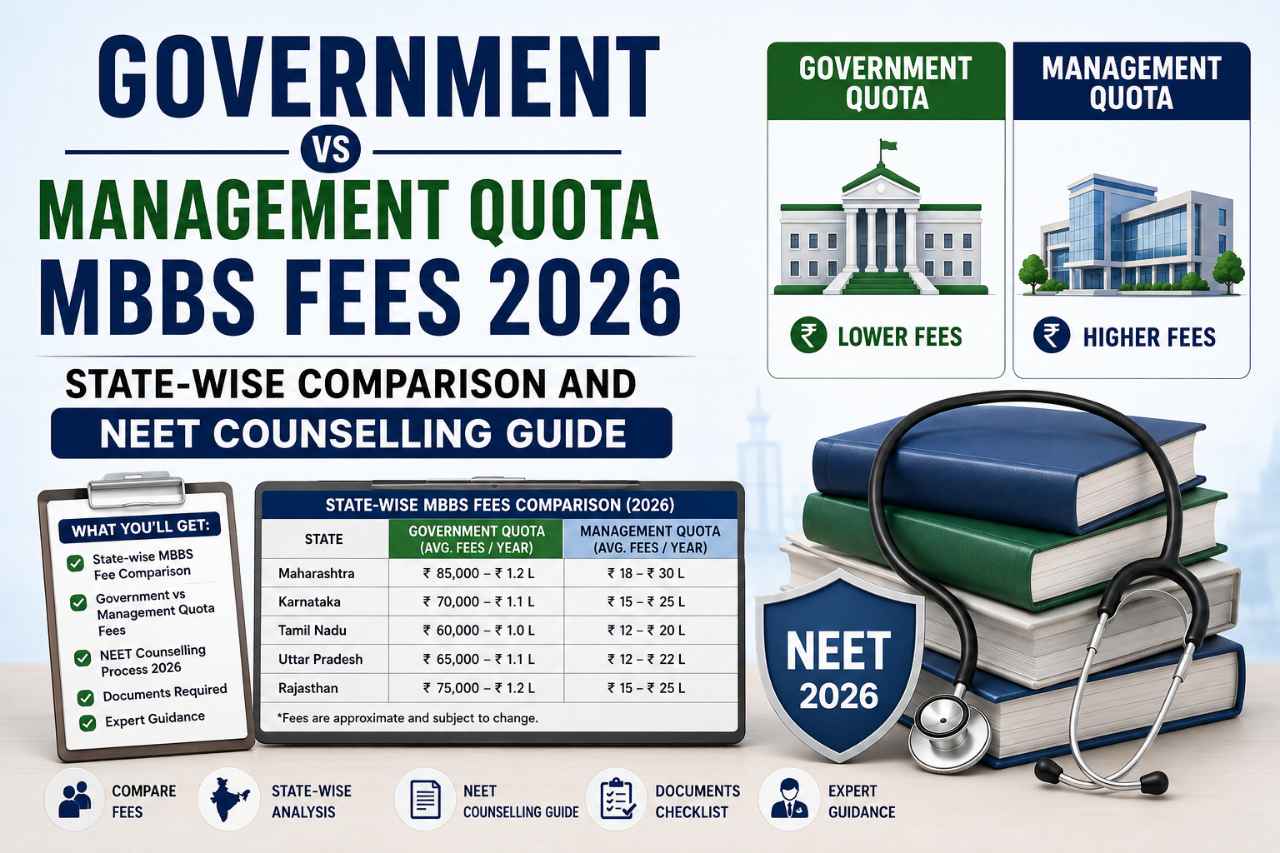
Tuition varies enormously by college category and admission quota. Below are widely reported annual tuition ranges for the 2026 admission cycle. Always verify the exact figure from your allotment letter and the state fee-fixation committee order, as these numbers can differ by institution.
| College Category | Annual Tuition (2026) | Tuition Duration | 4.5-Year Tuition Total (Approx.) |
|---|---|---|---|
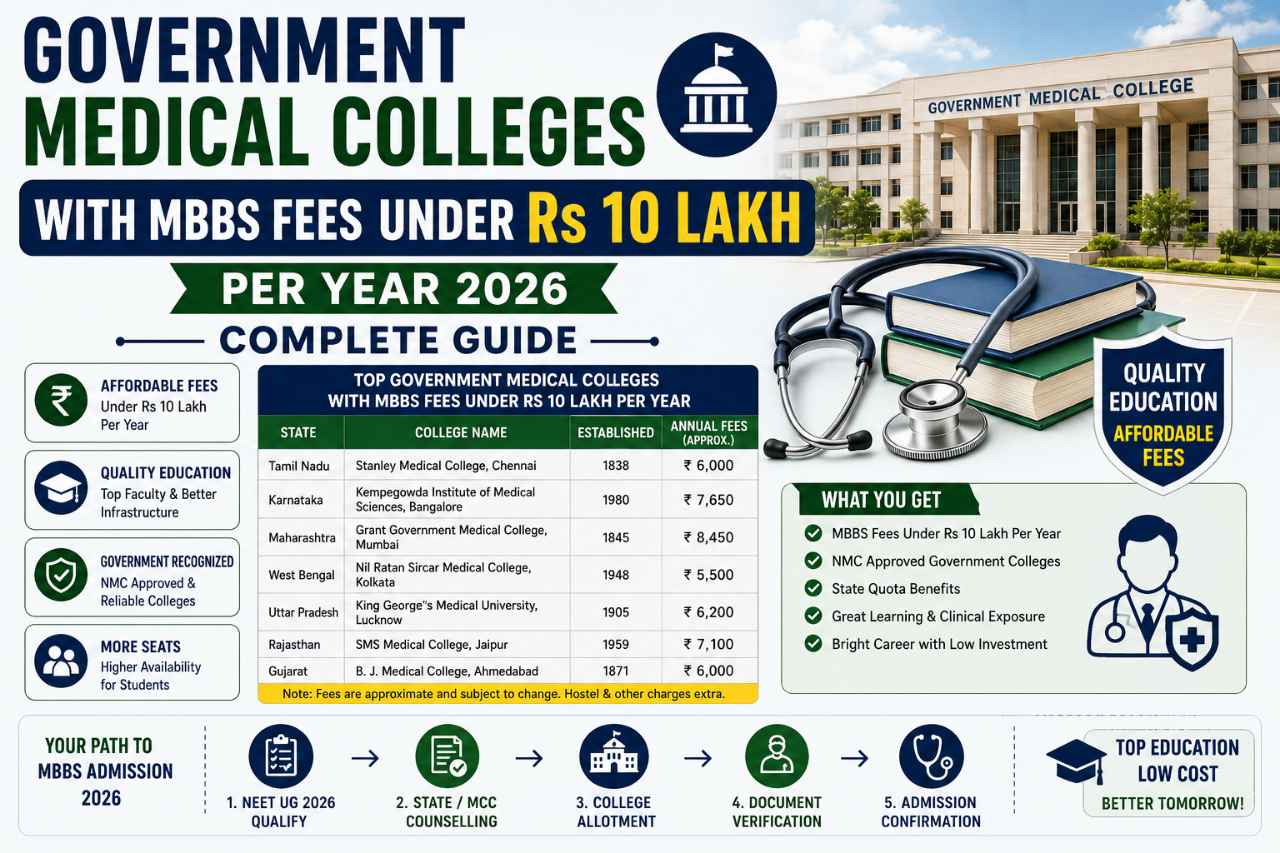
| Government medical colleges | Rs 1,360 – Rs 15,000 | 4.5 years | Rs 6,000 – Rs 67,500 |
| Private colleges (state/government quota seats) | Rs 7 lakh – Rs 12 lakh | 4.5 years | Rs 31.5 lakh – Rs 54 lakh |
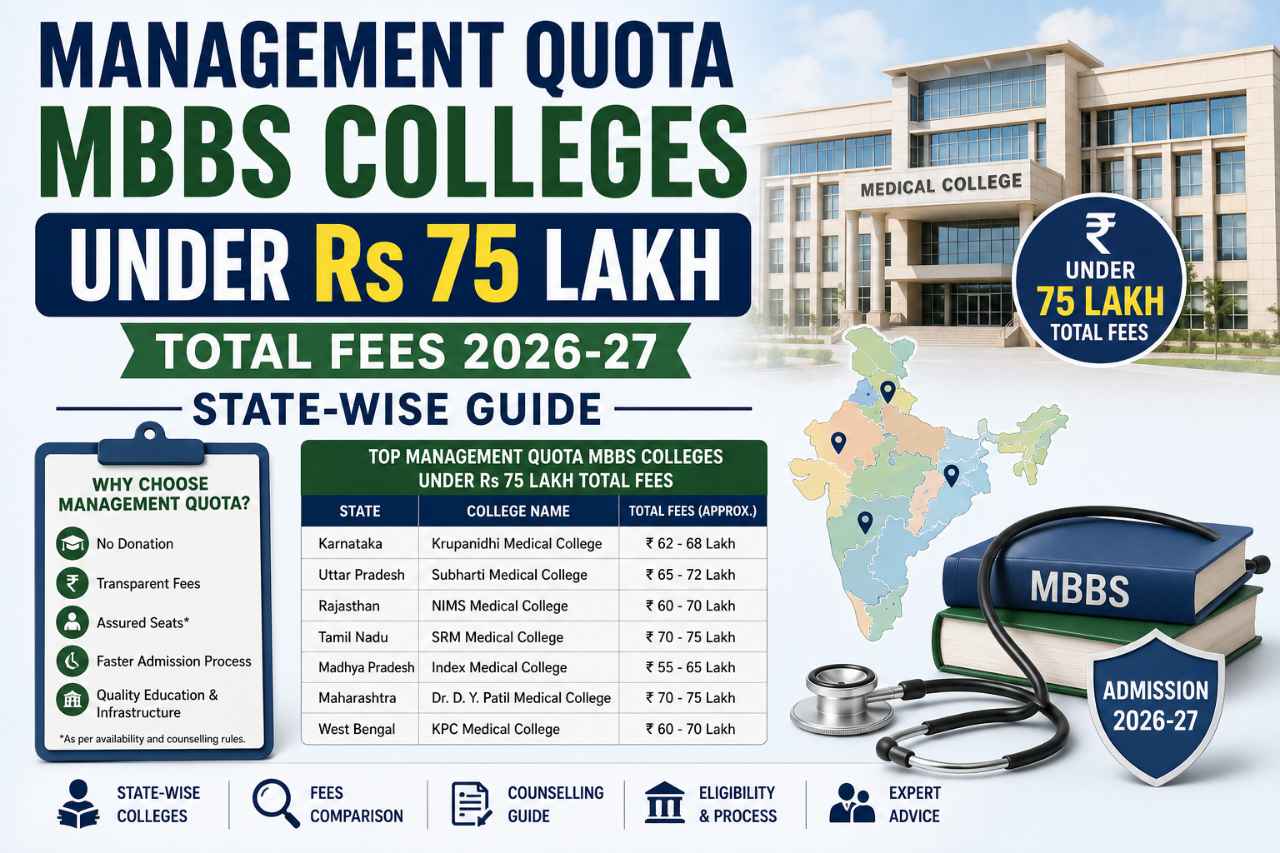
| Private colleges (management quota) | Rs 15 lakh – Rs 28 lakh | 4.5 years | Rs 67.5 lakh – Rs 1.26 crore |
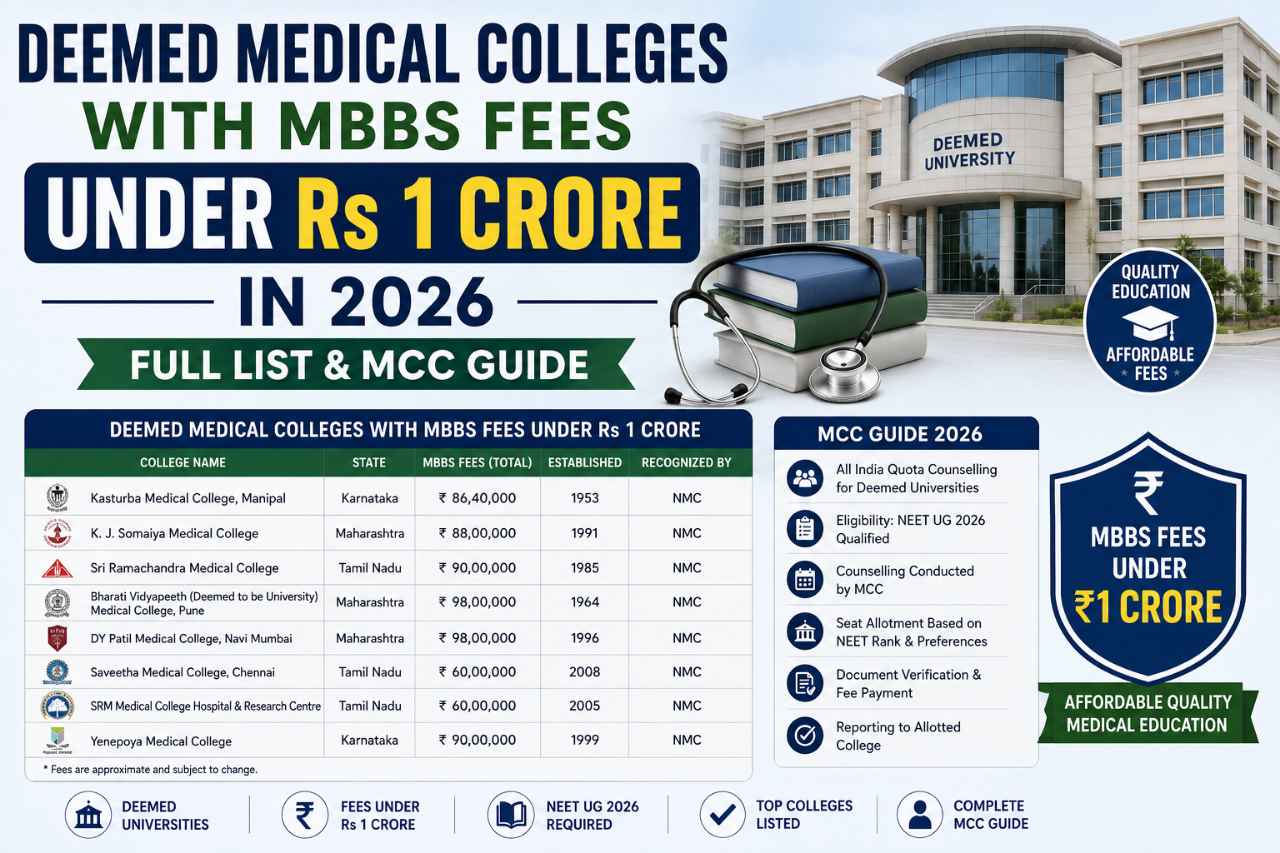
| Deemed universities | Up to Rs 30 lakh | 4.5 years | Up to Rs 1.35 crore |
The 50% Government-Rate Seat Rule in Private Colleges
One of the most important and underused provisions in the 2026 framework is the NMC mandate that half of all seats in private medical colleges and deemed universities must charge Government-college-level tuition. This benefit is allocated first to candidates admitted through the Government or state quota on merit through NEET counselling.
What this means in practice: a student who qualifies for a government-rate seat in a private college may pay Rs 10,000–Rs 15,000 per year in tuition instead of Rs 20 lakh. The savings on tuition alone can exceed Rs 80 lakh over 4.5 years. However, hostel, mess, and other charges at that private campus will still reflect private-college pricing—not government hostel rates. Always calculate the full 5.5-year bill, not just the discounted tuition line.
Example: AIIMS Delhi vs a Private Deemed University
Institutions like the All India Institute of Medical Sciences Delhi (AIIMS Delhi) represent the lowest end of the tuition spectrum. AIIMS charges nominal fees—often a few thousand rupees per year—making it among the most affordable MBBS programmes in India. Total cost at AIIMS remains low even after adding hostel and personal expenses, typically staying well under Rs 5 lakh for the entire course.
Compare that with a deemed university charging Rs 25 lakh annual tuition. Even with zero tuition during internship, 4.5 years of tuition alone totals Rs 1.125 crore before a single hostel bill is added. The gap between premier government institutes and high-fee private campuses is not incremental—it is transformational for middle-class families.
Extra Charges Beyond Tuition That Inflate Your Bill
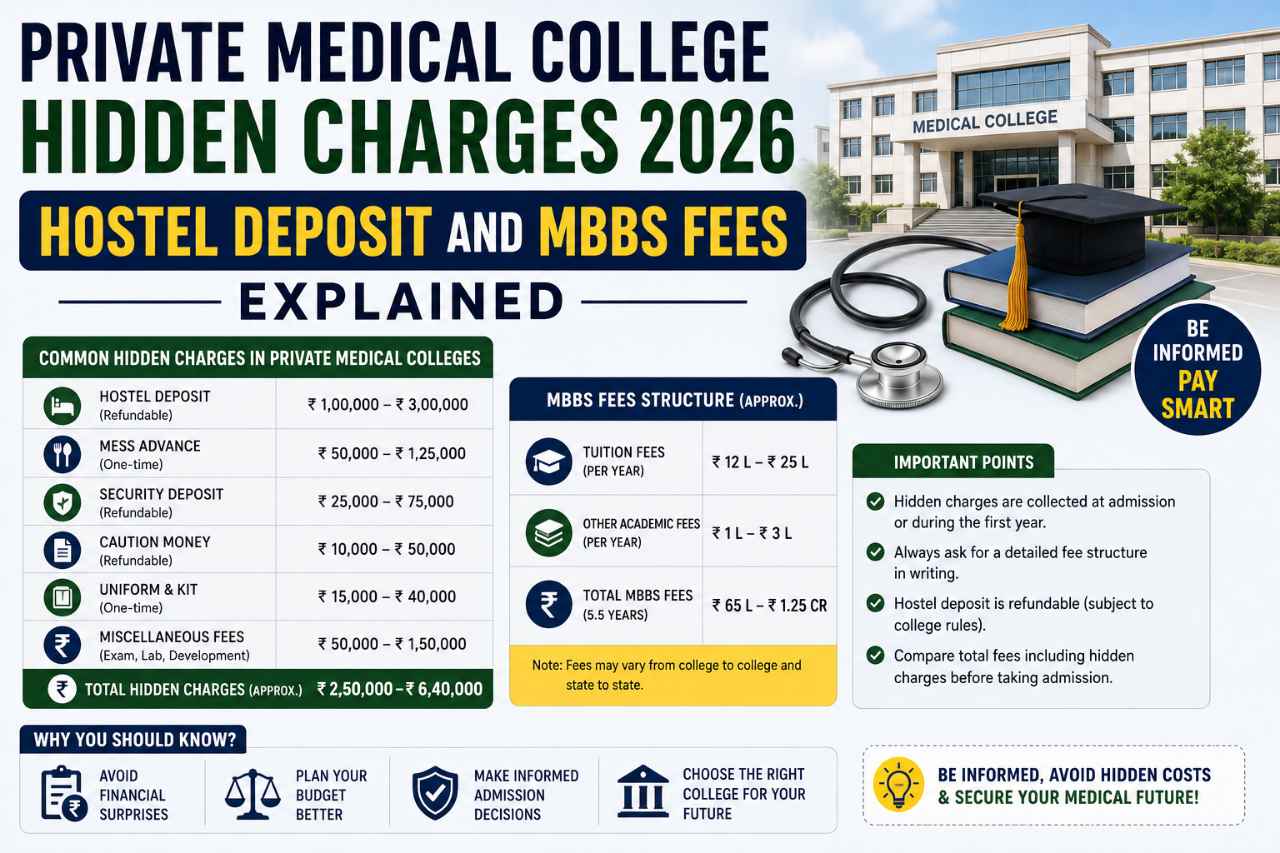
These charges sit outside the tuition head and are billed separately. Most apply for all 5.5 years. Some are one-time; others recur every year. Treat them as non-negotiable planning items, not optional extras.
| Charge Head | Typical Range (Per Year or One-Time) | When Charged | Refundable? |
|---|---|---|---|
| Hostel fee | Rs 70,000 – Rs 3 lakh/year | All 5.5 years | No |
| Mess and food | Rs 50,000 – Rs 1 lakh/year | All 5.5 years | No |
| Caution/security deposit | Rs 25,000 – Rs 3 lakh | One-time at admission | Usually yes, after course |
| University one-time fees | Rs 1 lakh – Rs 2 lakh | One-time | No |
| Books, dissection kit, white coat | Rs 50,000 – Rs 1 lakh/year | Recurring | No |
| Exam and university charges | Variable | Per exam or academic year | No |
| Transport and personal expenses | Rs 30,000 – Rs 1.5 lakh/year | Recurring | No |
Hostel and Mess: The Biggest Hidden Cost
Hostel and mess together often exceed tuition at government colleges and can add Rs 25 lakh–Rs 40 lakh over 5.5 years at premium private campuses. State-wise variation is significant:
- Karnataka private colleges: Hostel typically Rs 70,000–Rs 1.5 lakh per year; mess Rs 50,000–Rs 80,000
- Maharashtra private colleges: Hostel Rs 1.5 lakh–Rs 3 lakh per year in metro cities like Mumbai and Pune
- Tamil Nadu: Colleges affiliated with universities such as ACT Anna University Chennai region institutions vary widely; Chennai-based private hostels tend toward the higher band
- Government college hostels: Often Rs 5,000–Rs 30,000 per year—far cheaper but limited seats with high demand
Many families overlook mess charges because they appear small on a monthly basis. At Rs 8,000–Rs 12,000 per month, mess alone can total Rs 5 lakh–Rs 8 lakh over 5.5 years. Always ask whether mess is compulsory, whether outside food is permitted, and whether hostel allocation is guaranteed for all five years.
One-Time Charges That Surprise Families at Admission
Admission day brings a stack of receipts. Beyond tuition, expect:
- Caution deposit: Refundable in theory, but refund timelines vary from 6 months to 2 years after course completion
- University registration and enrolment: Rs 50,000–Rs 2 lakh depending on state university rules
- Identity cards, lab coats, stethoscope, dissection instruments: Rs 15,000–Rs 40,000 in the first year alone
- Medical insurance or health check-up: Rs 5,000–Rs 15,000, sometimes mandatory
Request a written fee schedule on college letterhead before paying. Verbal assurances from admission desks are not binding.
Total MBBS Course Cost Estimates for 2026
When tuition, hostel, mess, deposits, books, exams, and reasonable personal expenses are combined, the realistic 5.5-year totals look like this:
| College Type | Total 5.5-Year Cost (All Inclusive) | Key Cost Driver |
|---|---|---|
| Government medical colleges | Rs 1.5 lakh – Rs 10 lakh | Low tuition; hostel waitlists |
| Private colleges (state/government quota) | Rs 40 lakh – Rs 60 lakh | Moderate tuition + private hostel |
| Private colleges (management quota) | Rs 80 lakh – Rs 1.3 crore | High tuition + metro living costs |
| Deemed universities | Rs 1 crore – Rs 1.5 crore | Maximum tuition and campus fees |
Two students in the same country, both NEET qualifiers, can therefore face a cost difference of more than Rs 1.4 crore depending on seat type and college category. This is why rank alone does not determine affordability—quota, state counselling rules, and hostel availability matter equally.
NEET Rank, Quota, and Fee: How They Connect
Your NEET UG rank opens doors, but the fee you pay depends on which door you walk through:
- All India Quota (AIQ) government seat: Lowest total cost; intense competition
- State quota government seat: Requires domicile; fees set by state fee committee
- Private college government-quota seat (50% rule): Government tuition in a private campus; hostel at private rates
- Management/NRI quota: Highest tuition; fewer counselling protections
Students who miss a government seat by a narrow margin should seriously evaluate whether a government-rate private seat—with its tuition discount—offers better value than a management quota at the same institution.
How to Calculate Your Actual MBBS Cost Before Accepting a Seat
Never rely on a single tuition figure from a website or brochure. Use this four-step framework to build your personal cost estimate for 2026 admissions.
- Multiply annual tuition by 4.5—not 5.5. Confirm the college is not charging internship-year tuition.
- Multiply annual hostel + mess by 5.5—these continue through CRMI.
- Add all one-time charges: caution deposit, university fees, admission processing, equipment.
- Add recurring non-college costs: books, exam fees, transport, phone, clothing, and emergency medical expenses—budget Rs 50,000–Rs 1 lakh per year.
Sample Calculation: Private College Management Quota
Assume annual tuition of Rs 20 lakh, hostel Rs 1.5 lakh, mess Rs 80,000, one-time charges Rs 2.5 lakh, and personal expenses Rs 75,000 per year:
- Tuition: Rs 20 lakh × 4.5 = Rs 90 lakh
- Hostel: Rs 1.5 lakh × 5.5 = Rs 8.25 lakh
- Mess: Rs 80,000 × 5.5 = Rs 4.4 lakh
- One-time charges = Rs 2.5 lakh
- Personal/expenses: Rs 75,000 × 5.5 = Rs 4.125 lakh
- Estimated total: Rs 1.09 crore
Sample Calculation: Government Medical College
Assume annual tuition of Rs 12,000, hostel Rs 15,000, mess Rs 30,000, one-time Rs 20,000, personal Rs 40,000 per year:
- Tuition: Rs 12,000 × 4.5 = Rs 54,000
- Hostel: Rs 15,000 × 5.5 = Rs 82,500
- Mess: Rs 30,000 × 5.5 = Rs 1.65 lakh
- One-time = Rs 20,000
- Personal: Rs 40,000 × 5.5 = Rs 2.2 lakh
- Estimated total: Rs 4.8 lakh
Actionable Tips for NEET UG Aspirants and Parents in 2026
Smart financial planning starts before counselling, not after seat allotment. Here is a practical checklist aligned with NMC rules and state counselling timelines.
Before Counselling
- Download and read the NMC April 2026 public notice on tuition and internship-year fees from the official NMC website
- Shortlist colleges by total 5.5-year cost, not tuition alone
- Check whether you qualify for government-rate seats in private colleges based on your category and state merit list
- Discuss education loan eligibility with banks—most lenders consider total programme cost, not just tuition
During Seat Allotment
- Request a complete fee breakup on institution letterhead before fee payment
- Confirm which charges are refundable (caution deposit) and expected refund timeline
- Ask whether hostel is guaranteed for all 5.5 years or subject to availability after year 2 or 3
- Verify that the fee receipt shows tuition for 4.5 years only, with no internship-year tuition line
After Admission
- Keep every fee receipt and NMC/state fee committee order for dispute resolution
- Report colleges charging internship-year tuition to the NMC grievance portal and state fee fixation committee
- Track state fee-fixation committee orders for 2026–27, as some states revise hostel caps separately from tuition
- Budget for NEET PG preparation costs in the final year—many interns begin coaching during CRMI
What to Watch in 2026–27 MBBS Admissions
The tuition cap is a significant student-friendly reform, but enforcement and clarity are still evolving. Keep an eye on these developments:
- State fee-fixation committee orders: States like Karnataka, Maharashtra, Tamil Nadu, and Uttar Pradesh release separate orders for private college fee caps—tuition and hostel may be regulated independently
- NMC enforcement actions: Colleges found charging internship-year tuition may face penalties; students should document and report violations
- Supreme Court and High Court petitions: Fee-related litigation occasionally pauses or revises fee structures mid-session—stay updated through official counselling portals
- Education loan policy changes: Banks may adjust loan-to-cost ratios for medical courses exceeding Rs 50 lakh total cost
Conclusion
The NMC's 2026 decision to cap MBBS tuition at 4.5 years is a meaningful step toward fee transparency, especially for the internship year when students work as hospital trainees rather than classroom learners. Yet tuition remains just one line in a much longer financial statement. Hostel, mess, caution deposits, university charges, books, and personal expenses continue for the full 5.5 years and in private and deemed institutions, these add-ons can exceed tuition itself.
For 2026 NEET UG candidates, the smartest approach is to calculate the total 5.5-year cost before accepting any seat, leverage the 50% government-rate seat rule in private colleges where eligible, and demand written fee breakups from every shortlisted institution. Whether your goal is a low-fee government seat or a private college with a merit-based tuition discount, informed budgeting protects you from surprises that no brochure headline will warn you about.
Compare institutions carefully—from premier centres like AIIMS Delhi to state and private options across regions including Tamil Nadu and beyond. The degree is the same; the financial path to it is not. Plan accordingly, verify every charge in writing, and treat the NMC notice as your reference point when any college fee structure looks inconsistent with the law.