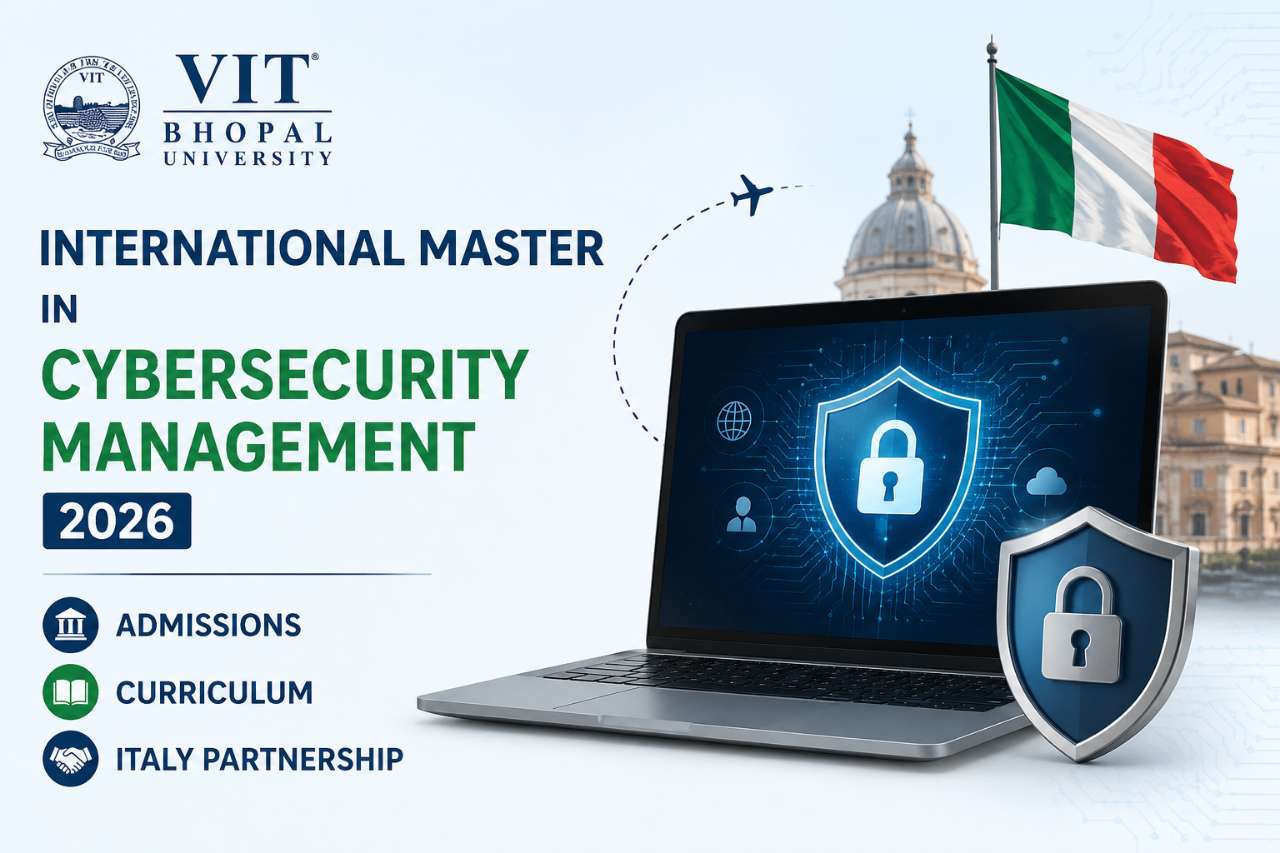
VIT Bhopal University has announced admissions for its first-ever International Master's in Cybersecurity Management, developed jointly with Politecnico di Milano (POLIMI) Graduate School of Management (GSoM) in Milan, Italy. For Indian students who want a postgraduate qualification that blends deep technical security training with business leadership skills, this 12-month programme offers a structured pathway that spans two countries in a single academic year.
Applications for the September 2026 intake are currently open and will close on August 31, 2026. The course follows a distinctive 6+6 India-Italy model: students spend the first six months at the VIT Bhopal campus in Madhya Pradesh and the next six months at POLIMI GSoM in Milan. On successful completion, graduates receive credentials from both institutions, including a specialisation master's degree from one of Europe's leading technical universities.
This guide explains everything Indian applicants need to know eligibility, curriculum, career outcomes, the Bhopal higher-education context, and a step-by-step application process in clear, actionable language aligned with what students and parents typically search for during admission season.
What Is the VIT Bhopal–POLIMI GSoM Cybersecurity Master's Programme?
The International Master's in Cybersecurity Management is a full-time, English-medium postgraduate programme designed for graduates who already have a foundation in technology and want to move into leadership-oriented roles in information security. Unlike a purely technical master's that focuses only on coding, networks, or ethical hacking, this programme deliberately combines cybersecurity expertise with management and strategic decision-making.
VIT Bhopal University brings its strength in technology education, industry-linked learning, and campus infrastructure in central India. POLIMI GSoM, based in Milan, contributes international academic standards, European business perspectives, and access to a global professional network. Together, the partnership reflects a growing trend in Indian higher education: collaborative degrees that give students cross-border exposure without committing to a full two-year study-abroad programme from day one.
For students comparing options across India, programmes at institutions such as the International Institute of Information Technology Bangalore, International Institute of Information Technology Hyderabad, and Dr Shyama Prasad Mukherjee International Institute of Information Technology Naya Raipur also emphasise technology and research. However, the VIT Bhopal–Italy model stands out because it integrates a formal management school curriculum with hands-on cybersecurity modules and a mandatory international residency phase.
Key Highlights at a Glance
- Duration: 12 months (one academic year)
- Delivery model: 6 months at VIT Bhopal + 6 months at POLIMI GSoM, Milan
- Medium of instruction: English
- Application deadline: August 31, 2026
- Intake: September 2026
- Focus areas: Cybersecurity, risk management, governance, digital forensics, and business strategy
- Final component: Internship or company project
- Credentials: Joint diplomas plus a Politecnico di Milano specialising master's degree
Why Cybersecurity Management Matters for Indian Graduates in 2026
Cybersecurity is no longer a back-office IT function reserved for large enterprises. From banking and e-commerce to healthcare, education, and government services, organisations across India are digitising rapidly and every digital touchpoint creates potential risk. Data breaches, ransomware attacks, phishing campaigns, and compliance failures can damage customer trust, invite regulatory penalties, and disrupt operations within hours.
According to VIT Bhopal faculty associated with the programme, cybersecurity has become one of the most critical priorities for organisations worldwide. That shift has changed hiring patterns. Companies no longer want only technicians who can configure firewalls; they need professionals who can translate technical threats into business decisions, communicate with boards and regulators, and design organisation-wide security strategies.
This is where a management-oriented cybersecurity master's adds value. Graduates who understand both attack surfaces and business continuity planning are well placed for roles that sit at the intersection of technology and leadership a space traditionally served by MBA graduates with limited security depth or engineers with limited management exposure.
Career Roles This Programme Prepares You For
VIT Bhopal has indicated that the programme is designed to prepare graduates for positions including:
- Security Operations Centre (SOC) Manager overseeing monitoring teams, incident response workflows, and escalation protocols
- Security Architect designing secure systems, cloud environments, and enterprise networks
- ICT Security Specialist implementing and auditing security controls across information systems
- Cybersecurity Manager leading security programmes, budgets, vendor relationships, and compliance initiatives
Students exploring broader management pathways may also compare this programme with offerings at the International Management Institute IMI Delhi, Fore School of Management Delhi, or New Delhi Institute of Management. Those programmes excel in general management. The VIT Bhopal–POLIMI route, by contrast, is built specifically for the cybersecurity and digital risk domain.
Programme Structure: The 6+6 India-Italy Model Explained
The most distinctive feature of this master's is its geographic split. Rather than asking students to relocate abroad for the entire programme, VIT Bhopal and POLIMI GSoM have structured a phased learning journey that balances domestic foundation-building with international immersion.
Phase 1 First Six Months at VIT Bhopal (India)
During the initial semester-equivalent period in Bhopal, students focus on building a strong technical foundation in cybersecurity. This phase is designed to ensure that all participants even those from varied undergraduate backgrounds develop core competencies before moving into strategy-heavy modules in Italy.
Expected focus areas in the India phase typically include:
- Fundamentals of cybersecurity architecture and operations
- Threat analysis and vulnerability assessment techniques
- Digital forensics and incident investigation basics
- Penetration testing and software security evaluation
- Introduction to governance, compliance, and risk frameworks
Studying in Bhopal also places students in a city that has grown into an important education hub in Madhya Pradesh. Nearby institutions such as Maulana Azad National Institute of Technology Bhopal, National Law Institute University Bhopal, and Indian Institute of Forest Management Bhopal contribute to a vibrant academic ecosystem. While these colleges serve different disciplines, their presence reflects Bhopal's expanding reputation as a destination for specialised higher education beyond traditional metro cities.
Phase 2 Next Six Months at POLIMI GSoM, Milan (Italy)
The second half of the programme shifts to Milan, where the emphasis moves from foundational technical training to connecting technology with strategic business and management skills. Students engage with international faculty, global case studies, and European perspectives on digital innovation, regulatory environments, and enterprise leadership.
This phase is particularly valuable for Indian students who aspire to work with multinational corporations, global consulting firms, or security vendors serving international clients. Exposure to European business culture, cross-border compliance standards such as GDPR-influenced practices, and Milan's position as a European business hub can strengthen both employability and professional confidence.
International experience of this kind is increasingly viewed favourably by recruiters. Even students who eventually return to India benefit from understanding how global enterprises structure security governance, vendor management, and board-level reporting.
Final Internship or Company Project
The programme culminates in a final internship or company project, allowing students to apply classroom learning to real-world business challenges. This capstone component is critical for three reasons:
- It converts theoretical knowledge into demonstrable work experience
- It helps students build a professional network in the industry
- It provides concrete talking points during job interviews
For employers, a candidate who has completed a live security or risk-management project for an organisation especially in an international setting often stands out compared to someone with coursework alone.
Curriculum and Learning Outcomes
The International Master's in Cybersecurity Management covers a wide spectrum of topics that reflect both technical depth and managerial breadth. Based on information released by VIT Bhopal, the curriculum includes the following core areas:
- Cybersecurity fundamentals and advanced practices
- Cyber risk management identifying, measuring, and mitigating organisational risk
- Governance and compliance aligning security programmes with laws, policies, and industry standards
- Digital innovation understanding how emerging technologies create new security challenges
- Cyber threat analysis studying attack patterns, intelligence gathering, and proactive defence
- Digital forensics investigating breaches and preserving evidence
- Penetration testing ethically simulating attacks to uncover weaknesses
- Software vulnerability testing assessing application-level security flaws
- Business continuity and strategic decision-making ensuring organisations can survive and recover from incidents
What You Will Learn to Do by the End of the Programme
By graduation, students should be able to:
- Design and evaluate security architectures for complex IT environments
- Lead incident response and coordinate cross-functional teams during breaches
- Conduct risk assessments that align with business objectives
- Communicate security priorities to non-technical stakeholders and senior leadership
- Apply forensic and testing methodologies to identify and remediate vulnerabilities
- Navigate international compliance and governance expectations in digital operations
Students with an undergraduate background in Computer applications or related technology streams will find many modules build directly on prior knowledge. However, the programme is intentionally designed to elevate that technical base into leadership capability a transition that short-term certification courses rarely achieve on their own.
Eligibility Criteria for Indian Applicants
Understanding eligibility early saves time and helps applicants prepare documents well before the August 31 deadline. VIT Bhopal has specified that the programme is open to graduates as well as final-year students from the following and related disciplines:
- Engineering (all relevant branches)
- Computer Science
- Information Technology
- BCA (Bachelor of Computer Applications)
- BSc in Computer Science or Information Technology
- Other closely related technology or computing disciplines
Can Final-Year Students Apply?
Yes. Final-year undergraduate students may apply, subject to successful completion of their degree requirements before the programme's formal commencement or as specified in the official admission guidelines. If you are in your last semester, start gathering transcripts, bonafide certificates, and provisional marksheets early to avoid last-minute delays.
Language and Academic Requirements
The entire programme is delivered in English. Applicants should be comfortable with academic reading, technical documentation, presentations, and professional communication in English. There is no substitute for checking the official portal for any updated requirements regarding minimum marks, entrance evaluation, or proof of English proficiency.
Who Should Consider This Programme?
This master's is a strong fit if you:
- Have a technology undergraduate degree and want to specialise in cybersecurity
- Aim for managerial or leadership roles rather than purely technical positions
- Want structured international exposure within a one-year format
- Are interested in working with MNCs, consulting firms, fintech, or regulated industries
- Prefer a blended India-abroad experience over a full two-year overseas master's
It may be less suitable if you are seeking a low-cost local diploma, a purely research-oriented PhD pathway, or a general MBA without technical security depth. In those cases, alternatives such as management programmes at the Asia Pacific Institute of Management or technology degrees at institutions like Sine International Institute of Technology Jaipur may align better with your goals though each serves a different career trajectory.
Admission Process and Important Dates
The admission process for the September 2026 intake follows a straightforward sequence designed to evaluate both academic readiness and documentation accuracy.
Important Dates
- Applications open: August 2026 (currently open)
- Application deadline: August 31, 2026
- Expected intake commencement: September 2026
Given the tight window, prospective applicants should treat document preparation and form submission as an immediate priority rather than a last-week task.
Steps in the Admission Process
According to VIT Bhopal, the process includes:
- Online application submission through the official VIT Bhopal admissions portal
- Document verification academic records, identity proof, and supporting certificates
- Academic evaluation assessment of undergraduate performance and programme fit
Unlike large national entrance exams such as GATE or CAT, this programme's admission appears to be handled through the university's own application and evaluation framework. Still, applicants should monitor the official website for any updates regarding interviews, statement-of-purpose requirements, or additional screening steps.
Documents Commonly Required for Postgraduate Applications
While you should always refer to the live application portal for the definitive checklist, most postgraduate programmes of this nature require:
- 10th and 12th mark sheets or certificates
- Undergraduate degree certificate or provisional certificate (for final-year students)
- Complete semester-wise transcripts
- Government-issued photo identity (Aadhaar, passport, etc.)
- Recent passport-size photographs
- Updated CV or resume highlighting projects, internships, and technical skills
- Passport (especially relevant before the Italy phase for visa processing)
Students already familiar with open and distance-learning pathways through institutions such as Indira Gandhi National Open University or Madhya Pradesh Bhoj Open University Bhopal should note that eligibility for this programme depends on the recognising university's evaluation of your specific degree. Always confirm equivalency before applying.
Degree and Credentials on Completion
One of the strongest value propositions of this programme is the credential stack awarded on successful completion. Graduates receive:
- A Master's Diploma from POLIMI GSoM
- A Master's Diploma from VIT Bhopal University
- A 1st Level University Specialising Master's Degree from Politecnico di Milano, recognising specialised training in cybersecurity management
Holding a specialising master's degree from Politecnico di Milano one of Italy's most respected technical universities can enhance credibility when applying to global employers or further international opportunities. For Indian students, presenting both an Indian university credential and a European university qualification offers flexibility: domestic recruiters recognise the VIT brand, while international firms may weigh the POLIMI credential heavily.
How This Compares to Other International Programmes in India
India has seen a rise in twinning, dual-degree, and collaborative programmes across disciplines. Universities such as Symbiosis International Deemed University Pune and Noida International University have long promoted global partnerships across multiple fields. The VIT Bhopal–POLIMI GSoM cybersecurity master's is part of this broader movement, but with a sharper focus on a high-demand technical-management niche.
When evaluating any collaborative degree, ask four questions:
- Are both partner institutions well regarded in their respective domains?
- Is the international phase mandatory and structured, not optional or loosely affiliated?
- Does the curriculum include practical industry exposure?
- Are the credentials clearly defined and independently verifiable?
Based on publicly available information, the VIT Bhopal programme appears to satisfy these criteria through its formal POLIMI GSoM partnership, defined 6+6 structure, and specified degree outcomes.
Studying in Bhopal: Campus Life and the Local Education Ecosystem
Choosing Bhopal as the first leg of an international master's offers practical advantages. The city is centrally located, generally more affordable than metros like Mumbai or Bangalore, and increasingly connected through rail, road, and air networks. VIT Bhopal's campus environment provides access to laboratories, faculty mentorship, peer networks, and industry interaction during the critical foundation phase of the programme.
Bhopal also hosts a diverse range of national institutions that contribute to the city's academic character. Beyond the institutes already mentioned, campuses such as National Institute of Technical Teachers Training Research Bhopal and Makhanlal Chaturvedi National University of Journalism and Communication Bhopal serve specialised fields. While these are not direct alternatives to a cybersecurity master's, they illustrate Bhopal's role as a multi-disciplinary education centre in central India.
Preparing for the Transition to Milan
During the Bhopal phase, students should simultaneously prepare for the Italy leg. Practical preparation includes:
- Applying for or renewing your passport well in advance
- Researching student visa requirements for Italy
- Budgeting for living costs in Milan, which differ significantly from Bhopal
- Building basic conversational awareness of Italian culture and workplace norms
- Networking with alumni or current students through official university channels
Universities with structured international mobility often provide pre-departure briefings. Take full advantage of these sessions to avoid administrative surprises before your second semester abroad.
Fees, Funding, and Return on Investment
As of the announcement covered in August 2026, detailed fee structures should be verified directly on the official VIT Bhopal admissions page. Collaborative international programmes typically include tuition plus additional costs for travel, visa processing, health insurance, and living expenses during the Milan phase.
How to Think About ROI for a Cybersecurity Master's
When assessing whether this programme is worth the investment, consider both tangible and intangible returns:
- Salary potential: Cybersecurity leadership roles in India often command premium compensation relative to generic IT support positions, especially at MNCs and in banking, insurance, and consulting.
- Global mobility: International credentials and on-ground experience in Europe can open doors to overseas placements or remote roles with global firms.
- Skill durability: Security, risk, and compliance skills remain relevant across economic cycles because digital infrastructure continues to expand.
- Network value: Classmates, faculty, and industry project supervisors often become long-term professional contacts.
Compare this programme not only with other cybersecurity certifications such as those offered through training academies like the International Academy for Certification and Training Kota but also with full-time master's degrees at technology institutes. Certifications can be faster and cheaper, but they rarely deliver the combined depth of a university master's, international residency, and multi-institution credentialing.
Actionable Tips for a Strong Application
Competitive postgraduate programmes even those without a national entrance exam still reward prepared applicants. Use these practical tips to strengthen your candidacy before the August 31 deadline:
- Highlight relevant projects: Include academic projects, hackathons, internships, or freelance work related to security, networking, or software development in your CV.
- Demonstrate continuous learning: Mention online courses, Capture-the-Flag participation, or lab work in ethical hacking and security tools if applicable.
- Be precise in your application form: Mismatched names, incomplete transcripts, or unclear degree details are common reasons for processing delays.
- Prepare for possible interaction: Even if not explicitly announced, universities may conduct interviews or profile reviews for specialised programmes.
- Apply early: Submitting near the deadline leaves no room to correct document errors or respond to verification queries.
- Research both partner institutions: Understanding VIT Bhopal and POLIMI GSoM's strengths shows genuine motivation and helps you write a more convincing application narrative.
Conclusion: Is the VIT Bhopal–POLIMI GSoM Cybersecurity Master's Right for You?
The International Master's in Cybersecurity Management at VIT Bhopal University represents a timely response to a clear market need: trained professionals who can protect digital systems while also guiding business strategy. For Indian graduates with a technology background, the programme offers a rare combination deep security training, management education, and six months of international immersion compressed into a single year.
With applications closing on August 31, 2026, interested candidates should act immediately. Review eligibility, gather documents, submit the online application, and begin planning for both the Bhopal foundation phase and the Milan specialisation phase. If your career goal is to lead security teams, architect resilient systems, or bridge the gap between boardrooms and server rooms, this programme deserves serious consideration among India's emerging postgraduate options in cybersecurity management.
For the latest official updates on fees, seat intake, and any additional admission requirements, always refer to the VIT Bhopal University website and the POLIMI GSoM programme page before submitting your application.