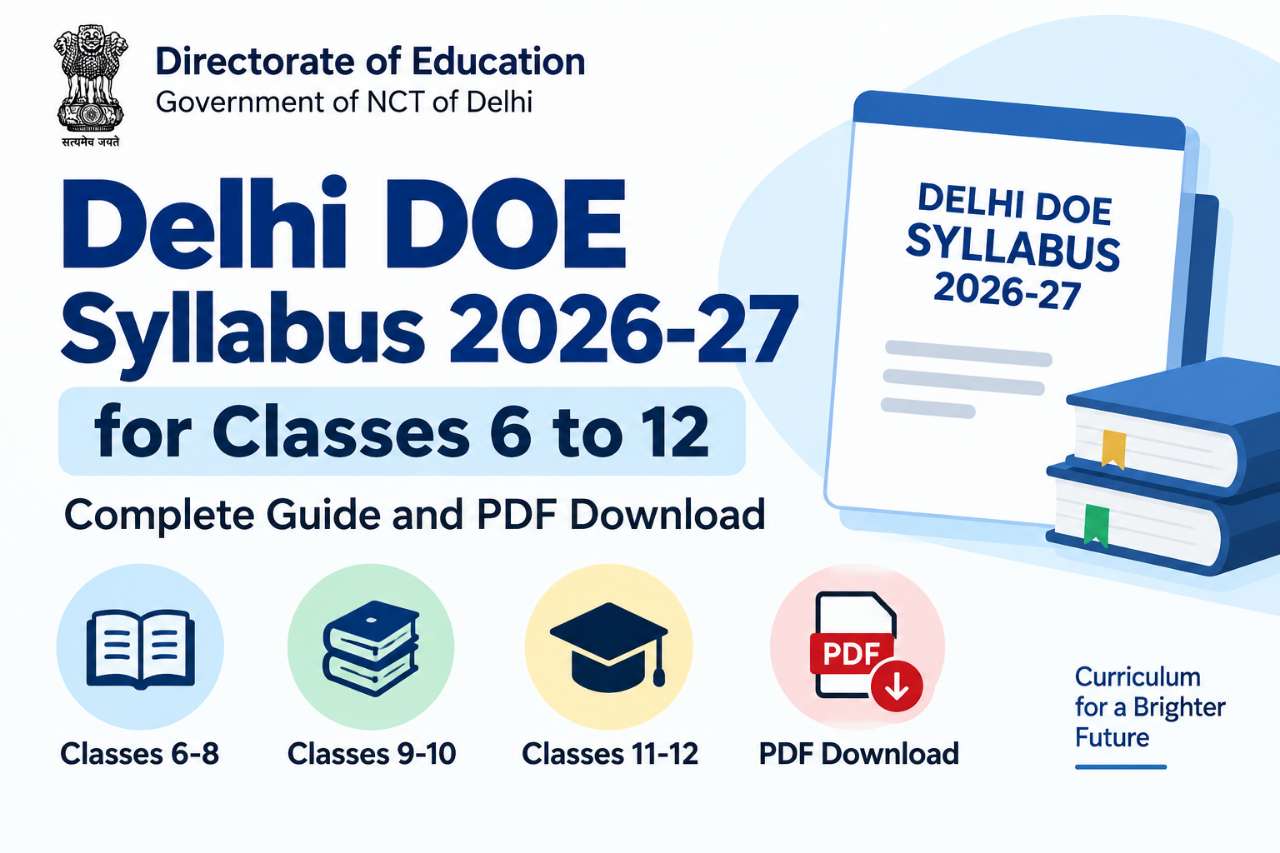
The Delhi DOE syllabus 2026-27 for Classes 6 to 12 is the official academic roadmap published by the Directorate of Education (DoE), Government of NCT of Delhi. Released on the Edudel portal at edustud.nic.in, these term-wise PDF documents tell students exactly which topics to study month by month across government schools in the capital. Whether your child is in Class 6 building foundational skills or in Class 12 preparing for board exams, downloading the correct class-wise syllabus is the first step toward structured preparation.
For Delhi families planning beyond school toward Delhi Uiversity colleges, engineering institutes like Indian institute of Technology Delhi (IIT Delhi), or medical pathways through AIIMS Delhi understanding the DoE syllabus early helps align daily study with long-term goals. This guide explains what the 2026-27 syllabus contains, how to download it, and how to use it effectively for exams and future admissions.
What Is the Delhi DOE Syllabus 2026-27?
The Directorate of Education (DoE) is the nodal body that governs Delhi government schools. Each academic year, it publishes a class-wise distribution of syllabus that breaks subjects into monthly and term-wise units. The 2026-27 edition follows the same framework used in 2025-26, ensuring continuity for teachers and students across all government schools in Delhi regardless of location or staffing levels.
Key Features of the Edudel Syllabus
- Term-wise division: Topics are spread across academic terms so teachers and students know what to cover each month.
- Subject-wise PDFs: Separate downloadable files for each subject, available in Hindi, English, and Urdu mediums where applicable.
- Uniform teaching standards: The DoE designed this system so every government school follows the same pace, enabling fair inspections and consistent learning outcomes.
- NCERT alignment: Middle and senior secondary syllabi largely follow NCERT textbooks, which also form the base for CBSE board exams in Classes 10 and 12.
- Vocational options: Classes 9 to 12 include vocational subject syllabi for students pursuing skill-based streams.
Unlike a generic CBSE syllabus document, the Delhi DoE syllabus is a operational calendar it tells you not just what to study, but when to study it. This makes it especially valuable for parents who want to track whether their child's school is keeping pace with official expectations.
Why the DoE Syllabus Matters for Delhi Students
Delhi hosts one of India's largest school ecosystems, with lakhs of students in government-run institutions. The syllabus serves multiple stakeholders:
For Students
Students gain clarity on examinable content, can plan revision calendars, and avoid studying out-of-syllabus material. Class 10 and Class 12 students, in particular, benefit because their DoE term tests and pre-board assessments mirror the final CBSE pattern. Strong performance in DoE assessments builds confidence before board exams.
For Parents
Parents can verify whether homework and classroom coverage match official expectations. If a topic listed for September appears in the December test without being taught, the syllabus document becomes evidence for constructive dialogue with school administration.
For Teachers
Teachers receive pre-planned monthly targets, reducing the burden of creating lesson plans from scratch. The online availability means substitute teachers can pick up exactly where the regular teacher left off.
Connection to Higher Education in Delhi
Disciplined syllabus-based preparation in Classes 9 through 12 directly influences admission prospects at top Delhi institutions. Science students aiming for Delhi Technological University (DTU) or Netaji Subhas University of Technology (NSUT) need strong Physics, Chemistry, and Mathematics foundations built through Classes 9 and 10. Commerce students targeting St Stephen's College or Ramjas College benefit from mastering Accountancy and Economics units listed in the Class 11 and 12 DoE documents. Humanities students eyeing Lady Shri Ram College for Women (LSR) or Miranda House should treat History, Political Science, and English syllabus units as building blocks for CUET and DU admissions.
Class-Wise Overview: Delhi DOE Syllabus 2026-27
The official portal hosts separate pages for each class. Below is a practical overview of what students at each level can expect.
Classes 6, 7, and 8 (Middle Stage)
At the middle stage, the DoE syllabus covers core subjects that build literacy, numeracy, and scientific thinking:
- Languages: Hindi, English, Urdu (where applicable), Punjabi, Sanskrit
- Mathematics: Number systems, algebra basics, geometry, data handling
- Science: Physics, Chemistry, and Biology concepts introduced through NCERT chapters
- Social Science: History, Geography, Civics, and Economics fundamentals
- Co-scholastic areas: Art Education, Physical Education and Wellbeing
Class 6 marks the transition from primary to middle school. The term-wise PDFs help students develop study routines an habit that pays off when they reach Class 9 and board-oriented preparation begins.
Classes 9 and 10 (Secondary Stage)
Class 9 introduces advanced tracks such as Mathematics (Advanced) and Science (Advanced) for students with strong aptitude. The Class 10 syllabus focuses on board-exam-ready content:
- English and Hindi (compulsory language papers)
- Mathematics or Mathematics Standard/Basic (as per CBSE policy)
- Science (Physics, Chemistry, Biology integrated)
- Social Science (History, Geography, Political Science, Economics)
- Optional languages: Sanskrit, Punjabi, Urdu
Class 10 is a milestone year. Students who master the DoE term-wise units for Science and Mathematics find the transition to Class 11 PCM or PCB streams smoother. Those planning engineering entrances later should treat Class 10 Mathematics and Science as non-negotiable priority subjects the same topics reappear in JEE and CUET Science domains.
Classes 11 and 12 (Senior Secondary Stage)
At the senior secondary level, the DoE syllabus branches into stream-specific subjects:
- Science stream: Physics, Chemistry, Biology, Mathematics, Computer Science, Informatics Practices
- Commerce stream: Accountancy, Business Studies, Economics, Mathematics (optional)
- Humanities stream: History, Geography, Political Science, Sociology, Psychology, Home Science
- Common subjects: English Core, Hindi Core/Elective, Physical Education
Class 12 syllabus PDFs cover high-weightage board topics. Medical aspirants should align Biology units with NEET syllabus overlaps, while engineering candidates can connect Physics and Mathematics chapters to JEE Main preparation. Delhi students often combine DoE school tests with coaching for competitive exams a strategy that works best when the school syllabus is followed systematically.
Term-Wise Structure: How the Syllabus Is Organised
One of the most distinctive features of the Delhi DoE syllabus is its month-wise and term-wise breakdown. Instead of receiving one bulk document listing all chapters, students get granular PDFs showing which NCERT units or textbook sections belong to each month.
Academic Terms in Delhi Government Schools
Delhi government schools typically follow a three-term or semester-style academic calendar aligned with the DoE syllabus distribution:
- Term 1 (April to September): Covers initial units across all subjects; internal assessments and periodic tests often fall at the end of this term.
- Term 2 (October to March): Completes remaining syllabus units and includes revision blocks before annual or pre-board examinations.
Why Term-Wise PDFs Help
Term-wise organisation prevents last-minute cramming. A Class 10 student who downloads the Mathematics term-wise PDF can see that quadratic equations may be scheduled for July-August, allowing them to allocate practice time accordingly. Similarly, a Class 12 Accountancy student can track which chapters fall before the first pre-board, ensuring no unit is skipped.
Teachers also use these documents for Lesson Plan Forecasting the DoE explicitly states that publishing syllabi online reduces teacher workload by providing ready-made monthly targets. For students transferring between Delhi government schools mid-year, the uniform syllabus ensures they can join a new school without missing critical content.
Medium of Instruction: Hindi, English, and Urdu
Delhi's linguistic diversity is reflected in the syllabus portal. Each class page displays subject links across three mediums:
- Hindi Medium: Core subjects like Hindi, Mathematics, Science, and Social Science are available in Hindi for schools using Hindi as the primary instruction language.
- English Medium: English, Mathematics, Science, Social Science, and most senior secondary subjects are offered in English common in schools across South Delhi, Central Delhi, and East Delhi.
- Urdu Medium: Urdu language papers and select core subjects are available for Urdu-medium government schools.
Students must download the PDF matching their school's medium of instruction. Downloading an English-medium Science syllabus when your school teaches in Hindi can create confusion about terminology and chapter sequencing. When in doubt, confirm with your class teacher before relying on a specific PDF.
How to Download Delhi DOE Syllabus 2026-27 PDF (Step-by-Step)
The official website for downloading the syllabus is edustud.nic.in (also referred to as the Edudel portal). Follow these steps to get class-wise and subject-wise PDFs for the 2026-27 session.
- Visit the official Education Department portal at edustud.nic.in.
- On the homepage, locate the Academics & Examinations section and click on it.
- From the menu, select Academics, then click on Syllabus.
- You will reach the Class Wise Distribution of Syllabus page listing Classes 1 through 12 for 2026-27.
- Click the link for your class (for example, Class X 2026-27).
- On the class page, find your subject in the table and click the PDF link for your medium (Hindi, English, or Urdu).
- Save the PDF to your device and organise files in a folder labelled with class, subject, and term for easy access.
Direct class pages for 2026-27: The portal maintains dedicated URLs such as class6_2026_27.html through class12_2026_27.html. Bookmark your class page at the start of the academic year so you can quickly check for updates or additional subject uploads.
Tip for mobile users: PDFs open in the browser on most smartphones. Use the download icon or "Save to Files" option so you can access syllabi offline useful during commute or when internet connectivity is limited.
Subject-Wise Highlights for Board Classes
Class 10: Science and Mathematics
Class 10 Science covers Physics (Light, Electricity, Magnetic Effects), Chemistry (Acids, Bases, Metals, Carbon Compounds), and Biology (Life Processes, Heredity, Environment). Mathematics includes Real Numbers, Polynomials, Pair of Linear Equations, Quadratic Equations, Arithmetic Progressions, Triangles, Coordinate Geometry, Trigonometry, Statistics, and Probability. These units directly map to CBSE Class 10 board exam weightage mastering the DoE monthly schedule means you are always board-ready.
Class 12: Stream-Specific Focus Areas
For Class 12 Science, Physics syllabus units on Electrostatics, Current Electricity, Electromagnetic Induction, and Optics carry significant board marks. Chemistry Organic and Inorganic sections require consistent term-wise practice. Biology units on Genetics, Biotechnology, and Ecology overlap heavily with NEET students aiming for Maulana Azad Medical College (MAMC) or VMMC Delhi should treat DoE Biology tests as NEET mini-mocks.
Commerce students in Class 12 will find Accountancy units on Partnership, Company Accounts, Cash Flow Statements, and Financial Statement Analysis. Business Studies covers Planning, Organising, Staffing, Directing, and Controlling topics that also appear in CUET Commerce domain tests for admission to colleges like Hindu College and Kirori Mal College.
Using the DoE Syllabus for Effective Exam Preparation
Downloading the PDF is only the starting point. Here is how Delhi students can turn the syllabus into a competitive advantage.
Build a Monthly Study Calendar
Print or digitally annotate the term-wise PDF. Mark each unit with a target completion date three to five days before the school test date. This buffer allows revision and doubt-clearing with teachers.
Cross-Reference with NCERT Textbooks
Every DoE syllabus unit corresponds to specific NCERT chapters. Maintain a subject-wise index mapping syllabus entries to textbook page numbers. This saves time during revision and ensures you never study deleted or out-of-syllabus content.
Align School Tests with Competitive Prep
Delhi students often prepare simultaneously for board exams and entrance tests. Use the DoE syllabus as your "school track" and overlay JEE, NEET, or CUET topics where they intersect. For example, Class 11 Physics units on Kinematics and Laws of Motion appear in both DoE tests and JEE Main dual preparation maximises efficiency.
Track Progress with a Checklist
Create a simple checklist: Subject → Unit → Completed (Yes/No) → Self-Test Score. Review weekly with parents or study groups. Students at Hansraj College and other top DU colleges often credit disciplined Class 11-12 planning for their strong board results.
Actionable Tips for Each Class Band
- Classes 6-8: Focus on reading comprehension and basic problem-solving. Strong language skills help in every future entrance exam.
- Classes 9-10: Solve DoE sample papers and previous year question papers alongside syllabus units. Identify recurring question patterns.
- Classes 11-12: Join test series aligned with DoE pre-board dates. Use gap months (summer break) to preview next term's syllabus units.
DoE Syllabus vs CBSE Syllabus: What Is the Difference?
Many parents ask whether the Delhi DoE syllabus differs from the CBSE curriculum. Here is a clear comparison:
| Aspect | Delhi DOE Syllabus | CBSE Board Syllabus |
|---|---|---|
| Publisher | Directorate of Education, GNCT of Delhi | Central Board of Secondary Education |
| Scope | Delhi government schools only | All CBSE-affiliated schools nationwide |
| Format | Month-wise and term-wise distribution | Annual subject-wise curriculum document |
| Content base | NCERT textbooks (aligned with CBSE) | NCERT textbooks |
| Exam link | DoE periodic tests, pre-boards, internal assessments | Class 10 and 12 board examinations |
In practice, the content is largely the same because both follow NCERT. The DoE syllabus adds a time-table layer telling schools when to teach each unit. Private CBSE schools in Delhi may not follow DoE pacing, but the underlying chapters remain similar. Students in Delhi government schools should treat the DoE document as their primary planning tool.
Vocational Education Syllabus for Classes 9 to 12
The DoE portal also lists vocational subject syllabi for Classes 9, 10, 11, and 12. These skill-based courses covering areas like Retail, Information Technology, Health Care, and Tourism provide practical career pathways alongside traditional academic streams.
Students interested in technical diplomas or industry-linked programmes can explore institutions such as Indra Gandhi Delhi Technical University for Women (IGDTUW) or NIT Delhi after completing Class 12, combining vocational exposure from school with higher technical education.
Planning Your Path from DoE Schools to Delhi Colleges
Delhi government school students compete successfully for seats at premier institutions every year. The syllabus is your four-year roadmap (Classes 9-12) to that goal.
Science and Engineering Pathway
Excel in DoE Class 10 Science and Mathematics → Choose PCM in Class 11 → Score well in board exams and JEE Main → Target IIT Delhi, DTU, NSUT, or IIIT Delhi.
Medical Pathway
Master Biology and Chemistry units in Classes 11-12 → Appear for NEET → Pursue MBBS at AIIMS Delhi, MAMC, VMMC, or UCMS Delhi.
Commerce and Management Pathway
Strong Accountancy and Economics in DoE tests → CUET for DU B.Com (Hons) → Postgraduate programmes at IIFT Delhi, IMI Delhi, or FORE School of Management.
Humanities and Social Sciences Pathway
Deep engagement with History, Political Science, and Sociology syllabus units → CUET for BA programmes at LSR, Miranda House, Gargi College, Kamala Nehru College, or Jesus and Mary College.
Common Mistakes to Avoid
- Downloading the wrong medium: Always match Hindi, English, or Urdu as per your school.
- Ignoring term-wise pacing: Studying chapters out of sequence can leave gaps before internal exams.
- Relying on outdated syllabi: Always check the 2026-27 label, not previous year files.
- Skipping co-scholastic subjects: Art Education and Physical Education also carry assessment weight in school reports.
- Not saving offline copies: Portal downtime during exam season can block access download early.
Conclusion
The Delhi DOE syllabus 2026-27 for Classes 6 to 12 is more than a list of chapters it is a structured academic calendar that brings uniformity, transparency, and planning clarity to Delhi government school education. By downloading the correct class-wise and subject-wise PDFs from edustud.nic.in, students and parents gain a reliable reference for monthly study targets, exam preparation, and long-term career planning.
Start the academic year by bookmarking your class syllabus page, building a term-wise study calendar, and connecting school subjects to your higher education goals whether that leads to DU colleges, engineering institutes, medical schools, or management programmes in Delhi. Consistent syllabus-based preparation today creates admission opportunities tomorrow.