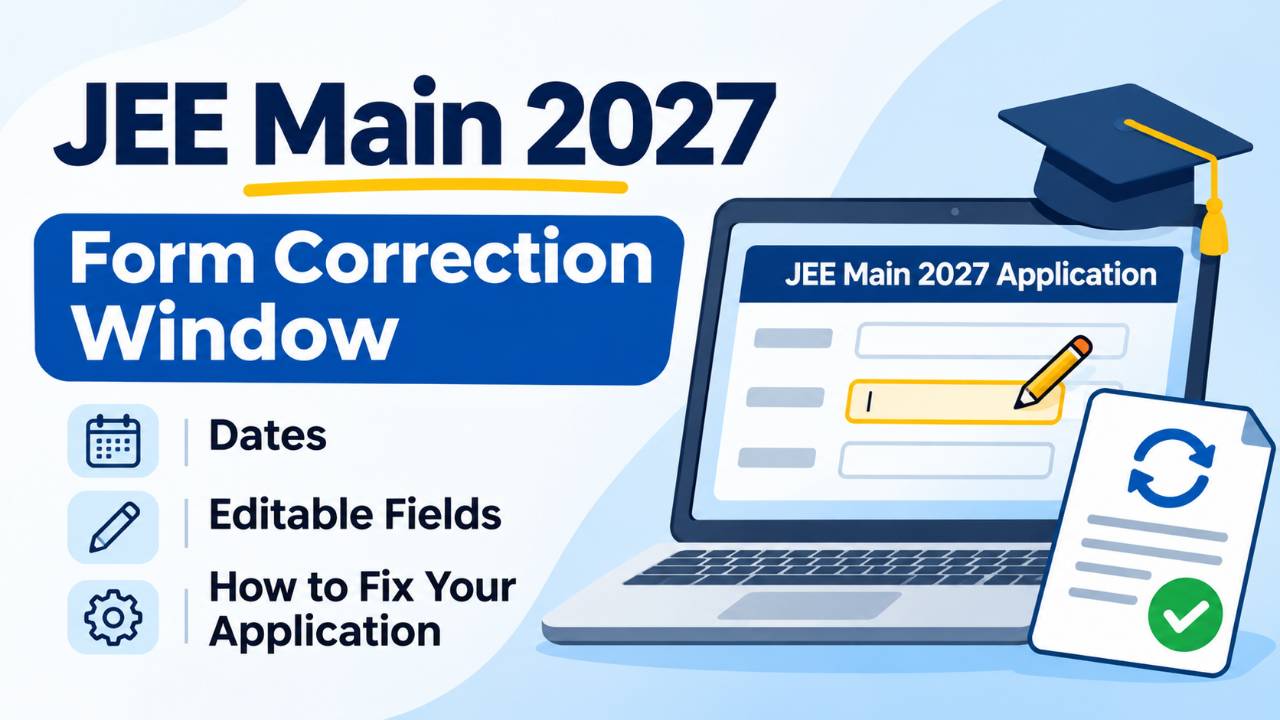
If you have already registered for Joint Entrance Examination (JEE) Main 2027 Session 1, the National Testing Agency (NTA) has opened a short but critical window to fix mistakes in your application. Between November 27 and November 29, 2026, registered aspirants can log in at jeemain.nta.nic.in and correct select personal, academic, and exam-related details before admit cards and exam city allocation are finalized.
For lakhs of students aiming at NITs, IIITs, GFTIs, and the gateway to JEE Advanced, an error in category, state of eligibility, or paper choice can change cutoffs, counselling rank, and even eligibility. This guide explains what you can and cannot edit, how to complete corrections safely, and how the process fits into the broader JEE Main timeline for January and April 2027.
Why the JEE Main 2027 Form Correction Window Matters
NTA conducts JEE Main twice a year. Session 1 is scheduled from January 20 to 28, 2027, and Session 2 from April 2 to 7, 2027. The examination is computer-based and covers Paper 1 (BE/BTech), Paper 2A (BArch), and Paper 2B (BPlanning). Your application form is the single source of truth for identity verification at the exam centre, normalization of scores, and participation in JoSAA and other counselling processes.
According to NTA figures reported around November 26, 2026, 15,73,018 application forms were submitted for Session 1, while 13,96,007 candidates had completed fee payment. If you are among those who paid but spotted a typo in your name, wrong category, or an incorrect state of eligibility, the correction facility is your last structured chance to fix it without filing a fresh registration in most cases.
Missing this window often means living with incorrect data through admit card release, result declaration, and admission. That is why experts advise treating these three days as seriously as the original registration deadline.
JEE Main 2027 Session 1 Correction Dates and Official Link
The Session 1 application form correction facility opened on November 27, 2026, and will remain available until November 29, 2026 (11:50 PM IST), unless NTA issues an extension which is uncommon and always announced on the official portal only.
- Official website: jeemain.nta.nic.in
- Login required: Application number and password (or credentials created during registration)
- What to keep ready: Class 10 and 12 mark sheets, category certificate (if applicable), revised signature scan, and payment method if additional fee applies
Do not rely on third-party links from social media. Bookmark the official NTA portal and use the link titled along the lines of “JEE Main 2027 Application Form Correction” on the homepage during the active window.
Registration Statistics: What They Tell Aspirants
More than 15 lakh registrations for a single session underline how competitive the engineering entrance landscape remains in India. Even a small percentage of forms with eligibility-state or category errors translates into thousands of students who might face counselling complications later. The gap between submitted forms and fee-paid applications also reminds candidates who submitted but did not pay to complete payment before correction ends, as unpaid applications may not proceed to the exam.
Fields You Can Edit During JEE Main 2027 Form Correction
NTA enables correction only for specific fields. Based on the current bulletin and correction guidelines, candidates can generally update the following:
- Candidate’s name, father’s name, and mother’s name (as per supported documents)
- Date of birth and gender
- Category and sub-category (with valid certificate where required)
- Class 10 and Class 12 board details and qualifying examination information
- State of eligibility (crucial for home-state quota in many institutions)
- Examination city preferences
- Course and paper selection (for example, adding Paper 2A or 2B if initially omitted)
- City and medium of examination where applicable
- Signature upload (if the earlier file did not meet specifications)
Changing category or adding a paper may trigger an additional application fee. Pay only through the official payment gateway on the portal and save the updated confirmation page immediately after submission.
Examples of High-Impact Corrections
State of eligibility: A student who studied in Kota but listed the wrong domicile might lose home-state benefit at institutions such as those covered under state quotas. Coaching hubs like Kota see heavy JEE traffic; aspirants training at centres such as the International Academy for Certification and Training Kota should still list eligibility exactly as NTA defines it in the information bulletin not based on coaching city alone.
Paper addition: A candidate who initially applied only for Paper 1 but later decides to pursue BArch should add Paper 2A during correction if permitted, rather than waiting for Session 2 registration.
Category update: Incorrect OBC-NCL or EWS selection affects seat matrix and fees during counselling. Upload and cross-check certificate numbers if the portal allows category correction.
Details You Cannot Change in the Correction Window
Understanding locked fields prevents wasted hours on the portal. Typically, NTA does not allow editing of:
- Registered mobile number and email address
- Present and permanent address details
- Emergency contact information
- Candidate’s photograph (uploaded during initial application)
If your photo or contact details are wrong, check the official bulletin for exceptional routes (helpdesk or notification-based processes). In most cycles, photograph revision is restricted because it is tied to biometric and identity checks at the exam centre.
For communication issues, continue using the email and mobile number registered at the time of application until NTA announces a separate update mechanism.
Step-by-Step: How to Edit JEE Main 2027 Application Details
The correction flow mirrors standard NTA interfaces: login, review enabled tabs, save, pay if needed, and download proof. Work on a laptop or desktop with stable internet; mobile browsers sometimes fail during payment.
- Visit jeemain.nta.nic.in and open the Session 1 form correction link when it is active.
- Enter your application number and password.
- Open each section personal, academic, exam and note fields highlighted as editable.
- Make changes carefully; double-check spelling against Class 10 certificate for name and DOB.
- If fee is due, complete payment and wait for success confirmation before logging out.
- Download and print the revised confirmation page; store a PDF backup in cloud storage.
Log out after finishing. Shared computers in cyber cafés should be avoided for entrance-exam credentials.
JEE Main 2027 Exam Pattern, Marking, and Papers
Paper 1 targets BE and BTech programmes and tests Physics, Chemistry, and Mathematics. Architecture aspirants take Paper 2A; planning candidates take Paper 2B. The marking scheme awards four marks for each correct answer and deducts one mark for each incorrect response in the applicable sections, as per NTA’s published scheme for 2027.
The syllabus for 2027 is unchanged from the previous year for Paper 1. Physics, Chemistry, and Mathematics each cover prescribed units from Classes 11 and 12. Download the official syllabus PDF from the portal rather than relying on unofficial chapter lists.
Quick Syllabus Orientation (Paper 1)
Physics includes measurement, kinematics, laws of motion, work-energy, rotational motion, gravitation, properties of matter, thermodynamics, waves, electrostatics, current electricity, magnetism, EMI, optics, modern physics, and electronics.
Chemistry spans physical chemistry (mole concept, thermodynamics, equilibrium, kinetics), inorganic chemistry (periodic table, p-block, d- and f-block, coordination compounds), and organic chemistry including oxygen- and nitrogen-containing compounds and biomolecules.
Mathematics covers sets and relations, complex numbers, matrices, permutations and combinations, binomial theorem, sequences, limits and continuity, integration, differential equations, coordinate and 3D geometry, vectors, statistics, probability, and trigonometry.
Balanced preparation across subjects matters more than chasing only “high-weightage” chapters, especially when normalization across shifts can level perceived difficulty.
Application Fees, Late Fee, and Correction-Related Payments
Standard Session 1 fees (before any late fee) are broadly structured as:
- General category male candidates: Rs 1,000
- Gen-EWS/OBC-NCL male candidates: Rs 900
- Female candidates (Unreserved/Gen-EWS/OBC-NCL): Rs 800
- SC/ST/PwD/Transgender candidates: Rs 500
Late registration carried an additional Rs 500 on top of the regular fee. If your correction involves category change or paper addition, expect differential fee as shown on the payment screen never assume the amount without completing the portal steps.
Session 2 Registration Timeline (Plan Ahead)
Session 2 registration is separate. NTA has indicated that application for the April session will open from January 5, 2027, with the last date without late fee around February 3, 2027, and a late-fee window from February 4 to 7, 2027. Candidates who appear in Session 1 must still apply and pay for Session 2 if they want a second attempt.
Use Session 1 corrections to lock accurate data now; use Session 2 registration strategically for a score improvement rather than fixing basic identity errors at the last minute.
After Correction: Admit Card, Exam Cities, and Counselling Prep
Once correction closes, NTA processes updated data before releasing admit cards. Examination city allotment depends on preferences, capacity, and logistics not coaching location. Students preparing in Rajasthan or other hubs should verify city preferences reflect travel feasibility, not just where they study.
Strong JEE Main scores open doors to National Institutes of Technology, Centrally Funded Technical Institutions, and many state engineering colleges. They also feed into JEE Advanced for IIT admission. Parallel options such as IIIT Delhi, IIIT Kota, Jaypee Institute of Information Technology, IIIT Allahabad, and DIT University Engineering remain on aspirants’ radar alongside JoSAA rounds.
Those exploring non-JEE pathways after school might later consider programmes such as a Bachelor of Computer Application (BCA) at universities like DIT University, but engineering-first students should still treat JEE form accuracy as non-negotiable.
Common Mistakes to Avoid During Form Correction
- Last-minute login on November 29: Server load peaks near the deadline; finish corrections by the afternoon of the last day.
- Wrong state of eligibility: Confusing mailing address with eligibility state harms quota claims.
- Skipping confirmation download: Without an updated confirmation page, proving corrections during disputes is harder.
- Unauthorized coaching claims: Only NTA’s portal and official notifications govern editable fields.
- Ignoring fee prompts: Incomplete payment after edits can leave the form inconsistent.
Who Should Use the Correction Facility First?
Priority users include anyone who discovers a mismatch between Aadhaar, school records, and the JEE application. Students upgrading from General to EWS or OBC-NCL with newly issued certificates should correct category before admit cards. Dual-degree or architecture-interested candidates who forgot Paper 2A or 2B should add papers now if the portal permits, instead of assuming a second registration will automatically merge attempts.
Repeaters and gap-year students must especially verify year of passing and roll numbers for Class 12. A single wrong digit in board roll numbers has caused result-matching delays in past cycles. international or state board students should confirm board name spelling exactly as NTA’s dropdown lists it.
DigiLocker, Identity Verification, and Why Some Fields Stay Locked
NTA has increasingly integrated identity verification through national SSO platforms such as MeriPehchaan, including options involving DigiLocker, Jan Parichay, and e-Pramaan. Because mobile numbers and emails are tied to this verification chain, they often remain non-editable during correction to prevent identity takeover. Candidates were advised to complete DigiLocker re-KYC where applicable so photographs pulled into records stay current yet the formal correction window still may not reopen photograph upload for everyone.
Understanding this design helps reduce frustration: correction is meant for factual academic and eligibility fixes, not wholesale identity re-registration.
Preparing for January 2027 While You Correct the Form
Form correction takes minutes; preparation takes months. Historical Session 1 papers suggest Mathematics often feels the most time-consuming for many test-takers, while Chemistry rewards precise NCERT coverage. Build a week-by-week plan from the official syllabus PDF, attempt timed mock tests, and analyse shift-wise difficulty trends without panicking over single-day social media claims.
Students in Delhi NCR might eye institutes such as Indira Gandhi Delhi Technical University for Women for later counselling choices; others in South India might track IIIT Kalyani or IIIT Guwahati. Private-deemed options such as ABV-IIITM Gwalior also attract strong applicants each year.
Editable vs Non-Editable Fields (Quick Reference)
Use this summary alongside the official bulletin, as NTA may refine labels on the live portal.
- Usually editable: Name fields, DOB, gender, category, academics, eligibility state, exam cities, papers, signature
- Usually locked: Mobile, email, addresses, emergency contact, photograph
- May attract extra fee: Category change, additional papers, some upgrades per bulletin rules
Support and Escalation: What to Do If the Portal Blocks You
If editable fields appear greyed out despite a known error, screenshot the page, note the timestamp, and check the public notice section for errata. NTA sometimes issues narrow windows for specific issues (for example, signature re-upload) through separate links. Avoid sharing passwords with unofficial “form correction services”; they cannot access NTA systems legitimately on your behalf.
Keep payment receipts from the original registration and from any correction transaction. These receipts help the NTA helpdesk trace fee status if the dashboard shows “unpaid” incorrectly after a successful payment.
Pre-Correction Checklist for Students and Parents
Before logging in, gather documents on a single table and compare each line with your current confirmation page. Start with the Class 10 certificate for legal name spelling and date of birth format. Match Class 12 board name, roll number, and year of passing with the marksheet you will present during admission. If you claim OBC-NCL, EWS, SC, ST, or PwD status, keep the certificate number and issuing authority visible while updating the portal.
Parents should help verify exam city order: first preference is not guaranteed, but illogical ordering such as choosing distant cities when a nearer centre is available can add travel stress in January. School mentors can re-read eligibility-state rules in the bulletin because parental domicile, schooling location, and permanent address are not interchangeable terms under NTA definitions.
After correction, compare the freshly downloaded page with the old PDF side by side. Highlight every changed field in a notebook so you remember what was updated if admit card data looks different later. This simple audit takes ten minutes and prevents panic when the hall ticket is released.
How Form Data Connects to JEE Advanced and Insititute Shortlisting
JEE Main is the first filter for most B.Tech journeys; only top performers move to JEE Advanced for IITs. Category and date-of-birth accuracy matter equally at both stages because continuity is maintained across databases. Students who also research individual campuses early whether IIIT Pune, IIIT Nagpur, or IIIT Lucknow benefit from knowing state quotas and branch cutoffs, but none of that research helps if the base application carries avoidable errors.
Treat the correction window as administrative hygiene: fix the form once, then return focus to chapter-wise mocks, formula revision, and error logs. Consistency across paperwork and preparation is what makes a candidate exam-ready in the truest sense.
Conclusion
The JEE Main 2027 Session 1 form correction window is a brief, high-stakes opportunity for more than 15 lakh registrants to align their applications with official records before January exams. Use the official portal, correct only what is allowed, pay any due fee, and archive the new confirmation page. Combine accurate paperwork with disciplined syllabus-based preparation across Physics, Chemistry, and Mathematics, and you set a solid foundation for Session 1 in January and, if needed, Session 2 in April. For ongoing updates on eligibility, cutoffs, and participating institutes, keep following trusted exam resources and the comprehensive JEE Main hub on CollegeDwar.