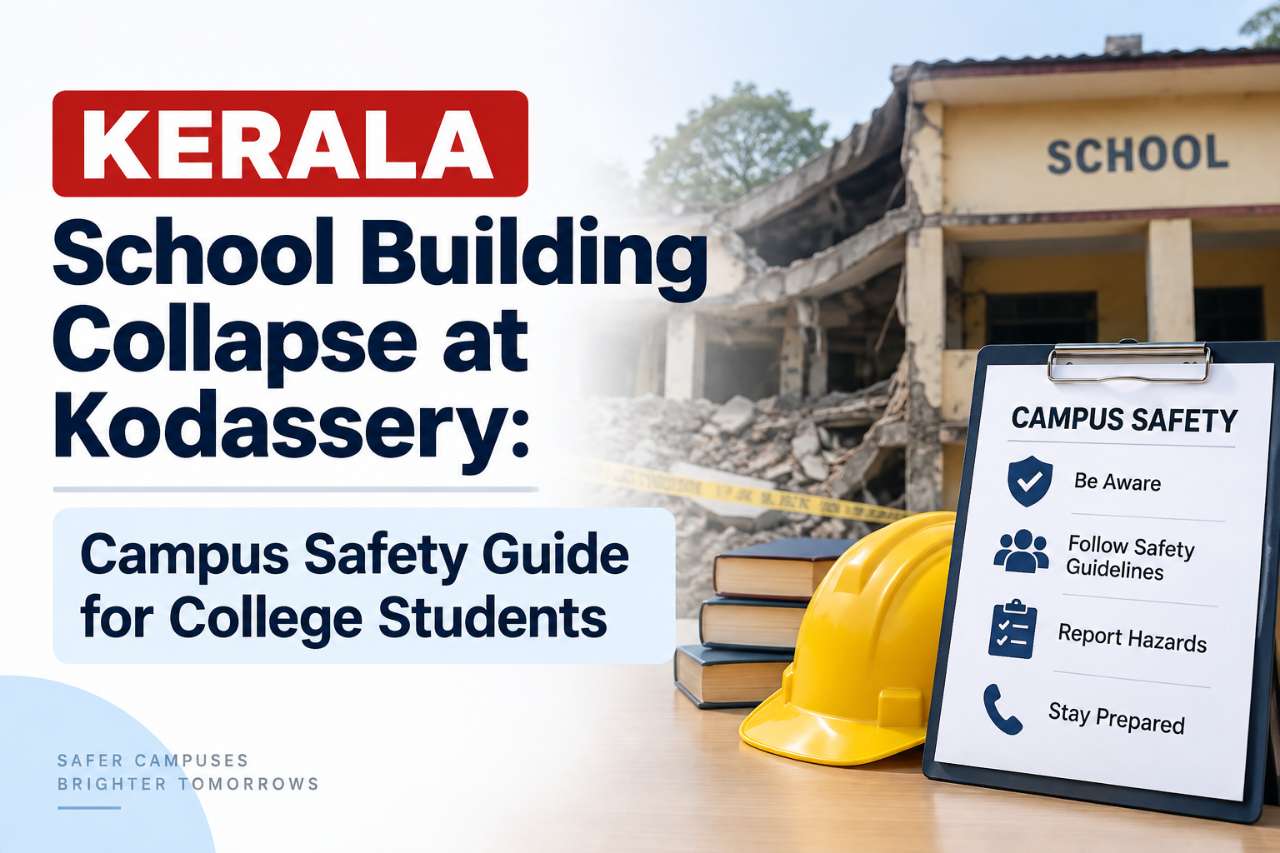
On Friday, 4 September 2026, a portion of the Chaipankuzhi Government Upper Primary School in Kodassery, Thrissur district, Kerala, collapsed while the campus was closed for Krishna Janmashtami. Panchayat officials reported that the compound wall gave way first, after which part of the open-stage structure fell onto a parked school bus and damaged it. Because students and staff were on holiday, a major tragedy was averted. Preliminary assessments linked nearby Hill Highway road-widening work to stress on the 2002-built structure. Public Works Department (PWD) teams inspected the remaining building, and the Kerala Education Department will decide whether classes can resume after a full safety audit.
For students planning higher education in Kerala and across India, this incident is a timely reminder that campus infrastructure safety matters as much as rankings, cut-offs, and placement packages. Whether you are comparing degree colleges near Thrissur, researching architecture programmes, or shortlisting hostels before admission season, knowing how to read structural red flags can protect your academic journey. This guide explains what happened at Kodassery, why such collapses occur, how Kerala regulates educational buildings, and what actionable steps students and parents should take before enrolling.
What Happened at Chaipankuzhi Government UP School, Kodassery?
Kodassery is a panchayat in Thrissur district, a region known for strong school education and proximity to major higher-education hubs. The affected institution, Chaipankuzhi Government Upper Primary School, is a state-run primary school not a college but the structural failure raises questions that apply equally to universities, polytechnics, and private professional colleges.
Timeline of the Incident
- Date and time: Friday, 4 September 2026, around 11:00 AM IST.
- Holiday closure: The school was shut for Krishna Janmashtami, so classrooms were empty.
- Sequence of collapse: The compound wall failed first; a section of the open-stage structure then collapsed onto a school bus on the premises.
- Damage: The bus was partially damaged; no student or staff casualties were reported because of the holiday timing.
- Official response: Kodassery panchayat officials, PWD engineers, and Education Department representatives visited the site to assess remaining structures.
Local officials noted that road-widening under the Hill Highway project may have disturbed the soil and foundations near the compound wall. The main building was constructed in 2002 relatively recent by Indian public-school standards yet still vulnerable when external civil works alter drainage, load paths, or retaining walls.
Why a Holiday Prevented a Major Accident
Empty campuses during festivals, summer breaks, and exam holidays reduce exposure risk, but they also delay detection. A collapse during a full school day could have injured hundreds of children. For college students, the parallel is clear: hostels, laboratories, and auditorium blocks may show cracks or water seepage during vacations when fewer people notice warning signs. Safety culture cannot depend on luck or empty calendars.
From School Collapses to College Campus Safety in Kerala
Kerala invests heavily in literacy and has a dense network of schools, colleges, and professional institutes. Thrissur alone hosts institutions ranging from agricultural sciences to digital technology. When evaluating where to study, students often focus on NAAC grades, NIRF ranks, or entrance exam cut-offs. Infrastructure audits deserve equal weight especially after monsoon seasons and when campuses sit near highway expansion zones.
Kerala Higher Education Institutions Worth Knowing
Students from Thrissur and neighbouring districts frequently explore options such as Kerala Agricultural University Thrissur, which sits in the same district as Kodassery and offers programmes in agriculture, forestry, and allied sciences. Other prominent choices include University of Kerala Thiruvananthapuram for arts, science, and professional courses; Kerala University of Health Sciences for medical and paramedical pathways; and Kerala University of Digital Sciences Innovation and Technology for tech-focused degrees. In northern Kerala, Central University of Kerala Kasaragod attracts students seeking central-university benefits and research exposure.
None of these institutions were involved in the Kodassery incident, but prospective students should still verify hostel blocks, workshop sheds, and temporary pandemic-era structures on any campus they visit.
Common Causes of Educational Building Failures in India
Structural collapses in schools and colleges rarely happen without warning signs. Understanding root causes helps students ask sharper questions during open days and counselling sessions.
1. Adjacent Construction and Road Projects
Highway widening, metro tunnelling, and commercial excavation can shift soil pressure on neighbouring walls. The Kodassery case highlights how Hill Highway road-widening may have compromised a compound wall built before the project scope was finalised. Colleges near urban flyovers or railway corridors face similar risks.
2. Ageing Infrastructure and Deferred Maintenance
Buildings from the 1990s and early 2000s may lack seismic detailing or waterproofing upgrades. Kerala's heavy monsoon accelerates corrosion in steel reinforcements and weakens lime-mortar joints in older blocks.
3. Unauthorized Additions and Overloading
Extra floors on lecture halls, overcrowded hostels, and rooftop water tanks not accounted for in original designs increase load beyond safe limits. Private colleges expanding intake without proportional civil upgrades are especially vulnerable.
4. Poor Drainage and Foundation Issues
Waterlogging softens soil under foundations. Campuses on reclaimed land or hill slopes common in Kerala need retaining walls and drainage channels inspected every monsoon.
5. Weak Regulatory Enforcement
While Kerala's local bodies and PWD maintain building codes, enforcement gaps persist in rural panchayats and in fast-growing private education corridors. Occupancy certificates and fire NOCs should be verified, not assumed.
Legal and Regulatory Framework for Educational Buildings
India does not have one single law covering every school and college building, but several layers apply:
- National Building Code (NBC) 2016: Sets standards for structural design, fire safety, and accessibility.
- State PWD and local body rules: Kerala's municipalities and panchayats issue building permits and conduct structural assessments after incidents.
- UGC and AICTE norms: Universities and technical institutions must meet minimum land and built-up area requirements; periodic inspections may cover labs and hostels.
- Right to Education Act (RTE): Applies primarily to schools but reflects national expectations for safe learning spaces.
- Disaster Management guidelines: State education departments issue monsoon preparedness circulars to institutions.
After the Kodassery collapse, the Kerala Education Department's decision on whether Chaipankuzhi school reopens will depend on PWD and panchayat safety certification a process similar to what colleges follow after floods or landslides in hilly districts like Wayanad, home to institutions such as Kerala Veterinary Animal Science University Wayanad.
How Students Should Evaluate Campus Safety Before Admission
Admission season brings brochures promising smart classrooms and global tie-ups. Use this checklist during campus visits or virtual tours:
| Area to Inspect | What to Look For | Red Flags |
|---|---|---|
| Main academic blocks | Cracks in walls, uneven floors, water stains | Diagonal cracks wider than 3 mm, bulging walls |
| Hostels | Fire exits, ventilation, ceiling condition | Blocked staircases, exposed wiring, damp odour |
| Labs and workshops | Structural columns, load-bearing integrity | Temporary partitions replacing load walls |
| Auditoriums and stages | Roof trusses, seating load limits | Rusted steel, sagging roofs similar to open-stage risks at Kodassery |
| Perimeter and retaining walls | Alignment, drainage outlets | Leaning walls, fresh patches after highway work nearby |
| Documentation | Occupancy certificate, fire NOC, structural audit reports | Refusal to share records, expired certificates |
Questions to Ask During Counselling
- When was the last third-party structural audit conducted?
- Are any blocks currently under repair or marked unsafe?
- Is construction happening adjacent to classrooms or hostels?
- What is the monsoon evacuation plan for low-lying campuses?
- Does the institution carry insurance covering student injury from infrastructure failure?
Students interested in designing safer campuses can explore careers through programmes at School of Architecture Anna University Chennai, School of Planning Architecture New Delhi, School of Planning Architecture Bhopal, or School of Planning Architecture Vijaywada. Civil engineers and planners play a direct role in preventing tragedies like the Kodassery collapse.
Role of Local Governance: Panchayat, PWD, and Education Department
In the Kodassery incident, Kodassery panchayat officials were among the first responders. Panchayats maintain roads, approve minor building works, and coordinate with district administration during disasters. The PWD evaluates structural integrity of government buildings, while the Education Department decides academic continuity.
This multi-agency model mirrors how college safety is managed: university syndicates, state technical education directorates, and municipal fire services each hold partial responsibility. Students should know which authority oversees their institution state university, private deemed university, or central university as complaint channels differ.
Reporting Unsafe Conditions
- On campus: Notify the dean of students, registrar, or internal complaints committee in writing.
- Local body: File complaints with the municipal engineer or panchayat secretary for illegal construction.
- State portals: Kerala's disaster management and education helplines accept infrastructure-related reports during monsoon advisories.
- Media and RTI: If responses stall, Right to Information applications can compel disclosure of inspection reports an approach student unions have used nationally to expose neglected hostel blocks.
Broader Context: Infrastructure Stress on India's Education Sector
The Kodassery collapse is not an isolated headline. Across India, rapid enrollment growth, PPP school models, and highway expansion strain ageing public buildings. Kerala's Hill Highway aims to improve connectivity in hilly districts, but civil works must include impact assessments for neighbouring schools and colleges.
For management students studying institutional risk, institutes such as Fore School of Management Delhi, Delhi School of Management, and Thiagarajar School of Management Chennai cover operations and compliance in their curricula. Understanding how administrators balance budgets, safety audits, and expansion timelines is part of modern education leadership.
Cultural and specialised institutions also maintain heritage buildings requiring careful restoration. Kerala Kalamandalam Thrissur, for example, blends traditional architecture with modern performance spaces a reminder that safety upgrades must respect structural heritage without cutting corners.
Admission Season Tips: Balancing Rank, Course, and Campus Safety
Entrance exams like KEAM, CUET, and institute-specific tests determine eligibility, but final college selection should weigh safety alongside academics:
- Visit before locking seats: Walk every block you will use, not just the marketing tour route.
- Talk to current students: Ask about leaks, hostel repairs, and how administration responded to past incidents.
- Check accreditation documents: NAAC peer team reports sometimes note infrastructure deficiencies.
- Compare alternatives in the same city: Thrissur students might weigh KAU programmes against options at Kerala University of Fisheries Ocean Studies Kochi or central-university courses elsewhere in the state.
- Plan for postgraduate pathways: If you pursue an MA or professional degree later, repeat safety checks PG blocks and research centres may differ from undergraduate campuses.
Law and policy enthusiasts tracking education governance may follow developments at institutions like National Law School of India University Bangalore, where campus safety intersects with student welfare litigation and regulatory reform.
What Officials Said After the Kodassery Collapse
According to reports from the scene, panchayat officials linked the compound wall failure to Hill Highway road-widening activity. PWD engineers examined whether the remaining school structure could safely accommodate students. The Education Department indicated that reopening would follow only after joint assessment by PWD and panchayat teams standard procedure when structural doubt exists.
This cautious approach should extend to colleges: temporary shifts to alternate campuses, hybrid classes, or deferred lab work are preferable to occupying blocks with unverified integrity.
Monsoon Preparedness for College Campuses in Kerala
Kerala receives heavy rainfall from June through November. Students arriving for first-year orientation should:
- Keep emergency contacts for wardens and local disaster cells saved on phones.
- Avoid sheltering under cracked walls or construction scaffolding during storms.
- Report landslide risks on hilltop campuses immediately.
- Confirm whether flood-prone ground floors are still used for hostels many institutions moved students after 2018 and 2024 flood seasons.
Health-sciences students training in clinical environments should also verify hospital annexes and nursing hostel blocks, especially when studying under Kerala University of Health Sciences affiliations across multiple districts.
Designing Safer Educational Spaces: Careers That Make a Difference
If the Kodassery incident motivates you toward infrastructure careers, consider B.Arch, B.Planning, or civil engineering pathways. Premier design schools such as Sir J J School of Art Architecture and Design and SPA campuses train professionals who draft the next generation of safe classrooms, labs, and hostels.
Environmental and sustainability programmes at TERI School of Advanced Studies New Delhi also address resilient building practices increasingly relevant as climate extremes test educational infrastructure nationwide. Design aspirants may also explore creative programmes at International School of Design Jaipur while keeping structural safety fundamentals in view.
Entrance Exams, Admission Timelines, and When to Raise Safety Concerns
Most Indian students finalise colleges between May and August after results for KEAM, CUET-UG, CUET-PG, JEE Main, NEET, and state-level tests. During this window, administration offices are busiest and some institutions rush occupancy before monsoon repairs finish. If you receive an admission offer, treat the acceptance deadline as negotiable when genuine safety questions remain unanswered. Request written replies about hostel occupancy limits, pending civil work, and alternative accommodation before paying capitation or first-semester fees.
KEAM and Kerala State Admission Context
Kerala Engineering Architecture Medical (KEAM) counselling places thousands of students in professional colleges across the state each year. While KEAM ranks and fee structures dominate family discussions, add a campus safety column to your preference list alongside course specialisation and commute time. Institutions in Thrissur, Ernakulam, and hilly taluks face distinct monsoon profiles; a coastal campus in Kochi may flood while an inland block in Palakkad may face different drainage issues. Tailor your inspection checklist to geography, not just brand name.
Document Checklist Before Fee Payment
- Copy of latest building occupancy certificate for blocks you will use daily.
- Fire safety NOC with valid expiry and last drill date for hostels.
- Structural stability certificate or engineer's report dated within the last three years.
- Written statement on adjacent government projects (highways, railways, pipelines).
- Hostel agreement clauses covering relocation if a block is declared unsafe mid-semester.
Student Welfare, Insurance, and Legal Recourse
Indian colleges increasingly carry group insurance for students, but policies vary in whether they cover injuries from infrastructure failure versus sports or transit accidents. Read the fine print or ask the student welfare officer. If a wall collapse, ceiling fall, or stair failure injures residents, institutions may face negligence claims under consumer protection and tort law. Documenting pre-admission concerns creates a paper trail should disputes arise later.
Student unions at universities including Madras School of Economics Chennai and Madras School of Social Work Chennai have historically pushed administrations to repair hostels and audit old blocks. Collective complaints through elected representatives often accelerate repairs faster than individual emails.
Lessons for Parents and First-Generation College Goers
First-generation students and parents from rural panchayats like Kodassery may lack familiarity with urban campus layouts. Local self-government experience knowing that panchayat and PWD teams respond to structural failures can translate into confidence when questioning college officials. No degree is worth studying in a block flagged unsafe by engineers. Community leaders and school teachers guiding Plus-Two graduates should include infrastructure checks in pre-admission counselling alongside cut-off marks and scholarship forms.
Parents comparing nursing or paramedical diplomas should apply the same rigour when evaluating clinical hostel blocks at institutes affiliated with health universities. Programmes linked to Government Girls School of Nursing Sikar or similar models nationwide vary in building quality; always visit in person when possible.
Conclusion
The partial collapse at Chaipankuzhi Government UP School in Kodassery, Thrissur, on 4 September 2026 ended without student casualties only because Krishna Janmashtami kept the campus empty. A compound wall failure, possibly linked to Hill Highway road-widening, triggered the fall of an open-stage section onto a school bus and raised urgent questions about structural oversight near active civil projects.
For higher-education aspirants, the lesson is practical: rankings and packages matter, but so does the physical integrity of the places where you will live and learn for three to five years. Whether you target agricultural sciences in Thrissur, digital programmes statewide, or professional degrees elsewhere in India, use campus visits, documentation checks, and official audit reports to make informed choices. Kerala's responsive coordination between panchayat, PWD, and Education Department offers a template safety first, classes second. Apply that standard to your college shortlist, and you invest not only in a degree but in your wellbeing throughout student life.