
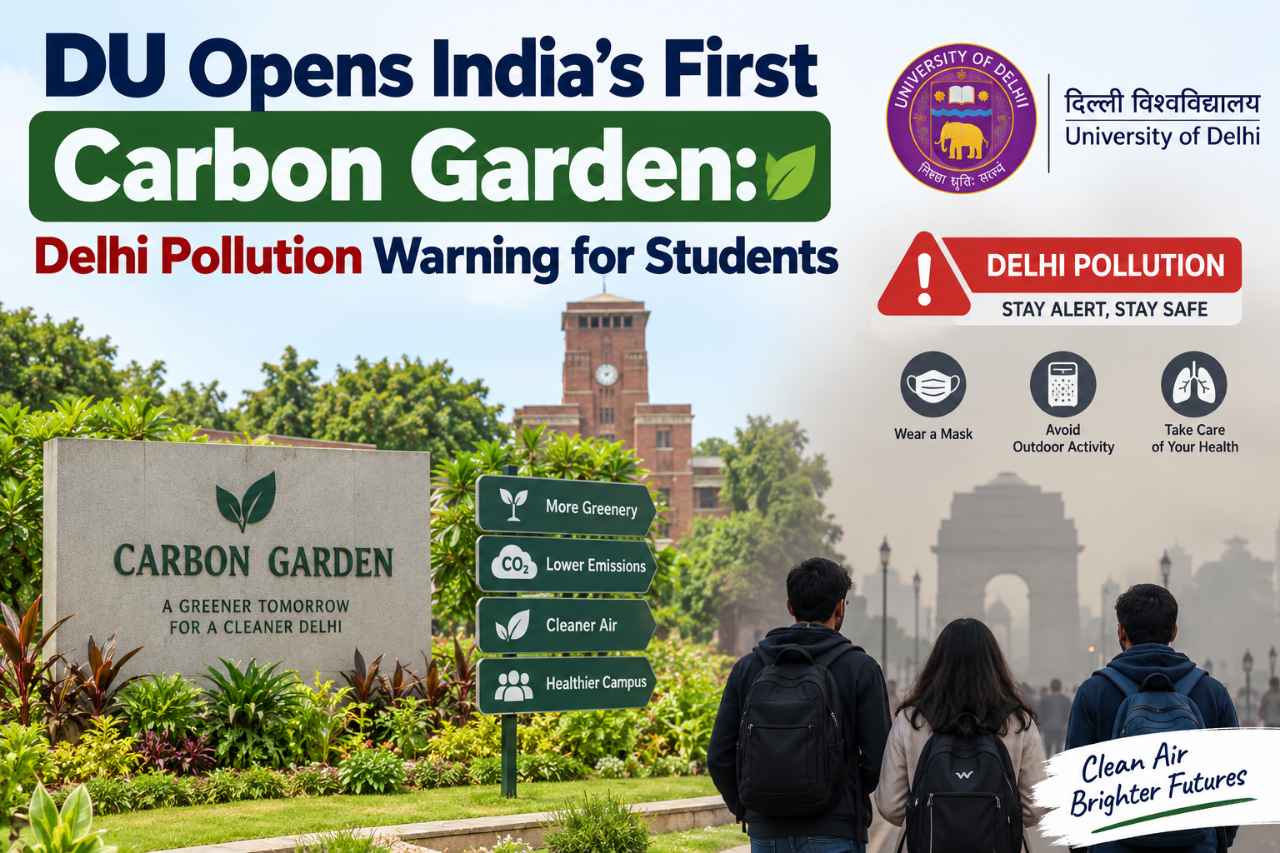

Delhi's air quality crisis is no longer a seasonal headline it is a year-round concern for students, parents, and educators planning higher education in the National Capital Region. In a significant step toward nature-based solutions, the University of Delhi has inaugurated India's first carbon garden at its Department of Botany. Vice-Chancellor Professor Yogesh Singh, while inaugurating the initiative, warned that Delhi could become the country's pollution capital if urgent environmental action is not taken.
For students exploring colleges in Delhi, this development matters beyond campus news. It signals how premier institutions are responding to urban pollution through research, sustainability, and student-facing green spaces. This guide explains what a carbon garden is, why DU launched it, what the Vice-Chancellor said about Delhi's future, and how students at Delhi universities can benefit from and contribute to similar initiatives.
What Is India's First Carbon Garden at Delhi University?
The carbon garden is a 2,000-square-foot ecological intervention established on the lawn in front of the Department of Botany at the North Campus of the University of Delhi. Unlike decorative landscaping, it is designed as a living system a mini biodiversity park that actively filters pollutants, sequesters carbon dioxide, and restores depleted urban soil.
Professor Dinabandhu Sahoo, Head of the Department of Botany and founder of the project, developed the garden after nearly four years of research and planning. The initiative was formally inaugurated by Vice-Chancellor Yogesh Singh, who planted a Kalpavriksha sapling to mark the occasion. Officials describe the physical size as modest, but the scientific and social idea behind it as immense.
Key Features of the DU Carbon Garden
- 45 plant species including herbs, shrubs, and trees selected for ecological function
- Multiple life forms: algae, fungi, bacteria, bryophytes, pteridophytes, gymnosperms, and angiosperms
- Spirulina (Arthrospira), one of the oldest living organisms, included in the ecosystem
- "Bark continent" tree bark hosting microbiota that consume methane, hydrogen, carbon monoxide, and volatile organic compounds
- Approximately 6 trillion microbial cells per square metre of bark surface
- Urban ecosystem services model replicable in schools, colleges, residential areas, and office complexes
The garden pulls carbon dioxide and deadly pollutants from the atmosphere into the ground, enriching soil that has been degraded by decades of urban expansion. In a crowded city landscape, even a small patch of scientifically designed greenery can deliver measurable environmental and mental health benefits.
Why Delhi University's VC Warned About the Pollution Capital Risk
During the inauguration, Vice-Chancellor Yogesh Singh placed the carbon garden within a broader warning about Delhi's environmental trajectory. He noted that air pollution causes more than seven million deaths globally every year, and around 1.7 million people die annually in India due to pollution-related health complications.
His message was direct: Delhi is the national capital and is facing a growing pollution crisis. If appropriate steps are not taken, it risks becoming the pollution capital. This is not alarmism for students and families it is a call to integrate environmental responsibility into how cities and campuses grow.
What the VC Said About Technology and Western Building Models
Professor Singh emphasised that environmental problems arising from human activities cannot be solved through technology alone. Sustainable, nature-based solutions must complement engineering and policy interventions. He also cautioned against blindly adopting building designs from Western countries without considering India's environmental conditions.
India receives sunlight for nearly 300 days a year. Multi-storey glass buildings, popular in Western urban design, can increase energy requirements for cooling in Indian climates. Higher electricity consumption for air conditioning adds to emissions and worsens the heat-island effect that students already experience during Delhi summers.
For students comparing campuses across Delhi from Delhi Technological University (DTU) to Netaji Subhas University of Technology (NSUT) this perspective matters when evaluating infrastructure, hostel comfort, and long-term sustainability commitments.
How Carbon Gardens Work: Science Behind the Green Space
Understanding the mechanism helps students appreciate why botany departments, environmental science programmes, and research councils are investing in carbon gardens rather than conventional lawns.
Carbon Sequestration Through Plants
Plants absorb carbon dioxide during photosynthesis and store carbon as biomass for extended periods. Trees, shrubs, and even micro-algae contribute to carbon stock in soil and plant tissue. In urban settings where vehicular emissions and construction dust dominate, targeted plant selection amplifies this natural filtration capacity.
Microorganisms and the "Bark Continent"
Tree bark is not merely protective outer tissue it hosts a dense community of bacteria and fungi. These microorganisms metabolise toxic gases including methane, hydrogen, carbon monoxide, and volatile organic compounds (VOCs). The DU model estimates roughly six trillion cells per square metre of bark, turning each tree trunk into a micro-scale air purification unit.
Soil Restoration in Polluted Cities
Delhi's soil quality has declined due to construction runoff, waste dumping, and chemical contamination. Carbon gardens redirect atmospheric pollutants into the ground while organic matter from plant litter and microbial activity rebuilds soil structure. Healthier soil retains moisture, supports biodiversity, and reduces dust resuspension a contributor to PM10 and PM2.5 levels that spike every winter.
Comparison: Carbon Garden vs Conventional Campus Green Space
| Aspect | Conventional Lawn or Ornamental Garden | Carbon Garden Model |
|---|---|---|
| Primary purpose | Aesthetics and recreation | Pollution mitigation and carbon sequestration |
| Plant selection | Often uniform, low diversity | 45+ species across life-form categories |
| Microbial role | Minimal design focus | Central bark microbiota, algae, fungi, bacteria |
| Space required | Large parks preferred | Works in 2,000 sq ft or smaller plots |
| Replicability | Standard landscaping | Designed for schools, colleges, RWAs, offices |
| Research value | Limited | High for botany, ecology, environmental science |
Delhi's Pollution Crisis: Context for College Students
Students who choose Delhi for undergraduate or postgraduate studies inherit both world-class academic opportunities and significant environmental challenges. Reports indicate that air pollution accounted for roughly 15 percent of total deaths in Delhi in 2023. During peak smog months, outdoor sports, internships requiring fieldwork, and daily commutes become health considerations not just convenience issues.
Health Impacts Relevant to Young Adults
- Respiratory issues including asthma exacerbation and chronic bronchitis
- Reduced lung function development in adolescents and young adults
- Increased risk of cardiovascular stress during high AQI days
- Mental health effects linked to prolonged exposure and limited outdoor activity
- Higher medical expenses over time, as Professor Sahoo's team has noted in framing the garden as a social as well as environmental intervention
Medical and health sciences students at institutions such as University College of Medical Sciences (UCMS), Delhi and AIIMS Delhi encounter these realities in clinical settings. Engineering and pharmacy students at Delhi Pharmaceutical Sciences and Research University and technical universities see parallel demand for clean-air innovation and sustainable drug manufacturing.
Why Campuses Must Lead on Air Quality
Universities occupy large land parcels, host thousands of daily commuters, and shape the next generation of policymakers, scientists, and entrepreneurs. When DU establishes India's first carbon garden, it sets a precedent for other Delhi institutions including GGSIPU, Jamia Hamdard University, National Law University Delhi, and Indira Gandhi Delhi Technical University for Women to embed green interventions into master plans rather than treating sustainability as a brochure bullet point.
Replication Beyond DU: A Growing National Movement
The carbon garden concept is designed for scalability. A national conference held at Delhi University in March brought together experts who endorsed carbon gardens as a replicable, economical, and sustainable nature-based solution for polluted and land-scarce cities.
44 Carbon Gardens Under Development
According to reports on the model's expansion, the Central Industrial Security Force (CISF) Eastern Sector is developing 44 carbon gardens across Jharkhand, Bihar, and eastern Uttar Pradesh. Four gardens are already operational in Ranchi (Jharkhand) and in Nabinagar, Barauni, and Tanda across Bihar and Uttar Pradesh, with work underway at 40 additional locations. Officials expect all 44 to be operational by the end of the monsoon season.
Professor Sahoo has also engaged civil society groups, resident welfare associations, and institutions interested in adopting the model. The message for students nationwide: you do not need a 50-acre forest to contribute a 2,000-square-foot scientifically planned garden can begin shifting local air and soil quality.
Local Ecological Context Matters
Environmental experts caution that replication must account for regional climate, native species, and soil conditions. A carbon garden in Delhi's semi-arid urban core will differ in plant palette from one in Ranchi or Patna. Students pursuing botany, environmental science, or agriculture should treat the DU model as a framework, not a copy-paste template.
What This Means for Delhi University Admissions and Campus Life
Prospective DU students often focus on cut-offs, college rankings, and hostel availability. The carbon garden adds another lens: research exposure, sustainability culture, and quality of campus environment.
Academic Programmes Connected to the Initiative
The Department of Botany at DU offers undergraduate and postgraduate pathways where students can engage with plant taxonomy, microbial ecology, and urban ecosystem services. Professor Sahoo also serves as Chairperson of the Research, Innovation and Entrepreneurship Council, linking the garden to broader innovation and startup ecosystems on campus.
Students in allied fields environmental studies at Dr B R Ambedkar University Delhi, interdisciplinary programmes at South Asian University, New Delhi, or science streams across affiliated colleges can draw inspiration for dissertations, internships, and social entrepreneurship projects.
VC's Call: Carbon Gardens Across All DU Colleges
Vice-Chancellor Yogesh Singh urged that similar carbon gardens be established across departments and colleges of the university. For students, this could mean greener courtyards, cleaner air near lecture halls, and hands-on volunteering opportunities. Parent and student communities should ask during open days: What green infrastructure exists? Is there a plan to replicate the botany department model?
Practical Tips for Students Studying in Polluted Cities
- Monitor AQI daily using reliable apps; plan outdoor activities when levels are moderate
- Use N95 masks during high pollution weeks, especially while commuting
- Choose hostels and PG accommodations with air purifiers or cross-ventilation away from main roads
- Join campus eco-clubs and propose micro-gardens modelled on the carbon garden concept
- Stay hydrated and maintain indoor plants that filter common indoor pollutants
- Advocate for sustainable campus design question glass-heavy buildings without passive cooling strategies
- Explore research electives in environmental botany, urban ecology, or public health
- Document local air quality for project work; data-driven advocacy influences policy
Green Campus Initiatives Across Delhi NCR Universities
Delhi University is not alone in pursuing sustainability, though the carbon garden is a first-of-its-kind national milestone. Understanding the broader landscape helps students make informed college choices.
Technical institutions such as Delhi Technological University and NSUT Delhi increasingly integrate renewable energy labs and smart building research. Private universities in the NCR including Amity University Noida and Galgotias University Greater Noida market green campuses, though students should verify claims against measurable outcomes such as tree cover, waste segregation, and carbon audits.
Professional universities like Delhi Teachers University and Delhi Skill and Entrepreneurship University train educators and entrepreneurs who will shape how future generations learn about climate action. The carbon garden model offers a ready-made case study for school-level environmental education.
Career Pathways Linked to Carbon Gardens and Urban Ecology
The carbon garden inauguration highlights career opportunities that Delhi students may not have considered while preparing for conventional entrance exams. Environmental botany, urban forestry, microbial ecology, and sustainability consulting are growing fields aligned with India's climate commitments and Smart Cities Mission.
Emerging Roles for Science and Engineering Graduates
- Urban ecologist designing green infrastructure for municipalities and campuses
- Air quality analyst monitoring PM2.5, NOx, and VOC levels for civic agencies and NGOs
- Environmental consultant helping institutions meet green building and NAAC sustainability criteria
- Green entrepreneur scaling carbon garden models through social enterprises and CSR partnerships
- Public health researcher studying pollution-health links, especially relevant for medical graduates from UCMS and AIIMS
Engineering graduates from GGSIPU Engineering or Jamia Hamdard University Engineering can complement the biological approach with IoT-based air quality sensors, automated irrigation, and data dashboards that quantify a garden's pollution-reduction impact over time.
How DU Admissions Candidates Can Prepare
Students awaiting CUET results or planning DU postgraduate applications in botany, environmental science, or zoology should explore the Department of Botany website and faculty publications. Mentioning genuine interest in urban ecology during interviews or SOPs demonstrates awareness of current institutional priorities. Even students in commerce, law, or humanities can connect the carbon garden to policy analysis, environmental law, or CSR strategy fields where NLU Delhi graduates increasingly specialise.
Policy, E-E-A-T, and the Future of Urban Higher Education
From an experience and trust perspective, Delhi University's carbon garden represents expert-led, evidence-based action. Professor Sahoo's four-year development timeline, peer endorsement at a national conference, and measurable ecological design (45 species, quantified bark microbiota) demonstrate authority in the field. The VC's public warning aligns institutional leadership with transparent communication about risks students face.
Questions Students Should Ask Before Choosing a Delhi College
- Does the campus have measurable green cover beyond ornamental lawns?
- Are there active research projects in air quality, botany, or environmental science?
- How does the institution respond on high AQI days class suspensions, purifiers, hybrid classes?
- Is sustainability integrated into curriculum or limited to annual events?
- Are there partnerships with civic bodies or RWAs for community greening?
Colleges that answer these questions concretely like DU with its carbon garden offer students both education and a healthier daily environment. That combination supports the mental well-being goals officials cite alongside air quality and biodiversity improvements.
Featured Snippet: Quick Facts About DU's Carbon Garden
- Location: Department of Botany, North Campus, University of Delhi, Delhi-110007
- Area: 2,000 square feet
- Plant species: 45 (herbs, shrubs, trees)
- Founder: Professor Dinabandhu Sahoo, Head, Department of Botany
- Inaugurated by: Vice-Chancellor Professor Yogesh Singh
- Status: India's first carbon garden
- Goal: Improve air quality, urban biodiversity, soil health, and mental well-being
Parents evaluating whether Delhi is the right city for their child's higher education should weigh academic reputation alongside environmental factors. Institutions that invest in projects like the carbon garden demonstrate long-term commitment to student welfare not just rankings. Checking AQI trends, campus green cover, and health facilities during college visits can prevent unpleasant surprises after admission.
Conclusion: Small Gardens, Large Lessons for India's Students
India's first carbon garden at Delhi University is more than a botanical experiment. It is a practical response to a city where pollution threatens health, productivity, and quality of life for millions including the student population that keeps the capital's universities alive. Vice-Chancellor Yogesh Singh's warning that Delhi could become the pollution capital should resonate with every family planning admissions in the NCR.
Yet the inauguration also carries hope. A 2,000-square-foot garden demonstrates that land-scarce cities can deploy nature-based solutions without waiting for massive budgets or decades-long forest projects. With 44 replication sites already underway and a national conference endorsing the model, carbon gardens may become as familiar on Indian campuses as libraries and laboratories.
For students, the actionable takeaway is clear: choose institutions that treat environmental health as academic priority, participate in green initiatives, and carry the carbon garden idea back to schools, neighbourhoods, and future workplaces. Delhi's air will not improve overnight but India's first carbon garden proves that science, community, and education can grow solutions one square foot at a time.