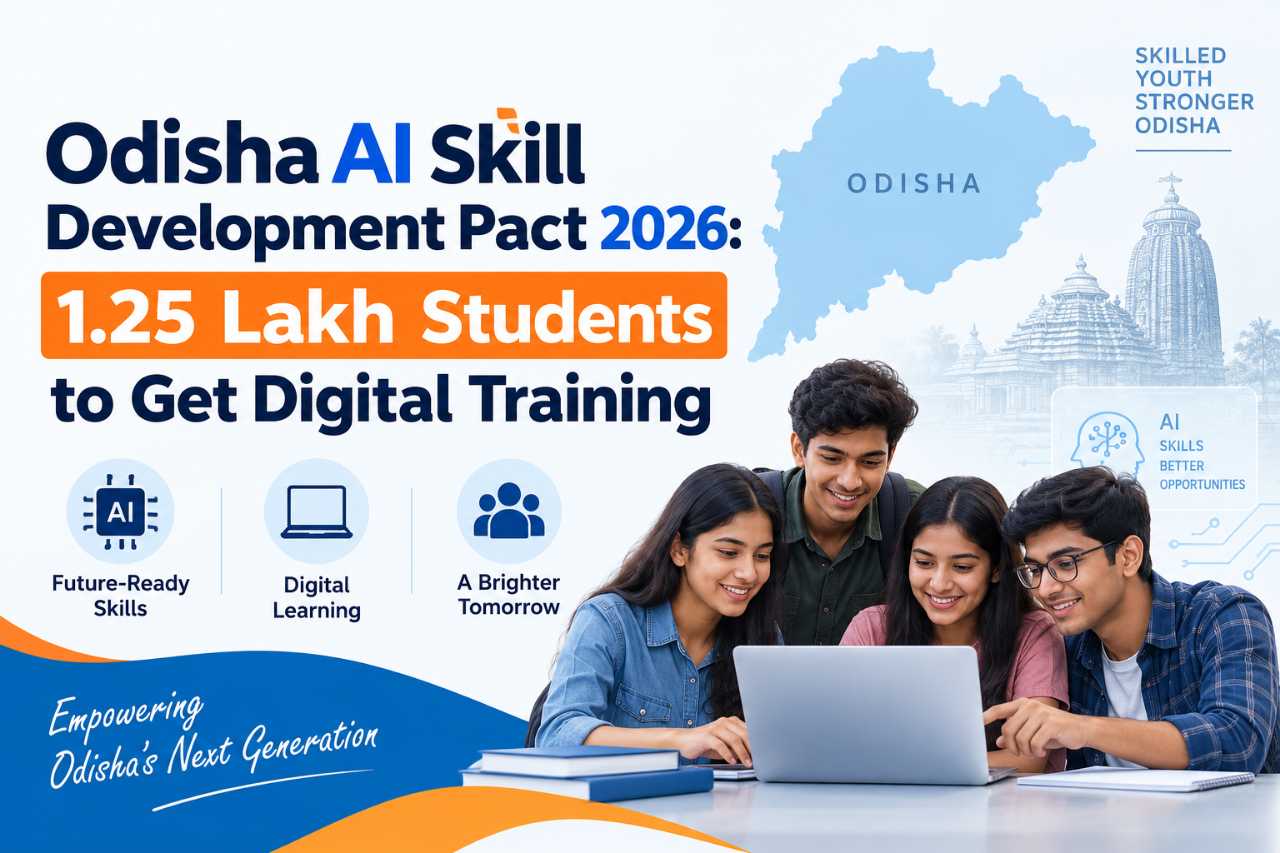
Odisha is taking a major step toward future-ready higher education. On September 6, 2026, the state's Higher Education Department signed skill development agreements with three organisations and rolled out new digital learning initiatives aimed at more than one lakh students. The move reflects a growing national trend: states are partnering with industry and nonprofits to bridge the gap between classroom degrees and real-world employability especially in artificial intelligence, digital literacy, and communication skills.
For students in Odisha colleges, these programmes could mean structured access to AI training, project-based learning, and employability modules without leaving their campus ecosystem. For parents and educators, the launch also signals stronger accountability through new assessment and question-bank portals. This guide explains what was announced, who benefits, how the partnerships work, and what students should do next written for clarity, search visibility, and practical action.
What Did Odisha Announce on September 6, 2026?
The Odisha government's Higher Education Department entered into Memorandums of Understanding (MoUs) with three partner organisations and unveiled several linked digital initiatives on the same day. According to official announcements reported in the media, the signatories include:
- CSRBOX (Gujarat-based organisation, partnering with IBM on skill development programmes)
- Naandi Foundation (Telangana-based nonprofit focused on social impact and youth empowerment)
- Odisha Knowledge Corporation Ltd (OKCL) (state-backed body for knowledge and digital learning)
Alongside these MoUs, the department launched the "AI Course for All" programme in collaboration with NASSCOM, plus two new portals the Academic Performance Assessment Portal and the Question Bank Portal. Together, these announcements form a coordinated push to upgrade skills, standardise academic quality, and expand digital access across Odisha's higher education network.
Key Numbers at a Glance
Understanding scale helps students and institutions plan participation early:
- 1.25 lakh+ students expected to benefit from the IBM–CSRBOX skill development track
- 1 lakh+ students targeted under the AI Course for All programme (including faculty upskilling)
- 107 higher educational institutions in remote and aspirational districts receive special focus
- 52 key indicators used in the new Academic Performance Assessment Portal
- 30 hours of communication skills training plus 10 hours of AI-based digital courses under the OKCL agreement
IBM–CSRBOX Partnership: AI, Digital Literacy, and Project-Based Learning
The MoU between Odisha's education department and IBM–CSRBOX is the largest component of the announcement by student reach. More than 1.25 lakh students across the state are set to receive training through a blended model combining online courses, workshops, and hands-on, project-based learning.
Skills Covered Under This Track
Students can expect structured exposure to competencies that employers increasingly treat as baseline requirements rather than optional extras:
- Artificial Intelligence (AI) – fundamentals, applications, and ethical use in professional settings
- Digital literacy – safe and effective use of digital tools, platforms, and data
- Enterprise design thinking – problem-solving frameworks used in product, service, and process innovation
- Project management – planning, execution, teamwork, and delivery skills applicable across sectors
This approach mirrors what dedicated skills universities elsewhere in India already emphasise: industry-aligned curricula, practical projects, and certification pathways rather than theory alone. Institutions such as Maharashtra State Skills University, Delhi Skill and Entrepreneurship University, and Symbiosis Skills and Professional University have shown how state-level and private skills ecosystems can improve graduate outcomes. Odisha's new pact brings a similar philosophy into its public higher education fold at massive scale.
Focus on Remote and Aspirational Districts
A defining feature of the IBM–CSRBOX programme is its emphasis on 107 higher educational institutions located in remote and aspirational districts of Odisha. Students in these regions often face uneven access to industry mentors, internship pipelines, and premium digital infrastructure. By channelling training through their existing colleges, the state aims to reduce geographic inequality in skill acquisition.
If you study at an institution such as Odisha University of Technology and Research, CV Raman Global University Odisha, or GIET University Odisha (Gunupur), watch for official circulars from your department about registration windows, lab requirements, and certification timelines.
Why Project-Based Learning Matters for Placements
Recruiters across IT, banking, manufacturing, and startups increasingly ask candidates to demonstrate applied skills not just marksheets. Project-based learning under the IBM–CSRBOX track allows students to work on real-world scenarios: analysing data sets, designing user journeys, managing team deliverables, and presenting outcomes. These experiences translate directly into stronger internship interviews and campus placement shortlists. Students should proactively document each project with problem statements, tools used, and results achieved.
Naandi Foundation MoU: Employability Training for Final-Year Women Students
The agreement with Naandi Foundation addresses a different but equally critical gap: soft skills and financial readiness among women nearing graduation. Under this pact, offline training will be provided to final-year girl students enrolled in undergraduate and postgraduate programmes across participating institutions.
What Will Students Learn?
The curriculum is designed to improve job-market preparedness through modules that traditional degree syllabi often underweight:
- Financial literacy – budgeting, savings, loans, taxation basics, and informed financial decision-making
- Critical thinking – analysing information, evaluating arguments, and making evidence-based choices
- Public speaking – confidence, structure, and audience engagement for interviews and workplace communication
- Communication skills – verbal and written clarity for professional environments
Research consistently shows that communication and financial awareness strongly influence early-career stability, especially for first-generation graduates and students from semi-urban backgrounds. Offline delivery ensures facilitator support, peer learning, and practice sessions that pure online modules may not fully replicate. Youth-focused development centres such as the Rajiv Gandhi National Institute of Youth Development have long emphasised similar life-skills frameworks at the national level.
Gender-Focused Employability: Why It Was Included
Women graduates in India continue to face higher dropout rates from the formal workforce during early career stages. Targeted offline training for final-year women students acknowledges that employability is not only about technical skills it also depends on confidence, financial independence, and communication in professional settings. Colleges should communicate batch schedules early so students can balance training with final-semester examinations and placement drives.
OKCL Agreement: Communication and AI Through Digital Mode
The Odisha Knowledge Corporation Ltd (OKCL) partnership adds a structured digital skills layer for participating students. As part of this agreement, learners will receive:
- 30 hours of communication skills training
- 10 hours of AI-based courses delivered through digital mode
OKCL's role as a state knowledge body makes it a natural anchor for scalable, standardised digital delivery similar to how open universities extend learning beyond conventional campuses. Students exploring flexible or supplementary credentials may also compare pathways offered by Odisha State Open University when planning long-term upskilling.
The 30-hour communication module is particularly valuable for students from Odia-medium schooling backgrounds who possess strong subject knowledge but want polish in English professional communication a common request at placement cells statewide. The 10-hour AI digital component offers a concise introduction that complements the deeper IBM–CSRBOX and NASSCOM tracks without overwhelming learners already managing degree coursework.
AI Course for All: NASSCOM Collaboration Explained
Separate from the IBM–CSRBOX track, the "AI Course for All" programme launched with NASSCOM targets both students and working faculty members in higher education institutions across Odisha. The programme aims to benefit more than one lakh students, making AI literacy a mainstream expectation rather than a niche elective.
Why Faculty Upskilling Matters
AI education succeeds only when teachers can guide projects, assess outcomes, and integrate tools responsibly into coursework. By including faculty, Odisha acknowledges that institutional transformation depends as much on educator capacity as on student enthusiasm. Faculty trained under AI Course for All can embed relevant modules into existing B.A., B.Sc., B.Com., B.Tech., and professional programmes without waiting for full syllabus revision cycles.
India's broader skills landscape offers useful reference points. Digital-first institutions like Kerala University of Digital Sciences, Innovation and Technology demonstrate how states can build dedicated ecosystems for emerging tech. Tech-skills universities such as Lamrin Tech Skills University Punjab and GH Raisoni International Skill Tech University show how project-led AI and digital curricula align with hiring trends. Odisha's programme brings comparable exposure into the general higher education stream.
Expected Outcomes for Students and Teachers
For students, AI Course for All should demystify concepts like machine learning basics, data awareness, prompt engineering fundamentals, and responsible AI use skills relevant even in non-IT careers such as journalism, law, commerce, and healthcare administration. For faculty, the programme supports lesson planning, assessment redesign, and academic integrity policies in an era where generative AI tools are widely accessible. Institutions that upskill teachers early typically see smoother adoption and fewer academic misconduct issues later.
New Portals: Academic Performance Assessment and Question Bank
Skill initiatives alone do not improve systemic quality unless institutions are measured and supported consistently. Two new portals address that need.
Academic Performance Assessment Portal
Launched by the Odisha State Higher Education Council, this portal will assess higher education institutions using 52 key indicators. Such frameworks typically cover areas like infrastructure, faculty qualifications, research output, student support services, placement records, and digital readiness though exact weightages should be verified from official council documentation.
For students and parents, transparent institutional assessment supports better college selection. For colleges, the portal creates incentives to improve weak parameters proactively rather than reactively. Research-oriented bodies like the Indira Gandhi Institute of Development Research Mumbai highlight how data-driven evaluation improves policy decisions; Odisha's portal applies a similar logic at the state higher education level.
Question Bank Portal
The Question Bank Portal supports standardised academic evaluation by providing curated question resources. When implemented well, question banks reduce arbitrary assessment gaps between colleges, help faculty design fair examinations, and support consistent learning outcomes tracking especially important as AI and digital skills modules enter mainstream curricula.
Students preparing for semester examinations should ask faculty whether question bank resources align with new skill modules. Combining conceptual study with practical AI and communication exercises produces better long-term retention than rote memorisation alone.
Comparison: Three MoU Tracks Side by Side
Students often confuse overlapping initiatives. The table below summarises the three MoU tracks announced on September 6, 2026:
- IBM–CSRBOX track: 1.25 lakh+ students; online courses, workshops, project-based learning; AI, digital literacy, design thinking, project management; priority for 107 institutions in remote/aspirational districts
- Naandi Foundation track: Final-year women UG/PG students; offline training; financial literacy, critical thinking, public speaking, communication
- OKCL track: Digital mode; 30 hours communication skills + 10 hours AI courses; scalable statewide delivery through state knowledge infrastructure
Additionally, AI Course for All (NASSCOM) runs as a parallel flagship programme covering students and faculty with AI-focused upskilling across Odisha's higher education sector.
Who Should Pay Attention to This Announcement?
While the programmes are state-led, specific groups stand to gain the most immediate value:
- Final-year undergraduate and postgraduate students, especially women eligible for Naandi Foundation offline training
- Students in 107 priority institutions across remote and aspirational districts
- Faculty members seeking structured AI upskilling through AI Course for All
- College administrators responsible for MoU compliance, data reporting, and portal integration
- Parents and counselors guiding students toward employable credentials alongside degrees
Students outside Odisha can treat this as a benchmark. Several states now operate dedicated skills universities Assam Skill University, Atal Bihari Vajpayee Skill University, Vishwakarma Skills University Jaipur, and Bhartiya Skill Development University Jaipur among them each offering parallel pathways for industry-ready learning.
How This Fits India's Broader Skills and AI Education Push
Odisha's announcement did not happen in isolation. Across India, governments, industry bodies, and universities are responding to rapid AI adoption in banking, healthcare, agriculture, logistics, education, and public services. National priorities around digital India, startup growth, and workforce readiness have pushed states to experiment with scalable partnerships rather than building every programme from scratch.
Partnerships with organisations like NASSCOM and IBM leverage existing courseware, mentor networks, and certification standards reducing rollout time. Nonprofit collaborators such as Naandi Foundation bring ground-level training expertise and focus on inclusion. State entities like OKCL ensure alignment with local policy and institutional structures.
For students comparing options nationally, dedicated skills institutions ITM Skills University, Medhavi Skills University, Rungta International Skills University, Seacom Skills University, and Team Lease Skills University remain valuable for full-time, credential-focused study. Odisha's new initiative complements degrees by embedding skills within the college experience itself.
Actionable Tips for Odisha College Students
Announcements create opportunity only when students act early. Here are practical steps:
- Check your college notice board and official email for MoU-related registration links and eligibility criteria.
- Confirm your district and institution category priority colleges in aspirational districts may receive resources first.
- Final-year women students should inquire specifically about Naandi Foundation offline batches and schedules.
- Build a skills portfolio save project outputs, certificates, and workshop participation records for placements and higher studies.
- Combine AI training with domain knowledge AI skills paired with commerce, science, law, or engineering degrees are far more marketable than generic certificates alone.
- Faculty members should register early for AI Course for All to integrate modules into upcoming semesters.
- Use the Question Bank Portal responsibly for exam preparation once your institution publishes access details.
- Track Academic Performance Assessment indicators when choosing electives, internships, or college transfer options.
Career Pathways After Completing AI and Digital Skills Training
Students often ask whether short-duration state programmes translate into careers. While these modules are not replacements for full degrees, they improve readiness for entry-level roles and internships in several domains:
- IT and software services – junior analyst, QA support, data entry and annotation, technical support with AI tool familiarity
- Banking and financial services – customer operations, KYC processing, digital banking support roles requiring communication and financial literacy
- Digital marketing and content – roles benefiting from digital literacy and communication training; compare with specialised institutes like Jaipur Institute of Digital Marketing
- Public sector and administrative support – data handling, report writing, and project coordination
- Entrepreneurship – design thinking and project management modules support startup ideation and business planning
Students aiming for deeper specialisation may later pursue full programmes at institutions such as G H Raisoni Skill Tech University Nagpur, Scope Global Skills University, or Kaushalya The Skill University while retaining the foundation built through Odisha's college-level initiatives.
Challenges and What to Watch For
Large-scale skill programmes succeed on execution, not intent alone. Students and institutions should monitor a few common risk areas:
- Uneven internet access in remote campuses may affect digital course completion unless offline support is provided
- Overlap between multiple tracks (IBM–CSRBOX, OKCL, NASSCOM) could confuse students unless colleges publish a single consolidated calendar
- Certification recognition verify whether certificates carry industry or state endorsement valued by employers
- Assessment portal data accuracy institutions must submit reliable information for the 52-indicator framework to remain meaningful
- Sustainability beyond launch year follow-up funding and trainer availability determine long-term impact
Asking clear questions through student unions, IQAC cells, and department coordinators helps ensure accountability an approach consistent with good academic governance anywhere in India. Development-focused universities such as Karnataka State Rural Development and Panchayat Raj University demonstrate how regional institutions can scale impact when training infrastructure and community engagement align.
Conclusion: A Structured Leap Toward AI-Ready Graduates in Odisha
Odisha's September 2026 skill development pact marks a coordinated effort to train more than one lakh students in AI, digital literacy, communication, and employability skills while strengthening institutional accountability through new assessment and question-bank portals. By combining industry partnerships (IBM–CSRBOX, NASSCOM), social-sector training (Naandi Foundation), and state digital delivery (OKCL), the Higher Education Department is attempting to reach students where they already study including 107 institutions in remote and aspirational districts.
For students, the immediate priority is simple: stay informed, register on time, and treat these modules as career investments rather than optional add-ons. For Odisha's higher education ecosystem, successful implementation could raise graduate readiness, improve institutional ratings on the new assessment portal, and position the state alongside leading digital skills initiatives nationwide. As official timelines, registration links, and college-wise schedules are released, CollegeDwar will continue tracking updates relevant to admissions, courses, and career planning across Odisha and India.