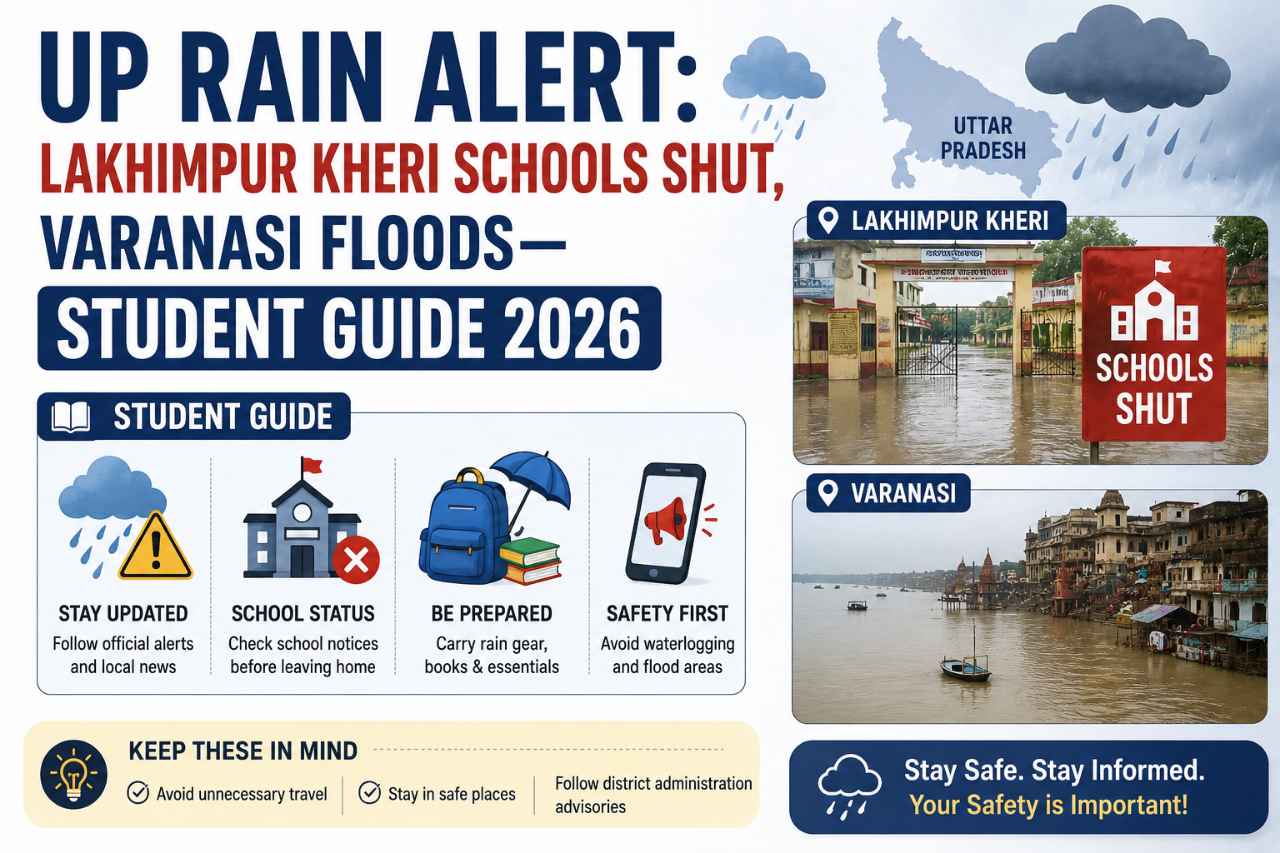

Heavy monsoon rain across Uttar Pradesh on Tuesday, September 1, 2026, disrupted daily life in two very different education hubs: Lakhimpur Kheri in the state's northern Terai belt and Varanasi, one of India's oldest centres of learning. School closures, flooded streets, suspended train services, and rising river levels forced families, teachers, and college aspirants to rethink travel plans, exam preparation routines, and campus visits at a critical point in the academic calendar.
For students preparing for board exams, university admissions, and competitive tests, weather emergencies are not just news headlines—they directly affect attendance, counselling deadlines, document verification, and safety during commutes. This guide explains what happened in Lakhimpur Kheri and Varanasi, how the closures work, what higher-education institutions in the region should know, and practical steps students and parents can take when floods interrupt schooling.
What Happened in Lakhimpur Kheri and Varanasi on September 1, 2026?
Incessant rainfall on Tuesday caused severe waterlogging across Lakhimpur Kheri and Varanasi districts. While both regions struggled with standing water and disrupted transport, the immediate impact on education differed: Lakhimpur authorities ordered a district-wide holiday for schools up to Class 8, whereas Varanasi faced a broader civic emergency with boats deployed on flooded lanes and religious ceremonies shifted away from river ghats.
Lakhimpur Kheri: Schools Closed Up to Class 8
District Basic Education Officer Pravin Tiwari announced that all schools teaching up to Class 8 in Lakhimpur would remain closed on Tuesday due to heavy downpour. This decision typically covers government primary and upper-primary schools, as well as many private institutions that follow district advisories for safety during extreme weather.
The closure did not automatically extend to all senior secondary or college-level institutions, but students travelling from rural blocks—especially near the Nepal border—may still have faced unsafe road conditions. Families with children in Classes 9 to 12 and those enrolled in local degree colleges should verify status through school WhatsApp groups, the district education office, or official social media channels before assuming normal operations.
Varanasi: Flood-Like Conditions Along the Ganga
In Varanasi, rising water in the Ganga created a flood-like situation across low-lying wards. According to the Central Water Commission (CWC), the river level was recorded at 70.28 metres at 10 am on Tuesday, marginally above the warning level of 70.26 metres and below the danger mark of 71.262 metres. The CWC noted the river was rising at approximately 0.5 centimetre per hour. The highest-ever recorded level in Varanasi stands at 73.901 metres.
District officials reported boats operating on several waterlogged lanes, while cremations at the Manikarnika and Harishchandra ghats were carried out on rooftops and bylanes after traditional riverbank sites flooded. Families along the Varuna river had already been evacuated to relief camps. For students at universities and colleges in the city, the disruption was less about formal closure orders and more about impassable roads, delayed public transport, and campus access challenges.
Nepal Border Rivers and the Sharda: Why Lakhimpur Faces Repeated Flood Risk
Lakhimpur Kheri's geography makes it especially vulnerable during monsoon bursts. The district sits in the Terai region, where rivers originating in Nepal can swell rapidly after upstream rainfall, even when local skies appear manageable.
Mohana and Karnali Rivers Near Tikunia
Authorities flagged rising water levels in the Mohana and Karnali rivers in the Tikunia area of Nighasan tehsil, close to the Nepal border. Both rivers originate in Nepal, and their unregulated flow affects several border villages in Kheri district, including settlements around Dudhwa National Park. When these tributaries overflow, rural roads to schools and colleges become unusable long before urban centres announce closures.
Sharda River Disrupts Train Services
Rising water in the Sharda river disrupted rail connectivity on the Mailani-Nanpara section. Water seepage between Bhira and Palia stations led to suspension of around half a dozen trains. North Eastern Railway (NER) PRO Mahesh Gupta stated that services between Mailani, Bichhia, and Nanpara would remain suspended until further orders.
For students who depend on trains to reach coaching centres, examination centres, or institutions such as North Lakhimpur University, such suspensions can delay document submissions, entrance test travel, and hostel move-ins. Always keep scanned copies of admission forms, identity proofs, and fee receipts in cloud storage when travelling during monsoon season.
Impact on Higher Education in Varanasi: IIT BHU, BHU Affiliates, and More
Varanasi is among India's most important student cities, hosting central universities, IITs, and specialised institutes that attract learners from every state. Heavy rain rarely closes these institutions outright, but flooding affects daily logistics in ways that matter for admissions season.
Major Institutions and Campus Access
Students at Indian Institute of Technology Banaras Hindu University Varanasi (IIT BHU) often live on campus, which reduces commute risk during urban flooding. However, visitors attending counselling, orientation, or JEE Advanced-related procedures may face delays if auto-rickshaw routes near the Varuna or Ganga ghats are submerged.
Similarly, learners at Mahatma Gandhi Kashi Vidyapeeth Varanasi and Sampurnanand Sanskrit Vishwavidyalaya Varanasi should confirm whether administrative offices remain open before travelling for certificate verification or revaluation applications. Research scholars at Central Institute Of Higher Tibetan Studies Varanasi may need to coordinate with supervisors if fieldwork or library access is restricted.
What Students Should Do During Campus Visits in Monsoon
- Check official institute websites and student portals—not unverified WhatsApp forwards—for schedule changes.
- Carry waterproof pouches for admission letters, caste/income certificates, and medical documents.
- Prefer daytime travel; several Varanasi lanes flood quickly after evening showers.
- Save helpline numbers for hostel wardens, local municipal flood control rooms, and railway inquiry.
- If counselling dates clash with travel bans, email the admissions cell immediately with proof of disruption.
Understanding UP School Closure Orders: Who Is Affected and for How Long?
When a District Basic Education Officer (DBEO) declares a holiday for schools up to Class 8, the order flows through the Basic Shiksha Adhikari (BSA) network covering primary and upper-primary schools. These closures are usually announced for a single day and reviewed based on the next morning's weather and road assessments.
Classes Covered Under Typical Rain Holidays
| Category | Usually Covered? | Notes |
|---|---|---|
| Classes 1 to 5 (Primary) | Yes | Young children face highest safety risk during waterlogging |
| Classes 6 to 8 (Upper Primary) | Yes | Included in Lakhimpur's September 1 order |
| Classes 9 to 12 | Case-by-case | Depends on secondary education officer or individual school decision |
| Degree colleges and universities | Rarely via same order | Autonomous decisions by registrars or deans |
| Coaching centres | Not automatic | Operators decide based on attendance and staff availability |
How Closures Are Communicated
In districts like Lakhimpur Kheri, announcements may appear through the DBEO office, local newspapers, All India Radio, and district collector social media handles. Parents should treat unofficial Telegram channels cautiously and cross-check with at least one official source. For board-registered schools, the UP Madhyamik Shiksha Parishad sometimes issues supplementary advisories during state-wide emergencies, though local rain holidays remain primarily a district function.
Exams, Admissions, and Deadlines: What Changes During Flood Disruptions?
September sits at the intersection of multiple academic timelines—UP Board advance registration for Classes 9 and 11, national counselling rounds for NEET and engineering programmes, scholarship applications, and university spot admissions. Weather events rarely cancel national deadlines automatically, but students can often request extensions with valid documentation.
Board Registration and State-Level Processes
Students completing UP Board Class 9 and 11 advance registration should monitor Parishad notifications. If flood conditions prevent visiting the school for fee submission or form verification, contact your school principal immediately. Many institutions accept delayed submission with a written explanation when district authorities confirm closures.
National Entrance Exam Counselling
NEET UG, JEE, and other national counselling schedules continue on central portals even when local schools close. Candidates from Lakhimpur or Varanasi who cannot reach reporting centres should:
- Download the seat allotment letter and travel advisory screenshots.
- Contact the institute's admission helpdesk before the reporting time expires.
- Explore whether online document upload or deferred physical reporting is permitted.
- Keep NER train cancellation notices if rail disruption caused the delay.
Local University Admissions
Aspirants targeting North Lakhimpur University for undergraduate or postgraduate programmes should watch the university website during monsoon months. Rural students from Nighasan, Palia, or Tikunia blocks may need extra travel days after Sharda river flooding recedes and train services resume on the Mailani-Nanpara section.
Safety Guidelines for Students and Parents During Urban Flooding
Floodwater in Indian cities often carries sewage, sharp debris, and open manholes hidden beneath murky surfaces. Students are among the most mobile populations—and therefore among the most exposed when classes resume before roads are fully safe.
Commuting Do's and Don'ts
- Do use main roads identified by municipal authorities, even if the route is longer.
- Do not wade through knee-deep water to reach coaching classes; missing one session is safer than injury or infection.
- Do share live location with family when travelling through Varanasi's old city during alerts.
- Do not rely on boats operated by untrained private operators in lanes not approved by disaster response teams.
Health and Hygiene After Exposure
If you must travel through waterlogged areas to reach an exam centre or college office, wash exposed skin with clean water, avoid touching your face, and seek medical advice if cuts come into contact with floodwater. Leptospirosis and waterborne infections spike after urban floods in the Gangetic plain.
Digital Continuity for Learning
When schools up to Class 8 close, parents can maintain learning continuity through DIKSHA app modules, NCERT ePathshala resources, and teacher-assigned homework via school groups. Higher-education students should backup project files and use institute LMS platforms if physical labs remain inaccessible.
Monsoon Preparedness Checklist for UP Board and University Students
Students across Uttar Pradesh—whether in flood-prone Terai districts or ancient riverine cities—benefit from treating monsoon readiness as part of academic discipline rather than an afterthought. Below is a practical checklist families can follow each June before the heaviest rains arrive.
Before the Rains Peak
- Photograph and upload all board mark sheets, Aadhaar copies, and admission receipts to secure cloud folders.
- Identify two alternative routes to your school, coaching centre, or college campus—one using main roads and one using elevated arterial lanes.
- Save offline copies of NCERT chapters and institute lecture notes in case mobile networks fail during storms.
- Register for SMS alerts from the Central Water Commission if you live near the Ganga, Varuna, Sharda, or Ghaghara basins.
- Confirm hostel room placement on upper floors when joining institutions in Varanasi during July–August admissions.
During Active Flood Alerts
When district authorities announce closures—as DBEO Pravin Tiwari did for Lakhimpur schools up to Class 8—use the unexpected break productively rather than treating it as lost time. Senior students can revise core subjects, complete pending scholarship forms such as NMMSS or state merit schemes, and update college preference lists for upcoming counselling rounds. Parents of primary students should engage children with structured reading through DIKSHA and state textbook portals so syllabus pace is maintained when classrooms reopen.
College aspirants waiting to visit IIT BHU Varanasi for orientation should reschedule rather than risk travel through ghats where boats replaced foot traffic on September 1. Admission teams at most universities understand weather-related delays when applicants provide timely written notice with supporting evidence such as district advisories or NER cancellation screenshots.
After Water Recedes
- Inspect school bags and document folders for moisture damage; laminate critical certificates if edges show dampness.
- Confirm reopening through official channels before resuming attendance—some rural blocks near Tikunia or Dudhwa remain inaccessible even after urban centres resume classes.
- Report damaged textbooks or uniforms to school administrators; many government schools maintain contingency stocks after flood seasons.
- Review whether mid-term tests or internal assessments were rescheduled and update study calendars accordingly.
Long-term, students considering higher education in eastern UP should weigh infrastructure resilience alongside course quality. Institutions in Varanasi offer unmatched academic heritage—from engineering at IIT BHU to Sanskrit studies at Sampurnanand Sanskrit Vishwavidyalaya—but choosing hostels away from chronic waterlogging zones saves stress every monsoon. Similarly, applicants to North Lakhimpur University should ask seniors about rail reliability on the Mailani-Nanpara section during Sharda river swell events before finalising travel-dependent admission plans.
Why Monsoon Disruptions Matter for Long-Term Education Planning
Repeated flood-related closures highlight a planning gap for students in riverine districts. Families investing in higher education—whether at IIT BHU, a local state university, or professional colleges elsewhere in India—should factor monsoon resilience into housing, budgeting, and timeline buffers.
Choosing Colleges with Geographic Awareness
When comparing institutions, look beyond rankings and cut-offs. Ask current students about hostel drainage, exam postponement history, and how quickly campuses reopen after extreme rain. Varanasi's academic ecosystem is robust, but low-lying hostels near the ghats face predictable challenges each monsoon. Lakhimpur's connectivity depends heavily on rail and rural roads vulnerable to transboundary river swell.
Building a Personal Academic Contingency Plan
- Maintain a digital folder of all certificates and application IDs.
- Register for official SMS/email alerts from UP Basic Education and your university.
- Keep a monsoon fund for unexpected travel or temporary lodging near exam centres.
- Follow CWC flood bulletins if your commute crosses the Ganga, Sharda, or Varuna basins.
- Coordinate with mentors at institutions like IIT BHU Varanasi or MGKVP Varanasi for flexible submission windows when possible.
Comparing Lakhimpur Kheri and Varanasi: Two Flood Stories, One State
Although both districts experienced heavy rain on the same day, the education impact followed different patterns. Lakhimpur responded with a formal school holiday for younger students, reflecting concern over rural access and Nepal-origin river surges. Varanasi experienced visible urban inundation—boats on streets, shifted cremations, evacuations along the Varuna—without a blanket school shutdown reported at the same scale.
Key Differences at a Glance
| Factor | Lakhimpur Kheri | Varanasi |
|---|---|---|
| Primary education action | Schools up to Class 8 closed on September 1 | No district-wide Class 8 closure announced in source reports |
| Main river concern | Sharda, Mohana, Karnali | Ganga (70.28 m at 10 am), Varuna flooding |
| Transport impact | Train suspension on Mailani-Nanpara section | Boats on waterlogged lanes; local road disruption |
| Higher-ed hub | North Lakhimpur University region | IIT BHU, MGKVP, Sanskrit University, CIHTS |
| Border dimension | Nepal-origin rivers affect Tikunia, Dudhwa belt | Primarily urban riverine flooding |
Students applying to colleges in either city should research hostel locations on elevated terrain, confirm alternative transport when NER sections suspend service, and stay informed through official channels rather than rumour networks.
Government Response and Where to Find Official Updates
Effective crisis communication helps students avoid unnecessary travel while ensuring critical exams and admissions are not missed without cause. In UP, multiple agencies coordinate during floods:
- District Basic Education Officer (DBEO): Primary and upper-primary school holidays.
- District Magistrate / Collector: Evacuation orders and relief camp information.
- Central Water Commission: River level bulletins for the Ganga at Varanasi.
- North Eastern Railway: Train cancellation and restoration updates for Lakhimpur section.
- University registrars: Campus-specific attendance and exam postponements.
Bookmark the official websites of your target institutions—such as Sampurnanand Sanskrit Vishwavidyalaya Varanasi and Central Institute Of Higher Tibetan Studies Varanasi—for the most accurate local guidance during extreme weather.
Conclusion: Staying on Track with Your Education Goals Despite Monsoon Setbacks
The September 1, 2026, rain emergency in Lakhimpur Kheri and Varanasi reminds every student and parent that academic success depends not only on syllabus completion but also on preparedness for predictable seasonal disruptions. School closures up to Class 8 in Lakhimpur, Ganga levels brushing the warning mark in Varanasi, and train suspensions on the Mailani-Nanpara route are manageable hurdles when you verify information through official sources, protect documents, and communicate early with schools and colleges.
Whether you aspire to study at North Lakhimpur University close to the Terai's river networks or pursue technical and humanities programmes at IIT BHU and allied Varanasi campuses, build monsoon buffers into your admission calendar. One day of closure does not derail a career—but uninformed travel during active flooding can. Plan ahead, stay safe, and keep your academic paperwork ready for whatever the skies bring next.