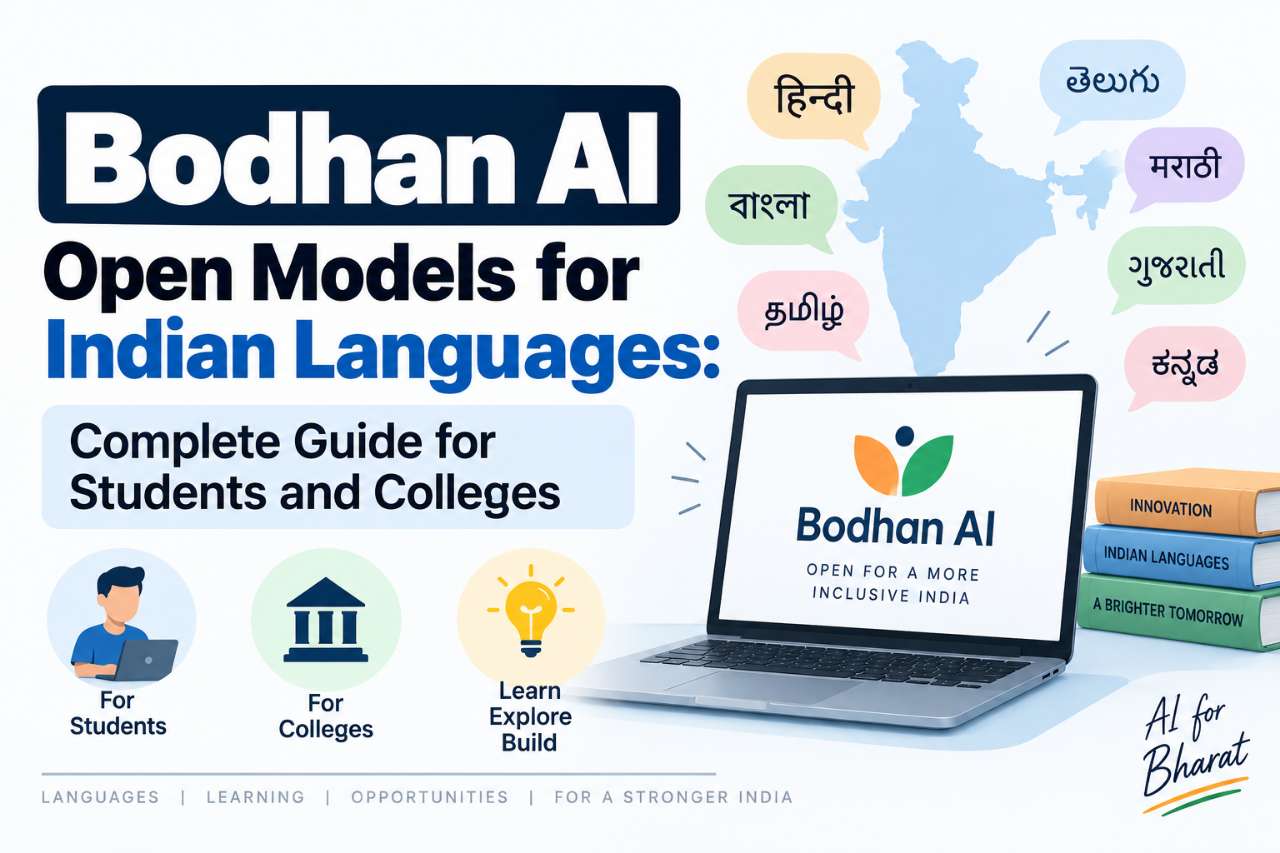
India's higher education landscape is changing fast as artificial intelligence moves from English-only tools to systems that understand the country's linguistic diversity. In September 2026, Bodhan AI an initiative incubated at the Indian Institute of Technology Madras released four open foundational AI models for Indian languages in partnership with AI4Bharat. These models support speech recognition, translation, text-to-speech, and optical character recognition across dozens of Indian languages, and are offered as digital public goods under the broader Bharat EduAI Stack vision.
For students preparing for JEE, NEET, and board exams, and for teachers working in multilingual classrooms, this launch matters because it signals a shift toward sovereign, India-first AI infrastructure in education. This guide explains what the models do, who can use them, and what they mean for colleges, schools, and edtech across the country.
What Did Bodhan AI and AI4Bharat Launch?
Bodhan AI, incubated at IIT Madras Chennai, has launched four foundational AI models designed specifically for India's multilingual education ecosystem. Developed with AI4Bharat a research group known for open-source Indian-language datasets, tools, and models the release targets students, teachers, edtech companies, universities, and government partners who need reliable AI that works in regional languages rather than only in English.
Unlike closed commercial systems, these models are positioned as digital public goods. That means organisations can build, adapt, and deploy applications on top of a shared layer instead of every institution rebuilding the same speech or translation infrastructure from scratch. Bodhan AI describes this as early output of the Bharat EduAI Stack, envisioned as sovereign digital public infrastructure for education AI in India.
Alongside the four models, Bodhan AI also introduced two application-layer tools: a Student Tutor Bot for Classes 6 to 12 and a Teacher Assistant Bot for classroom planning and assessment. Together, the launch represents one of the most significant open-language-AI announcements in Indian education in recent years.
The Four Open Models: Capabilities and Language Coverage
Each model addresses a distinct need in multilingual learning environments. Understanding what each one does helps students, faculty, and developers decide how to integrate them into existing workflows.
1. Automatic Speech Recognition (ASR)
The ASR model converts spoken language into text. It supports 27 Indian languages, making it useful for voice-based tutoring, oral exam practice, accessibility tools, and classroom transcription. Students who are more comfortable speaking in Hindi, Tamil, Bengali, or other regional languages can interact with AI systems without typing in English.
Bodhan AI post-trained NVIDIA Nemotron 3.5 ASR to handle Indian languages, including regional dialects and accents a critical detail because standard global ASR models often perform poorly on Indian speech patterns.
2. Text-to-Speech (TTS)
The TTS model converts written text into natural-sounding speech across 23 languages. This supports audiobook-style learning, screen readers, language practice, and voice responses in tutoring apps. For visually impaired learners and students in low-literacy contexts, TTS can make NCERT and state-board content far more accessible.
3. Bodhan-Translate (Machine Translation)
Bodhan-Translate supports translation across 22 Indian languages. Machine translation can help a student in Odia access explanations originally created in Marathi, or allow a teacher in Kerala to adapt material for a multilingual classroom. When paired with curated educational content, translation models can reduce the English-only barrier that many Indian students face during exam preparation.
4. Optical Character Recognition (OCR)
The OCR model recognises and extracts text from documents and images in 23 languages. It can read printed textbooks, worksheets, handwritten answers, and scanned notes. For schools using paper-based assessments or for students photographing homework, OCR bridges the gap between physical learning materials and digital AI tools.
Below is a quick comparison of the four models:
| Model | Primary Capability | Languages Supported |
|---|---|---|
| ASR | Speech to text | 27 |
| TTS | Text to speech | 23 |
| Bodhan-Translate | Cross-language translation | 22 |
| OCR | Text extraction from images/documents | 23 |
These models were trained and optimised using NVIDIA Nemotron open models and libraries, including the NVIDIA NeMo framework for ASR, machine translation, and OCR. Inference is served through NVIDIA TensorRT-LLM and vLLM microservices, which helps organisations deploy them efficiently at scale.
Why Sovereign AI Matters for Indian Education
Global AI systems dominate headlines, but most are trained primarily on English and Western contexts. For Indian students whether preparing for board exams, JEE Main, NEET UG, or state-level engineering and medical entrances language is not a minor feature. It shapes whether a student can ask doubts, understand explanations, and complete assessments confidently.
IIT Madras Director Prof. V. Kamakoti emphasised that India's AI journey must be built on technology that understands the country, not technology alone. He described the voice and vision models as an important step toward sovereign digital public infrastructure for AI in education systems that serve India's linguistic diversity and enable innovation at scale.
The concept of sovereign AI in this context does not mean isolation from global research. It means India controls foundational layers data practices, deployment models, language coverage, and governance so that education AI serves Indian institutions on Indian terms. Bodhan AI's hosted API infrastructure is being developed around a sovereign deployment model, giving institutions and partners greater control over how capabilities are deployed.
Institutions such as IIT Delhi, IIT Bombay, and the network of Indian Institutes of Information Technology are already investing heavily in AI research and campus innovation. Bodhan AI's open models give these ecosystems a shared language-AI foundation rather than forcing each campus or startup to duplicate foundational work.
Bodhan AI and AI4Bharat: Building With the Ecosystem
Bodhan AI's approach is deliberately collaborative. Principal Investigator Mitesh Khapra stated that the organisation aims to build with the ecosystem, not compete with it. By releasing voice and vision models as digital public goods on shared digital public infrastructure, Bodhan AI hopes to reduce fragmentation across India's edtech and research landscape.
AI4Bharat brings deep expertise in Indian-language AI, multilingual modelling, and open datasets. Its partnership with Bodhan AI strengthens the data and evaluation pipeline needed for models that perform reliably across scripts, dialects, and educational contexts.
Prof. Balaraman Ravindran, Head of the Wadhwani School of Data Science and AI (WSAI) at IIT Madras, noted that building AI for India requires more than adapting existing models it requires foundational capabilities that understand the richness of Indian languages and educational needs. Open-weight models and APIs allow researchers, startups, and education innovators to experiment and build India-relevant applications at scale.
For language-focused institutions such as The English and Foreign Languages University Hyderabad, such open infrastructure creates opportunities for research collaboration, curriculum innovation, and new bilingual pedagogy tools.
Student Tutor Bot: AI Support for Classes 6 to 12
Beyond raw models, Bodhan AI launched the Student Tutor Bot, aimed at school students from Classes 6 to 12. The bot is aligned with NCERT and SCERT curricula, which makes it directly relevant for board exam preparation across CBSE and state boards.
Key Features for Students
- Multilingual input: Students can ask questions via text or voice in 22 Indian languages.
- Curriculum-grounded answers: Explanations draw from textbook content, with examples and assessments.
- Step-by-step guidance: The bot can walk students through problems rather than giving one-line answers.
- Interactive digital canvas: Supports diagrams, calculations, and visual work useful for maths and science.
- Adaptive learning signals: Student responses can inform subsequent learning support.
For a Class 10 student revising for board exams or a Class 12 student balancing NEET or JEE preparation with school syllabus, a tutor bot that understands regional languages can reduce dependence on English-only doubt-solving platforms. It also supports students in tier-2 and tier-3 cities where access to quality coaching in local languages remains uneven.
Actionable Tips for School Students
- Use voice mode if typing in English slows you down practice framing clear questions aloud.
- Cross-check AI explanations with your NCERT textbook until you trust the tool for a given subject.
- Use the canvas feature for maths and physics problems instead of skipping steps.
- Share useful interactions with classmates preparing for the same board or entrance exam.
Teacher Assistant Bot: Planning, Content, and Assessment
The Teacher Assistant Bot is designed as an AI workspace for educators. Rather than replacing teachers, it helps them plan, create, assign, assess, and refine classroom work more efficiently especially in multilingual settings where preparing differentiated material takes significant time.
What Teachers Can Do
- Generate lesson plans, worksheets, quizzes, homework, and revision sheets.
- Specify grade, subject, topic, duration, difficulty, and assessment requirements.
- Upload student work for evaluation against defined marking criteria.
- Review, edit, regenerate, or discard AI output before using it in class.
Bodhan AI has been clear that AI-generated content will not automatically become a classroom decision. Teachers remain in control a design choice that aligns with responsible AI principles and with how most Indian schools and colleges expect technology to support, not override, professional judgment.
Teacher training colleges, DIETs, and university B.Ed. programmes can use such tools to demonstrate how AI assists lesson design while preserving pedagogical oversight. Institutions like IIIT Lucknow and IIIT Guwahati, which combine technology and education innovation, may also explore integration in teacher upskilling initiatives.
Impact on Higher Education, Admissions, and Exam Preparation
Although the Student Tutor Bot targets school grades, the foundational models have broader implications for higher education in India.
Bridge from School to College
Students entering engineering programmes at IITs, NITs, and IIITs often face an English-heavy academic environment even when they studied in regional languages till Class 12. Open translation, speech, and OCR tools can help bridge that transition supporting note-taking, textbook reading, and lab documentation in multiple languages during the crucial first year.
Entrance Exam Ecosystem
JEE, NEET, CUET, and state entrance exams serve millions of candidates annually. Edtech platforms built on Bodhan AI's open layer could offer vernacular mock tests, voice-based doubt clearing, and OCR for scanning handwritten practice sheets. This is especially relevant for aspirants from non-metro cities who may not afford premium English-only coaching.
Research and Campus Innovation
Universities incubating startups or running AI labs such as those at IIEST Shibpur or ABVIITM Gwalior can build domain-specific applications without training language models from zero. Researchers can fine-tune applications for legal, medical, agricultural, or financial education using a common Indian-language base.
Management and Professional Education
Even MBA and executive education programmes at institutions like IIM Kozhikode or IIM Lucknow benefit when case discussions, simulations, and study material can be accessed in multiple languages supporting diversity in cohorts and inclusive classroom participation.
Data Privacy, Governance, and Responsible Deployment
Education AI raises legitimate concerns about student data, consent, and institutional accountability. Bodhan AI has stated that data privacy and responsible deployment are central to its architecture.
- Data anonymisation protocols are planned as part of the system design.
- Compliance with applicable national education data frameworks is a stated priority.
- Sovereign deployment gives institutions greater control over where and how AI runs.
- The guiding principle is "AI for India, governed in India."
For colleges evaluating edtech vendors, these points should be part of procurement checklists: Where is student data processed? Can the institution opt for on-premise or sovereign cloud deployment? Can teachers audit AI-generated content before it reaches students?
Parents and students should also ask whether a tutoring app uses closed foreign models with unclear data policies or India-focused infrastructure with transparent governance. As AI becomes common in admissions counselling, lecture capture, and proctoring, responsible deployment is not optional it is a baseline expectation.
How EdTech Companies, Startups, and Colleges Can Use the Models
Bodhan AI intends these models to power a wide ecosystem. Here is how different stakeholders can think about adoption:
EdTech and Coaching Institutes
Coaching chains preparing students for JEE, NEET, and board exams can integrate ASR and TTS for vernacular video lectures, voice quizzes, and automated transcription of live classes. OCR can digitise handwritten test papers for faster feedback.
State Education Departments
SCERT-aligned content in multiple languages can be translated and narrated at scale, supporting NEP 2020 goals around multilingual education and reducing dependence on English-only digital resources.
Universities and IIITs
Campus teams at institutions such as IIIT Pune, IIIT Kota, and IIIT Kottayam can prototype accessibility tools, regional-language MOOCs, and research projects on top of open APIs rather than rebuilding foundational models.
Independent Developers and Researchers
Open-weight models enable experimentation fine-tuning for tribal languages, domain-specific medical vocabularies, or local exam patterns while contributing improvements back to the ecosystem.
What Aspiring IIT and IIIT Students Should Know
If you are preparing for JEE Advanced and hoping to study at IIT Madras or peer institutions, this launch is a glimpse of the research culture you may join. IIT Madras has been active across AI, data science, edtech incubation, and multilingual computing. Understanding Bodhan AI helps you see how top Indian labs translate research into public infrastructure.
Practical takeaways for aspirants:
- Explore multilingual AI tools early if English is a barrier in self-study do not wait until college.
- Follow how NCERT-aligned bots handle physics and maths explanations; compare with your coaching material.
- Learn basic AI literacy: what models can and cannot do, and how to verify answers.
- If you enjoy coding, experiment with open Indian-language APIs strong projects help in IIT and IIIT portfolios.
Admission to premier institutes still depends on exam performance, counselling, and eligibility criteria but the learning tools available during preparation are improving rapidly for Indian language users.
Future of Bharat EduAI Stack and Indian Language AI
The September 2026 launch is described as an early output, not the final state of Bharat EduAI Stack. NVIDIA and Bodhan AI are collaborating on datasets, training methods, and evaluations for future foundational models. AI4Bharat's continued involvement suggests ongoing expansion in language coverage, dialect handling, and domain-specific educational content.
Expect future releases to support more granular grade levels, vocational education, higher-education textbooks, and possibly integration with national digital education platforms. For India's education sector spanning Kendriya Vidyalayas, state boards, private coaching, IITs, NITs, IIITs, and central universities a shared AI layer could reduce cost, speed innovation, and make quality support reachable in every language students actually speak.
The success of this initiative will depend on adoption: whether states, universities, and edtech firms build on open models rather than siloed proprietary stacks, and whether governance keeps student trust at the centre.
Conclusion
Bodhan AI's launch of four open Indian-language models ASR, TTS, Bodhan-Translate, and OCR marks a meaningful step toward sovereign, inclusive AI in Indian education. Developed at IIT Madras with AI4Bharat and offered as digital public goods, these tools address real barriers faced by students and teachers who work in regional languages every day.
With the Student Tutor Bot for Classes 6 to 12 and the Teacher Assistant Bot for classroom planning, the initiative moves beyond research demos into practical applications aligned with NCERT and SCERT curricula. For higher education, the models provide shared infrastructure that colleges, IIITs, edtech firms, and government partners can adapt without duplicating foundational work.
As you plan admissions, choose colleges, or prepare for competitive exams, pay attention to how institutions embrace responsible, multilingual AI. The colleges and universities that integrate such tools thoughtfully while protecting data and keeping teachers in the loop will likely offer richer, more accessible learning experiences for India's next generation of students.