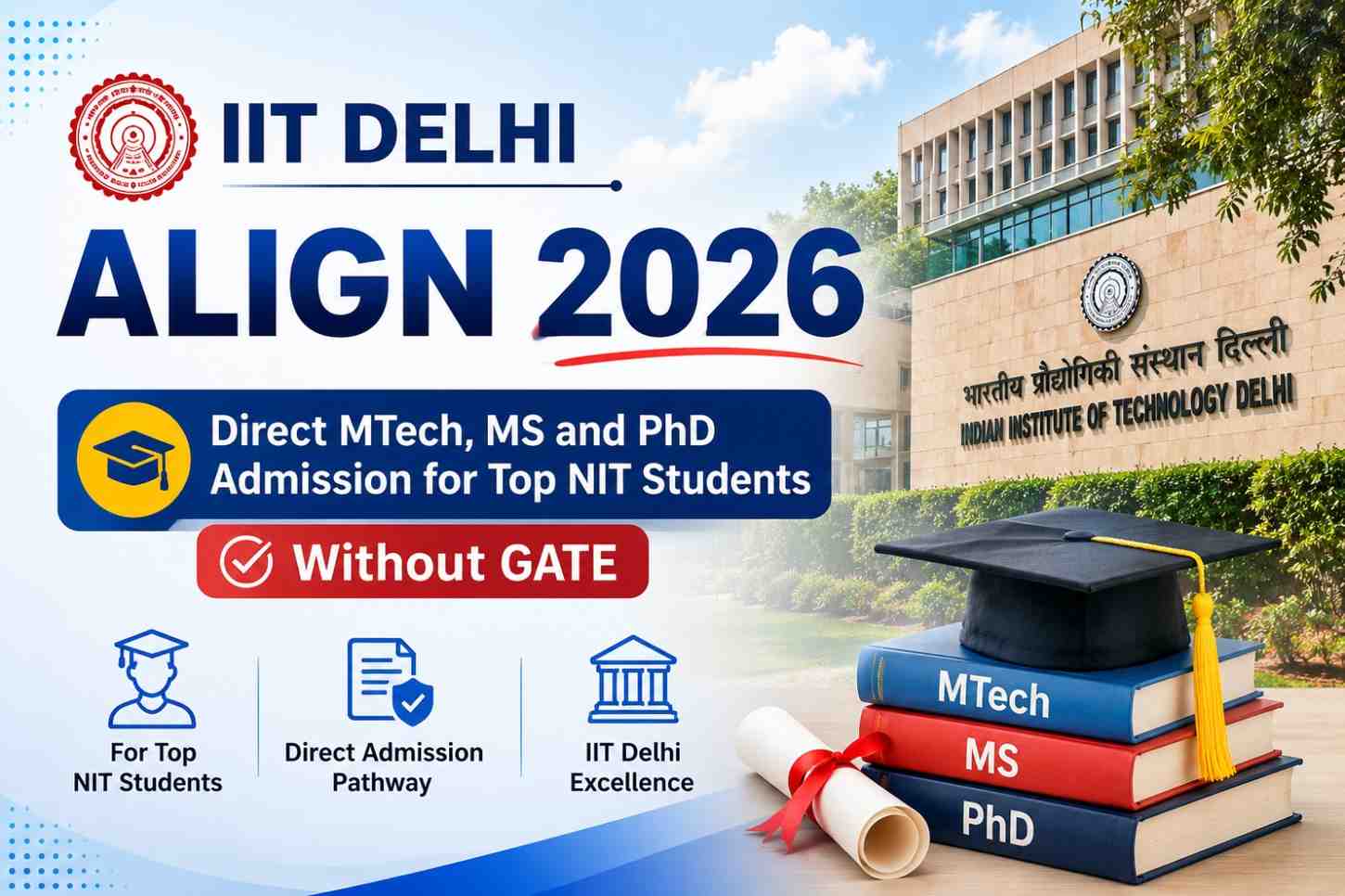
For years, top NIT graduates who missed a strong GATE score faced a frustrating bottleneck: excellent undergraduate performance, but limited access to premier IIT postgraduate seats. That landscape is shifting. Indian Institute of Technology Delhi (IIT Delhi) has launched ALIGN the Accelerating Learning and Innovation Growth Network—a structured partnership with 18 National Institutes of Technology that opens direct routes into MTech, MS (Research), and PhD programmes without requiring GATE.
Announced on the official IIT Delhi portal, ALIGN is among the most significant NIT–IIT bridge programmes announced in recent years. It combines early admission, final-year exchange, predoctoral fellowships, and joint research funding into one framework. If you are a high-performing BTech student at a partner NIT, this guide explains what ALIGN means, who qualifies, how to apply, and how it compares with the traditional GATE pathway.
What Is IIT Delhi ALIGN?
ALIGN is a multi-component academic collaboration between IIT Delhi and 18 partner NITs, formalised through Memoranda of Understanding (MoUs). The initiative is designed to identify academically strong and research-oriented students early, give them exposure to IIT Delhi's labs and faculty, and eventually absorb them into postgraduate programmes without a separate GATE qualification.
Unlike informal research internships or one-off MoUs that some departments had in the past, ALIGN operates at institute level. All 18 NITs signed agreements simultaneously, signalling a coordinated, long-term pipeline rather than ad hoc arrangements. For students, this means a clearly defined pathway from NIT undergraduate classrooms to IIT Delhi research groups a route that previously depended heavily on competitive exam scores.
Why IIT Delhi Launched ALIGN Now
India's engineering talent pool is spread across NITs nationwide, yet postgraduate mobility has historically favoured students who excel in national exams like GATE. Many capable researchers—students with strong CGPA, published work, or exceptional project output—were filtered out because of a single test day performance. ALIGN addresses that gap by treating sustained academic and research performance as the primary selection signal.
From IIT Delhi's perspective, the programme strengthens research pipelines, deepens inter-institutional collaboration, and creates a predictable feeder network. From a student's perspective, it reduces exam pressure while rewarding consistent excellence across six or more semesters of engineering study.
Key Components of the ALIGN Framework
ALIGN is not a single admission window—it is a bundle of interconnected schemes. Understanding each component helps you plan whether you should target direct PG entry, a final-year exchange, or a research fellowship first.
1. Early Admission Scheme (MTech, MS Research, PhD Without GATE)
The headline feature of ALIGN is direct postgraduate admission without GATE for eligible students from partner NITs. This covers:
- MTech – coursework-based master's programmes across IIT Delhi departments
- MS (Research) – research-intensive master's track with thesis component
- PhD – doctoral programmes for students demonstrating strong research aptitude
Each IIT Delhi department may define discipline-specific benchmarks, but the central idea remains: merit built over years of BTech study can substitute for a GATE score under this MoU framework.
2. Special Exchange Student Programme
Final-year undergraduate students from partner NITs can spend part of their BTech final year at IIT Delhi as Special Exchange Students. During this period, they take advanced coursework and work on research projects under IIT Delhi faculty supervision. This exchange serves two purposes: it gives students early exposure to IIT research culture, and it helps departments evaluate candidates before formal PG admission.
3. Predoctoral Fellowship Scheme
Students moving toward doctoral studies may access predoctoral fellowships under ALIGN. These fellowships support research continuity between BTech completion and PhD enrolment, reducing financial uncertainty for candidates who want to pursue long-term academic careers.
4. Research Seed Grant and Immersion Schemes
Faculty collaboration sits at the heart of ALIGN. The Research Seed Grant Scheme funds joint projects between IIT Delhi and partner NIT faculty. The Research Immersion Visit Scheme allows on-campus collaboration visits, enabling students and professors to work together before formal admission cycles begin.
Complete List of 18 Partner NITs
Only students enrolled at the following 18 NITs are currently covered under ALIGN. If your institute is not on this list, the standard GATE route—or department-specific MoUs at other IITs—remains applicable.
| Region | Partner NITs |
|---|---|
| North | MNIT Jaipur, MNNIT Allahabad (Prayagraj), NIT Kurukshetra, NIT Srinagar, NIT Jalandhar |
| East & Northeast | NIT Jamshedpur, NIT Rourkela, NIT Sikkim, NIT Meghalaya, NIT Silchar |
| West & Central | VNIT Nagpur, SVNIT Surat, MANIT Bhopal, NIT Raipur |
| South | NIT Tiruchirappalli (Trichy), NIT Calicut, NIT Surathkal (Karnataka), NIT Warangal |
Students at MNIT Jaipur and other northern NITs gain a direct bridge to Delhi's premier IIT a significant opportunity for those who also explore engineering pathways through institutions such as Imperial College of Engineering and Research Jaipur, ICG Institute of Educational Research Jaipur, or Rajasthan College of Engineering Research and Technology Jaipur before or alongside NIT education.
Eligibility Criteria for ALIGN Admission
Eligibility under ALIGN is merit-driven and multi-layered. While IIT Delhi publishes official criteria on its website, the following benchmarks have been referenced in prior MoU frameworks and remain useful planning guides.
Academic Performance Benchmark
Previous MoU arrangements between IIT Delhi and partner NITs required a minimum CGPA of 8.0 on a 10-point scale after the sixth semester of BTech. ALIGN is expected to follow similar rigorous standards, though individual departments may set higher cut-offs for competitive programmes like Computer Science, Electrical Engineering, or Mathematics.
Actionable tip: If your CGPA after Semester 6 is below 8.0, focus on improving subsequent semesters and building a strong research portfolio. Some departments weigh project work and faculty recommendations alongside raw CGPA.
Research Performance and Credentials
ALIGN prioritises research potential. Useful credentials include:
- Undergraduate thesis or major project with demonstrable outcomes
- Conference papers, journal submissions, or preprints
- Competition wins (Smart India Hackathon, BAJA, robotics contests)
- Internships at reputed labs or industry R&D centres
- Strong recommendation letters from NIT faculty who know your research work
Enrollment at a Partner NIT
You must be a current student (or recent graduate, depending on final notification) at one of the 18 listed NITs. Students at National Institute of Technology Delhi (NIT Delhi) should confirm directly with their academic office whether NIT Delhi is included in the current ALIGN partner list, as partner lists can evolve.
Department-Specific Requirements
Each IIT Delhi department—Mechanical Engineering, Chemical Engineering, Computer Science, Design, and others—may add prerequisites such as specific BTech branches, core course grades, or interview performance. Always check the target department's ALIGN notification rather than relying on general institute-level announcements alone.
Programmes Covered: MTech vs MS (Research) vs PhD
Choosing the right postgraduate track matters. Here is a concise comparison to guide your decision.
| Programme | Duration (Typical) | Best For | ALIGN Relevance |
|---|---|---|---|
| MTech | 2 years | Industry-oriented specialists, structured coursework | Direct entry without GATE for eligible NIT students |
| MS (Research) | 2–3 years | Thesis-driven research before PhD or R&D roles | Ideal for students with UG project experience |
| PhD | 4–5+ years | Academic and deep research careers | Predoctoral fellowship may support transition |
Students unsure about committing to a five-year PhD often enter through MS (Research) or MTech and convert later—a well-established pathway at IIT Delhi and comparable to routes available at Netaji Subhas University of Technology (NSUT Delhi) and Delhi Technological University (DTU), though those universities follow their own admission rules.
How ALIGN Differs From the GATE Route
GATE remains the dominant postgraduate entry mechanism for IITs. Understanding how ALIGN compares helps you decide whether to invest energy in both pathways simultaneously.
GATE Route: Key Features
- Open to graduates from any recognised institution nationwide
- Single exam determines eligibility for MTech, PSU jobs, and some fellowships
- Highly competitive top ranks required for popular IIT branches
- Exam-focused preparation often begins in the third year of BTech
ALIGN Route: Key Features
- Restricted to 18 partner NIT students meeting academic and research criteria
- No GATE score required for covered programmes
- Emphasis on multi-semester CGPA and research track record
- May include interviews and department-level evaluation
- Final-year exchange can strengthen your profile before formal admission
Strategic advice: Even if you target ALIGN, preparing for GATE as a backup is wise. Exam dates, cut-offs, and ALIGN window announcements may overlap, and GATE keeps options open at IIT Bombay, IIT Madras, IIT Kanpur, and other institutes outside the ALIGN network.
Step-by-Step Application Process Under ALIGN
Although official application dates are released on the IIT Delhi news portal, the procedural flow below reflects the expected process based on the announced framework.
- Monitor official announcements – Bookmark home.iitd.ac.in and check the News section regularly for ALIGN updates, deadlines, and department-wise notices.
- Verify eligibility – Confirm your NIT is on the partner list and your CGPA meets the benchmark after Semester 6 (or the semester specified in the notification).
- Contact your NIT academic office – Partner NITs typically coordinate nominations. Speak with your department head, dean, or training and placement cell about internal selection procedures.
- Identify your target IIT Delhi department – Research faculty profiles, ongoing projects, and programme structures on departmental websites.
- Prepare documents – Transcripts, CV, statement of purpose, research summary, recommendation letters, and proof of projects or publications.
- Apply when the window opens – Submit through the channel specified in the official notification—often an online portal or department email process.
- Appear for interviews – Shortlisted candidates may face technical interviews or research discussions with faculty panels.
- Complete admission formalities – Upon selection, follow IIT Delhi's standard PG admission procedures for fee payment, document verification, and enrollment.
Special Exchange Student Route: A Smart Early Move
The Special Exchange Student option is especially valuable for third- and fourth-year BTech students who are uncertain about postgraduate plans. Spending a semester or more at IIT Delhi allows you to:
- Work directly with IIT faculty on cutting-edge research
- Access advanced lab infrastructure unavailable at many NIT campuses
- Build relationships that strengthen ALIGN or conventional PhD applications
- Experience life at an IIT before committing to a multi-year programme
Exchange students typically remain enrolled at their home NIT while taking courses and projects at IIT Delhi—a model similar in spirit to semester-abroad programmes, but focused on research depth rather than general credit transfer.
Fellowships, Funding, and Research Support
Financial support can define whether a student accepts a research-oriented path. ALIGN bundles several funding mechanisms:
Predoctoral Fellowships help bridge the gap between BTech and PhD enrolment. If you are considering an academic career—similar to pathways pursued by researchers at MGR Educational Research Institute Chennai or other research-focused institutions—these fellowships reduce the need to take unrelated employment between degrees.
Research Seed Grants fund collaborative projects between IIT Delhi and NIT faculty. Students benefit indirectly by gaining access to joint projects, co-supervised theses, and shared equipment.
Research Immersion Visits allow shorter on-campus stays for focused collaboration—useful for students who cannot commit to a full final-year exchange but want IIT exposure.
Planning Tips for NIT Students Targeting IIT Delhi
Success under ALIGN is rarely accidental. High-performing students typically follow a deliberate preparation strategy starting from the second or third year of BTech.
Build Your Profile Early
- Maintain CGPA above 8.0 consistently—not just in the sixth semester
- Join research labs at your NIT during summers and weekends
- Present work at institute symposiums; aim for external conferences
- Develop coding, simulation, or experimental skills relevant to your target department
Network With Faculty on Both Campuses
Identify IIT Delhi professors whose research aligns with your interests. Read their recent publications. If your NIT faculty collaborate with IIT Delhi under seed grants, request an introduction. Personalised outreach\ respectful, informed emails can distinguish your application.
Prepare for Interviews
Without GATE as a filter, departments rely more on interviews. Expect questions on core BTech subjects, your final-year project, and basic research methodology. Revise fundamentals in mathematics, programming, or domain-specific engineering depending on your branch.
Keep Alternative Options Open
Delhi NCR hosts strong engineering and research ecosystems beyond IIT Delhi. Institutions such as Indraprastha Institute of Information Technology Delhi (IIIT Delhi), NSUT, and DTU offer competitive MTech programmes through their own entrance processes. Students in Rajasthanmay also evaluate Modern Institute of Technology and Research Centre Kota and allied colleges while pursuing NIT or IIT ambitions.
Who Should Consider ALIGN—and Who Should Not?
ALIGN is best suited to BTech students at partner NITs who have maintained a strong CGPA, engaged meaningfully with research, and want to pursue advanced study at IIT Delhi without centring their final year entirely on GATE preparation. If you thrive in project labs, enjoy reading research papers, and can articulate your interests clearly in an interview, ALIGN aligns well with your strengths.
It may be less suitable if your undergraduate record is uneven, your home NIT is outside the partner list, or you prefer keeping every IIT option open through a single national exam. In those cases, a focused GATE strategy—or exploring MTech routes at institutions such as Hindu College Delhi for interdisciplinary pathways or Jamia Millia Islamia New Delhi for broader postgraduate choices—may serve you better.
ALIGN in the Broader Context of Indian Higher Education
ALIGN reflects a wider shift in Indian higher education: reducing over-reliance on single high-stakes exams and recognising sustained institutional performance. Similar philosophies appear in direct PhD admissions at IISc Bangalore, institute-specific fellowship programmes, and industry-linked MTech tracks.
For NIT students, ALIGN validates the NIT system's academic rigour. NITs like Trichy, Surathkal, Warangal, and Rourkela consistently produce graduates who compete globally; a formal IIT Delhi pipeline acknowledges that talent without forcing every student through the same exam funnel.
Delhi remains India's education capital. Alongside IIT Delhi, the city hosts central universities, medical institutes like AIIMS Delhi, liberal arts colleges such as Miranda House Delhi and St Stephen's College Delhi, and management schools including Fore School of Management Delhi and International Management Institute (IMI Delhi). ALIGN adds one more reason for engineering students nationwide to consider Delhi as a postgraduate destination.
What to Watch For: Dates, Cut-Offs, and Official Updates
As of the ALIGN announcement, institute-level notifications on application windows and department-wise cut-offs were still rolling out. Rely only on primary sources:
- IIT Delhi official website news section
- Your partner NIT's academic office circulars
- Target department notices on IIT Delhi departmental pages
Avoid unverified social media claims about cut-offs or guaranteed seats. ALIGN is merit-based; meeting the minimum CGPA benchmark does not assure admission if seats are limited and competition within partner NITs is strong.
Conclusion
IIT Delhi's ALIGN initiative marks a meaningful step toward integrating NIT and IIT ecosystems. For high-performing students at the 18 partner NITs, it offers a credible, GATE-free pathway into MTech, MS (Research), and PhD programmes—supported by exchange opportunities, predoctoral fellowships, and joint research funding. The programme rewards consistency, research curiosity, and faculty mentorship over single-exam performance.
If you are an NIT student with a strong academic record, start by confirming your eligibility, connecting with your academic office, and tracking official IIT Delhi announcements. Whether you ultimately join IIT Delhi through ALIGN, qualify via GATE, or pursue postgraduate study at another premier institution, the preparation principles remain the same: excel in coursework, engage deeply with research, and build relationships with faculty who can guide your next step.