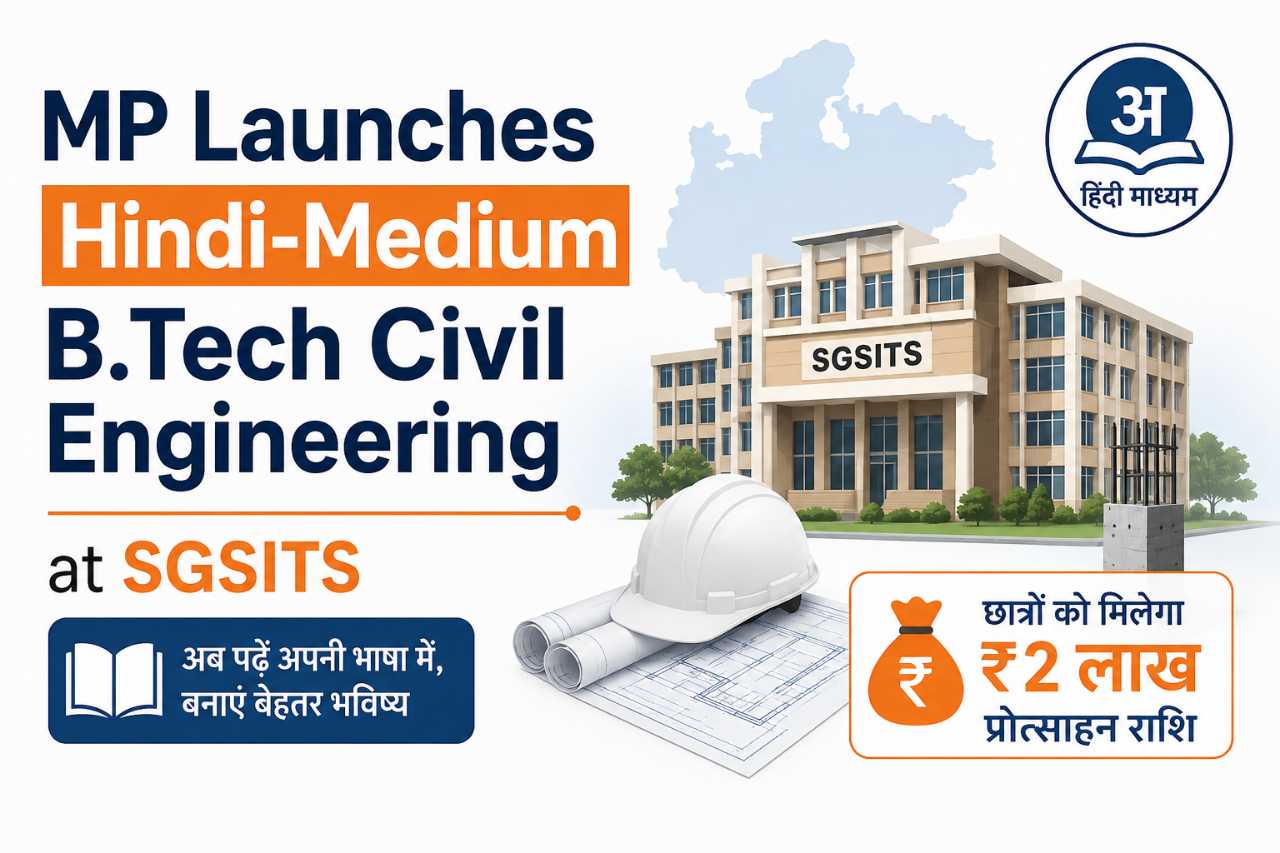
Madhya Pradesh has taken a notable step in widening access to technical education. From the current academic session, students can pursue a Hindi-medium B.Tech in Civil Engineering at Shri G S Institute of Technology and Science (SGSITS) in Indore, with eligible learners also set to receive a Rs 2 lakh government incentive in their final year. The move aligns with the National Education Policy (NEP) 2020 emphasis on learning in the mother tongue while keeping graduates career-ready.
For thousands of Class 12 pass-outs from Hindi-medium schools across MP and neighbouring states, engineering has long felt out of reach—not because they lacked aptitude, but because English-heavy instruction created an early barrier. This article explains what the new programme offers, who it is for, how admissions work, and what students should consider before enrolling.
What Is the MP Hindi-Medium Civil Engineering Programme?
The Madhya Pradesh government, in coordination with SGSITS Indore, has introduced a dedicated B.Tech Civil Engineering batch taught primarily in Hindi. Students study core subjects, attend lectures, and write examinations in Hindi, while still building essential English communication skills for professional settings.
Key highlights of the initiative include:
- Institution: SGSITS (Shri G S Institute of Technology and Science), an aided autonomous Institute in Indore
- Degree: B.Tech in Civil Engineering (four-year undergraduate programme)
- Medium of instruction: Hindi for teaching and examinations
- Intake: 30 seats in the inaugural batch; around 20 students had already been admitted at the time of the announcement
- Financial support: Rs 2 lakh incentive from the state government in the final year for eligible enrolled students
- Policy context: Designed to implement NEP 2020 goals on multilingual and inclusive technical education
Civil engineering remains one of India's most in-demand branches, covering infrastructure, construction, transportation, water resources, and environmental systems. Making this pathway accessible in Hindi could help rural and semi-urban learners who excel in science and mathematics but struggle when every technical concept arrives only in English.
Why SGSITS Indore Was Chosen
SGSITS is among central India's better-known engineering institutions. As an aided autonomous Institute, it combines academic autonomy with strong legacy recognition among employers and postgraduate programmes. Launching Hindi-medium civil engineering here signals that the initiative is not a peripheral experiment but an extension within an established technical ecosystem.
Department officials noted a recurring pattern: students who completed schooling in Hindi often found the sudden switch to English-medium engineering overwhelming. Some adapted with extra coaching; others dropped out or underperformed despite solid fundamentals in physics and mathematics. Hosting the programme at SGSITS allows Hindi-medium learners to benefit from existing laboratories, faculty expertise, industry linkages, and campus infrastructure without starting an entirely new institution from scratch.
Sunil Ajmera, head of the civil engineering department at SGSITS, told reporters that the institute had observed dropout and performance gaps linked to language for years. The Hindi-medium batch is a direct response to that lived student experience—not a theoretical policy exercise.
Students comparing options nationwide often look at reputed private and government colleges. For instance, learners from Rajasthan may explore institutions like Government Engineering College Ajmer or Rajiv Gandhi Government Engineering College Alwar, while those in Delhi NCR frequently shortlist colleges such as Inderprastha Engineering College or Guru Gobind Singh Indraprastha University Engineering. The SGSITS Hindi-medium track is distinctive because it keeps the degree within a flagship MP institute while changing the language of delivery—not the qualification itself.
Understanding the Rs 2 Lakh Government Incentive
One of the most talked-about aspects of the launch is the Rs 2 lakh incentive promised in the final year of the programme. While full disbursement rules may be clarified through official notifications, the incentive appears designed to:
- Reduce the financial burden on students from economically weaker or middle-income Hindi-medium backgrounds
- Encourage completion of the degree rather than mid-course exit
- Signal state government commitment to mother-tongue technical education
- Support transition costs such as internships, licensure exam preparation, or skill certifications near graduation
Students should treat the incentive as a confirmed policy announcement but verify exact eligibility—attendance thresholds, academic progress, domicile requirements, and documentation—through SGSITS admission offices or the Madhya Pradesh Technical Education Department. Do not rely on informal social media summaries alone.
How the Incentive Compares With Other Support Schemes
Many engineering colleges offer scholarships based on merit, category, or economic status. Private universities such as Lovely Professional University Engineering or Galgotias College Of Engineering publish separate fee waiver policies. The MP Hindi-medium incentive is notable because it is tied specifically to this programme and timed for the final year, potentially acting as a completion bonus rather than a first-year tuition discount.
NEP 2020 and Mother-Tongue Engineering Education
The National Education Policy 2020 recommends that higher education institutions offer programmes in Indian languages wherever feasible, especially at the undergraduate level. The logic is straightforward: cognitive load drops when learners grasp concepts in a language they think in daily. Engineering is not less rigorous in Hindi—the rigour sits in mathematics, physics, design standards, and problem-solving, not in memorising English definitions alone.
Several states have experimented with regional-language options in law, arts, and science streams. Technical education has moved more slowly because global engineering literature, software interfaces, and many employer interviews remain English-heavy. MP's approach attempts a balanced model: Hindi for classroom comprehension, English for career readiness.
Faculty at SGSITS reported preparing for this shift over several years. Technical textbooks and reference material were translated into Hindi, and workshops were held to train teachers in bilingual pedagogy—explaining concepts in Hindi while introducing standard English terminology students will encounter on job sites and in IS codes.
Inside the Classroom: Translation, Training, and Student Voices
Vivek Tiwari, assistant professor in the civil engineering department at SGSITS, noted that institute experts spent roughly four years translating English technical study material into Hindi. Parallel workshops helped faculty move from instinctive English lecturing to structured Hindi delivery without diluting precision.
Enrolled student Rohit Sharma shared a practical perspective with reporters: studying civil engineering entirely in English would have forced constant reliance on online translation tools for difficult subjects. In Hindi, teachers could explain technical terms clearly while still naming them in English when needed. That hybrid approach mirrors how many site engineers already communicate in India—Hindi or regional language on the ground, English on drawings and formal reports.
Faculty stressed that the objective is not to distance students from English but to stop language from blocking entry into engineering altogether. Essential English skills remain part of the broader training arc across four years.
Admission Process, Eligibility, and Seat Matrix
Although precise admission rules should be confirmed on the official SGSITS portal each cycle, Hindi-medium B.Tech civil engineering programmes typically follow patterns similar to other state engineering admissions.
Likely Eligibility Criteria
- Completion of Class 12 (or equivalent) with Physics, Chemistry, and Mathematics
- Minimum aggregate and subject-wise marks as prescribed by the institute or state counselling authority
- Valid score in MP engineering entrance examinations or counselling routes applicable to SGSITS (such as state-level merit lists or institutional quotas—verify current year rules)
- Preference or requirement for applicants from Hindi-medium schooling backgrounds may apply; confirm with admission notices
- Domicile or state residency rules may influence the Rs 2 lakh incentive; check official guidelines
Seat Intake
The inaugural batch reserves 30 seats. With about 20 admissions already reported early in the session, remaining seats may fill quickly if demand is high. Students interested in civil engineering but unsure about Hindi medium should attend counselling sessions or open-house interactions at SGSITS before locking choices.
Actionable Tips for Applicants
- Download the latest prospectus and Hindi-medium programme notification from the official SGSITS website.
- Keep Class 10 and 12 mark sheets highlighting medium of instruction.
- Prepare for state counselling registration deadlines; missed windows cannot always be reopened.
- Compare backup options—other MP polytechnics, lateral entry routes, or English-medium B.Tech programmes at peer institutions.
- Document income and category certificates early if applying for incentives or fee concessions.
Curriculum, Pedagogy, and Examination Pattern
The Hindi-medium B.Tech Civil Engineering degree covers the same broad domains as standard programmes: structural analysis, geotechnical engineering, surveying, transportation, environmental engineering, construction management, and design software exposure. What changes is the language of explanation and assessment, not the underlying technical standards.
Students already enrolled shared practical feedback: studying in Hindi allows teachers to clarify difficult ideas in real time instead of forcing learners to depend on online translation tools for every paragraph. That said, faculty emphasised parallel English language skill development so graduates can read international papers, write site reports, and face campus placement interviews confidently.
What a Typical Week Might Include
- Core lectures in Hindi with English technical vocabulary highlighted on boards and slides
- Laboratory sessions using universal equipment manuals and bilingual lab sheets
- Workshops on communication English, report writing, and interview readiness
- Site visits and surveying fieldwork—often more visual and hands-on, easing language barriers
- Internal assessments in Hindi; exposure exercises in English for professional terms
English vs Hindi Medium: A Practical Comparison
Choosing medium of instruction is not about pride in language—it is about learning efficiency and long-term career fit. The table below summarises common considerations for MP students:
| Factor | Hindi-Medium B.Tech (SGSITS) | Conventional English-Medium B.Tech |
|---|---|---|
| Concept clarity in Year 1 | Often higher for Hindi-school backgrounds | Steep adjustment period possible |
| Textbook access | Growing Hindi translated resources | Wider global textbook availability |
| Placement interviews | Requires added English preparation | Still needs communication training |
| GATE / PSU exams | English sections need dedicated practice | Same requirement |
| State incentive | Rs 2 lakh final-year support announced | Not applicable to this specific track |
| Peer ecosystem | Focused cohort of 30 students | Larger mixed-medium batches |
Students who are comfortable in English and have strong board scores may still prefer conventional tracks at institutions like Chandigarh Engineering College or Krishna Institute Of Engineering And Technology. The Hindi-medium route is best viewed as a targeted bridge, not a replacement for all engineering admissions statewide.
Career Prospects After Hindi-Medium Civil Engineering
Employers hire civil engineers based on skills, licensure, and project experience more than medium of school instruction. Graduates from SGSITS historically enter roles across:
- Public Sector Undertakings (PSUs) and state PWD departments
- Construction and infrastructure firms (L&T, Afcons, local contractors)
- Consultancy and design studios
- Urban local bodies and smart-city projects
- Higher studies—M.Tech, GATE, UPSC Engineering Services
Hindi-medium graduates who invest in English communication and software tools (AutoCAD, STAAD.Pro, Revit basics) remain competitive. Regional infrastructure growth across Madhya Pradesh—highways, dams, housing, metro expansions—creates steady demand for civil engineers who understand local contractor ecosystems and regulatory processes.
Students aiming for national mobility may later pursue certifications or postgraduate programmes at institutions such as Niet Engineering College, Graphic Era University Engineering, or Shiv Nadar University Engineering for specialisation and network building.
How This Initiative Fits the Broader MP Education Landscape
Madhya Pradesh has expanded engineering capacity through government colleges, private universities, and autonomous institutes. Programmes like Hindi-medium civil engineering complement—not replace—existing English-medium B.Tech routes. Similar accessibility conversations are happening nationally, from polytechnic diploma streams to regional-language content in online learning platforms.
Parents comparing colleges across tiers often evaluate accreditation (NBA), placement records, fees, and city infrastructure. Indore offers a relatively affordable student lifestyle with growing industrial corridors. For Hindi-belt learners, studying in Indore while retaining linguistic comfort may outperform migrating to an English-only campus where both language and geography feel unfamiliar.
Those exploring alternatives in other states might review Lords Institute Of Engineering And Technology Jaipur, Chitkara University Engineering, or Feroze Gandhi Institute Of Engineering, but should note that the MP incentive and Hindi-medium degree combination is currently specific to SGSITS.
Exam Pathways: GATE, SSC JE, and State Engineering Services
Civil engineering graduates commonly target competitive exams for stable careers. Hindi-medium students should plan early because exam papers often use English, even when questions test technical knowledge rather than literary fluency.
- GATE: Required for many M.Tech admissions and some PSU recruitments; technical subjects can be prepared bilingually, but general aptitude sections need English practice.
- SSC JE and state JE exams: Popular among diploma and degree holders; MP and neighbouring states release notifications annually.
- UPSC Engineering Services: Long-term goal demanding deep subject mastery and English comprehension.
Colleges with structured coaching support—such as Dronacharya College Of Engineering, Gnit College Of Engineering, or Integral University Engineering—often highlight exam training in brochures. SGSITS applicants should ask whether the Hindi-medium batch will receive shared placement and exam-prep resources with existing civil engineering students.
Challenges, Criticisms, and Realistic Expectations
No policy innovation is without debate. Common questions include:
- Industry readiness: Will employers accept Hindi-medium degrees identically? Autonomous institute accreditation and identical degree titles help, but students must still prove skills.
- Resource limits: Thirty seats cannot serve entire MP; scaling requires more translated content and trained faculty statewide.
- English dependence in software: Most civil engineering tools use English interfaces; bilingual training must continue through all four years.
- Exam parity: GATE, SSC JE, and UPSC components test English comprehension; early preparation is essential.
Transparent placement tracking for the first few batches will ultimately determine public confidence. Students should ask SGSITS for internship tie-ups, alumni mentorship, and documented English support hours before admission.
Who Should Consider Enrolling?
This programme is a strong fit if you:
- Completed Class 12 from a Hindi-medium school with solid PCM scores
- Felt held back in mock engineering environments due to English rather than technical understanding
- Want a B.Tech Civil degree from a reputed Indore institute without immediate full English immersion
- Plan to actively build English skills alongside technical training
- Are eligible for the Rs 2 lakh final-year incentive based on state rules
It may not suit you if you already think fluently in English, aim for immediate overseas higher education, or prefer large metropolitan private campuses such as Jims Engineering College, Bpit Engineering College, or Northern India Engineering College without language-specific support structures.
Future Outlook: Will More Branches and Colleges Follow?
If the SGSITS pilot succeeds—measured by retention, pass rates, internships, and placements—the model could expand to other branches such as mechanical or electrical engineering, or replicate at additional MP institutions. Other states watching MP's experiment may launch similar programmes in Marathi, Tamil, or Bengali at select government colleges.
For now, civil engineering is a sensible starting point because of visible public infrastructure demand and strong diploma-to-degree pathways already present in the state. Students waiting for expansion can monitor official announcements rather than delaying admission indefinitely on speculation alone.
Conclusion
Madhya Pradesh's Hindi-medium B.Tech Civil Engineering programme at SGSITS Indore marks a meaningful attempt to align technical education with learner realities on the ground. By offering instruction and examinations in Hindi, coupled with English skill-building and a Rs 2 lakh final-year government incentive, the state is lowering a language barrier that has quietly pushed capable students away from engineering for decades.
Success will depend on sustained faculty investment, high-quality translated materials, honest placement reporting, and clear incentive guidelines. For eligible Class 12 students—especially Hindi-medium learners across MP—this pathway deserves serious consideration alongside traditional English-medium options at institutes like Guru Premsukh Memorial College Of Engineering, Ymca University Engineering, or Dit University Engineering. Visit official sources, attend counselling, and choose based on fit, not fear of language alone.