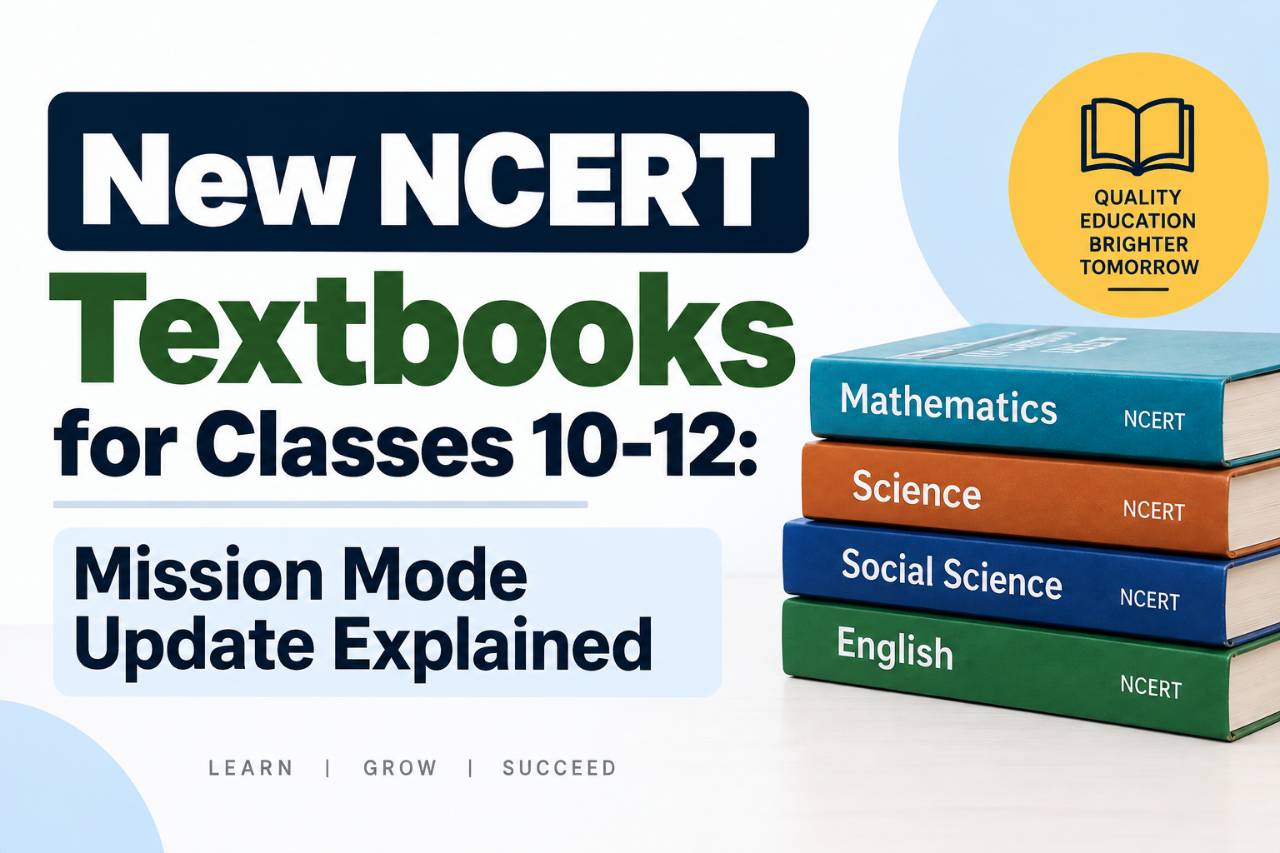
India's school education system is entering a decisive phase of curriculum renewal. At the 66th Foundation Day of the National Council of Educational Research and Training (NCERT), Union Education Minister Pralhad Joshi announced that revised NCERT textbooks for Classes 10 to 12 are being prepared in mission mode, while new books aligned with the National Curriculum Framework (NCF) for Classes 1 to 9 have already been released. For students, parents, and teachers planning board exams, competitive tests, and higher education admissions, this update is more than a textbook change it reshapes what learners study before they enter colleges, professional courses, and national entrance exams.
This guide explains what the NCERT revision means for indian students, how it connects to NEP 2020 and artificial intelligence in classrooms, and what Class 10, 11, and 12 learners should do today to stay exam-ready without panic.
What Did the Education Minister Announce About NCERT Textbooks?
Speaking at NCERT's Foundation Day event in New Delhi, Education Minister Pralhad Joshi stated that NCERT is playing a central role in building a Viksit Bharat by nurturing skilled, capable, and globally responsible learners through quality education. His key announcements can be summarised as follows:
- Classes 1–9: New NCERT textbooks based on the updated National Curriculum Framework are already out.
- Classes 10–12: Revised textbooks are under active preparation in mission mode, indicating accelerated drafting, review, and publication timelines.
- AI in education: Textbooks and curricula must evolve so young learners can use artificial intelligence confidently and responsibly.
- Parental role: Parents need greater awareness to counsel and monitor children, especially around technology use.
- India's youth dividend: India's young population is a national and global asset, making school-level reform strategically important.
These statements signal that secondary and senior secondary education the bridge to undergraduate admissions is next in line for structured reform, not ad hoc patchwork.
Why NCERT Textbook Revision Matters for Higher Education
NCERT books are the backbone of CBSE-affiliated schools and influence state boards, teacher training, and competitive exam foundations. When Classes 10 to 12 textbooks change, the effects ripple across:
- Board exam patterns for CBSE Class 10 and Class 12
- Foundation concepts for JEE Main, JEE Advanced, NEET UG, CUET, and other entrance tests
- Teacher education programmes that train future school educators
- College readiness in science, commerce, humanities, and vocational streams
Institutions focused on pedagogy and teacher preparation such as the District Institute of Education and Training Sikar, Shekhawati College For Education Losal Sikar, and leading B.Ed colleges in Rajasthan like Tirupati College Of Education Jaipur and Satyam College Of Education Jaipur will eventually align their training modules with the revised NCERT content. Aspiring teachers should track syllabus notifications alongside university-level curriculum updates.
Connection to NEP 2020 and NCF 2023
The National Education Policy (NEP) 2020 calls for holistic, flexible, and future-ready schooling. The National Curriculum Framework (NCF) 2023 translates that vision into stage-wise learning standards. Minister Joshi explicitly linked the textbook overhaul to NEP goals, including:
- Competency-based learning instead of rote memorisation
- Multidisciplinary exposure and critical thinking
- Integration of emerging technologies, including AI literacy
- Ethical and responsible digital citizenship from school age
For students eyeing premier institutions whether Indian Institute Of Science Education Research IISER Berhampur or professional universities like Icfai Foundation For Higher Education Hyderabad strong NCERT fundamentals remain the first rung of the ladder, even as higher-order skills gain weight.
Understanding Mission Mode: What It Means for Publication Timelines
When a government initiative is described as operating in mission mode, it usually involves dedicated task forces, fixed milestones, regular review meetings, and fast-track approvals. For NCERT's Classes 10 to 12 project, this likely means:
- Subject expert committees working on parallel tracks for Science, Mathematics, Social Science, Languages, and vocational subjects
- Expedited pilot testing and feedback from select schools before nationwide rollout
- Coordination with CBSE and state boards on syllabus mapping documents
- Simultaneous preparation of teacher handbooks, digital content, and supplementary materials
Students should not assume overnight replacement in every school. Distribution often begins in phases metro cities and CBSE schools first, followed by wider availability through NCERT sales counters and the ePathshala app. Schools typically announce which batch will switch to new books; mid-year transfers between old and new editions are rare without board-level guidance.
Classes 1–9 Books Are Out: What Changed at the Foundational Level?
With Classes 1 to 9 textbooks already released, the school system is building a new learning base. Early reports and NCERT communications around the NCF-aligned series suggest emphasis on:
- Conceptual clarity through activity-based chapters
- Indian knowledge systems woven into age-appropriate contexts
- Reduced content load in some subjects to discourage unhealthy coaching pressure at young ages
- Language and numeracy strengthening in foundational stages
Students currently in Class 9 will soon transition into the first cohort that may encounter fully revised Class 10 material. That makes the 2026–27 and 2027–28 academic cycles especially important for planning. Parents of younger children should compare chapter lists with previous editions to spot structural changes early.
Classes 10–12 in Mission Mode: What Students Should Expect
"Mission mode" typically means coordinated teams, fixed deadlines, inter-ministerial support, and priority resource allocation. For Classes 10 to 12, expect revisions across major subjects Mathematics, Science, Social Science, Languages, and vocational areas rather than cosmetic updates alone.
Likely Focus Areas in Senior Secondary Textbooks
While NCERT will publish official details subject-wise, the minister's speech offers clear direction:
- Artificial intelligence awareness: Understanding what AI is, how it assists learning, where it can mislead, and how to verify information.
- Applied learning: More real-world examples, data interpretation, and project-based assessments.
- Responsible technology use: Classroom discussions on plagiarism, deepfakes, privacy, and academic integrity.
- Global competencies: Content that positions Indian students as contributors to international workforce needs.
Science stream students preparing for medical and engineering entrances should note that NCERT remains the conceptual base for NEET and JEE, even when exam bodies add application layers. Commerce and humanities students will see evolving case studies relevant to CUET and professional programmes offered at institutions such as Delhi Metropolitan Education and Ramakrishna Mission Vivekananda Educational And Research Institute Howrah.
Subject-Wise Preparation Outlook
Although final chapter lists will come from NCERT, students can prepare strategically by stream:
- Class 10 Science: Continue mastering Physics, Chemistry, and Biology concepts with emphasis on diagrams, numericals, and NCERT intext questions the pattern competitive exams inherit.
- Class 10 Mathematics: Focus on algebra, geometry, trigonometry, and statistics with application problems; calculator-free board exam skills remain essential.
- Class 12 PCB/PCM: Deepen derivations, reaction mechanisms, and problem-solving speed; revised books may add interdisciplinary links between biology and data science.
- Class 12 Commerce: Accountancy, Business Studies, and Economics may include updated case laws, GST examples, and digital economy references.
- Humanities: Political Science, History, and Sociology could feature refreshed narratives aligned with NCF's emphasis on critical citizenship.
AI in School Education: Opportunities and Responsibilities
Minister Joshi observed that artificial intelligence has rapidly become part of everyday life, with younger age groups adopting AI tools quickly. Schools cannot treat AI as an optional extra it must be embedded thoughtfully in curricula.
What AI-Ready Textbooks May Include
- Introduction to machine learning concepts at an accessible level in senior classes
- Guidelines for using AI tutors, chatbots, and research assistants ethically
- Activities that compare human reasoning with AI-generated outputs
- Career pathways linking AI to mathematics, coding, biology, and social sciences
Role of Parents and Schools
The minister stressed that parents must become more alert, offering counselling and monitoring support. Practical steps include:
- Setting device rules during homework and exam seasons
- Teaching children to cite sources and declare AI assistance where required
- Discussing misinformation, cheating risks, and mental health impacts of over-reliance on tools
- Partnering with schools on digital literacy workshops
Teacher-training ecosystems from Sanskriti College Of Education Jaipur to Loyola Institute Of Vocational Education Chennai will need updated pedagogy modules so educators can guide classrooms through this shift. Colleges such as Sambhal College Of Education Sikar and Prince Academy Of Higher Education Girls College Sikar play a regional role in supplying trained teachers who understand both NCERT content and classroom technology policy.
Impact on CBSE Board Exams and State Boards
CBSE traditionally aligns its syllabus with NCERT textbooks. When new Class 10 and Class 12 books arrive, the Central Board of Secondary Education typically issues circulars on:
- Subject-wise rationalised syllabus
- Sample question papers and marking schemes
- Internal assessment guidelines
- Transition rules for batches mid-stream
State boards that adapt NCERT content may follow with staggered implementation. Students in states like Rajasthan, Jharkhand, Kerala, and Maharashtra should watch both NCERT and their respective board websites not rumour channels on social media.
Who Should Monitor Which Official Source
- Class 10 students: NCERT.nic.in and cbse.gov.in New textbook list, board syllabus PDF, sample papers
- Class 12 students: NCERT.nic.in and cbse.gov.in Stream-wise books, practical manuals, exam dates
- JEE/NEET aspirants: nta.ac.in Whether NCERT edition changes affect recommended reading
- CUET candidates: cuet.samarth.ac.in Domain subject syllabus mapping
- Parents: School notices and parent-teacher meetings Implementation year for their child's batch
Competitive Exams: Will JEE, NEET, and CUET Change?
Entrance exam syllabi do not always move in perfect sync with NCERT publication dates. Historically, NTA and other exam bodies issue clarifications when board books change. Until official notices appear:
- Continue using the NCERT edition your coaching centre and school recommend
- Do not discard old books immediately after new ones launch compare syllabi first
- Prioritise conceptual understanding over edition-specific trivia
- Watch for updated NCERT exemplar problems and official CBSE sample papers
Medical education pathways connected to institutions like Hemwati Nandan Bahuguna Medical Education University still begin with Class 11–12 PCB mastery. Engineering aspirants targeting IITs and NITs should treat Physics, Chemistry, and Mathematics NCERT as non-negotiable reading, supplemented with problem banks.
Common Myths About NCERT Textbook Changes
Syllabus updates often trigger misinformation. Separating facts from rumours protects students from wasted effort:
- Myth: Board exams will become easier overnight. Fact: NEP-aligned assessments emphasise application and analysis, which can feel harder if preparation remains rote-based.
- Myth: Entire syllabi will disappear without notice. Fact: NCERT and CBSE publish official rationalisation lists; nothing is removed without documented notification.
- Myth: Only CBSE students are affected. Fact: Many state boards reference NCERT content, and teacher education programmes nationwide follow NCERT frameworks.
- Myth: AI tools can replace textbooks. Fact: The minister's message stresses responsible AI use alongside structured curricula, not substitution of core reading.
Trust verified announcements from NCERT, the Ministry of Education, and your school principal not forwarded WhatsApp messages claiming instant exam pattern overhauls.
From School Desks to College Admissions: The Long View
Revised senior secondary curricula aim to produce graduates who adapt faster to university-level learning. India's demographic advantage a large youth population while several countries face ageing workforces means school reform is tied to national competitiveness.
Higher education hubs are expanding across India. Students from revised NCERT backgrounds may pursue degrees at universities such as Baba Saheb Ambedkar Education University, Bharath Institute Of Higher Education Research, Avinashilingam Institute For Home Science Higher Education For Women Coimbatore, and Noorul Islam Centre For Higher Education Kanyakumari. Admissions will still depend on entrance exams, board percentages, and counselling cut-offs but conceptual strength built in Classes 10–12 remains decisive.
Education colleges preparing the next generation of teachers examples include Shri Balaji College Of Education Jaipur, Prabhakar College Of Education Jaipur, Vardha College Of Education Sikar, and Aklank College Of Education Kota should integrate NCERT updates into B.Ed and D.El.Ed practicum training early. Additional Jaipur-based institutions such as Saraswati College Of Education Jaipur, Shri Ram College Of Education Jaipur, and Bhavan Shri Ramakrishna College Of Education Jaipur form a strong network for teacher supply in North India.
Actionable Tips for Class 10 and Class 12 Students
Uncertainty about textbook timelines creates anxiety. The following strategies keep preparation steady regardless of publication dates:
- Master current NCERT editions first: Until official replacements reach your school, existing books remain the exam reference.
- Follow competency-style practice: Solve case-based, assertion-reason, and source-based questions aligned with NEP direction.
- Build AI literacy now: Learn to prompt tools for explanations, then cross-check with textbooks and teachers.
- Maintain consolidated notes: When new chapters arrive, mapped notes help you transfer knowledge quickly.
- Use official PDFs only: Download free NCERT e-books from ncert.nic.in to avoid pirated or outdated versions.
- Plan backward from target exams: Board exams, JEE, NEET, and CUET timelines should drive monthly study plans.
- Join structured doubt-solving: School teachers, government DIET centres, or reputable platforms not unverified Telegram forwards.
- Track batch-specific rules: Ask your school whether your registration year will use old or new textbooks for board exams.
Jaipur and Rajasthan host numerous teacher-education colleges including Mahesh College Of Education Jaipur, Pink City College Of Education Jaipur, Gyanodaya College Of Education Jaipur, and Vidya Bharati College Of Education Jaipur making the region a useful barometer for how school curriculum changes translate into teacher supply and coaching culture.
Viksit Bharat and Global Human Resource Goals
Minister Joshi framed NCERT's mission within Viksit Bharat the national vision of a developed India by 2047. Quality textbooks support:
- Workforce readiness in STEM, healthcare, law, education, and vocational trades
- Ethical leadership and civic responsibility among youth
- India's rising human resource ranking in the global economy
Research-oriented institutions such as Chettinad Academy Of Research Education Kancheepuram, Datta Meghe Institute Of Higher Education Research Deemed To Be University, and Aurora Higher Education And Research Academy depend on school pipelines that emphasise inquiry, not only examination scores. Vocational and professional pathways through Academy Of Maritime Education And Training Chennai, Sarvodaya College Of Paramedical And Nursing Education Kota, and India International University Of Legal Education And Research also begin with the discipline and literacy built in secondary school.
What Teachers and Coaching Centres Should Do Now
School teachers and coaching faculty are the first line of support during curriculum transitions. Proactive steps include attending NCERT and SCERT webinars, updating lesson plans only after official syllabus PDFs release, and creating bridge materials that map old chapters to new ones. Teacher educators at institutions like Shri Ganesh College Of Education Jaipur, Shanti Niketan College Of Education Jaipur, and Central Institute Of Fisheries Education Fishries University Mumbai can model how faculty adapt when national frameworks shift. Coaching centres should avoid marketing fear-based campaigns about syllabus chaos; instead, publish transparent comparison charts once NCERT lists are final.
Conclusion: Stay Informed, Stay Flexible
The announcement that NCERT is preparing Classes 10 to 12 textbooks in mission mode confirms that India's secondary education reform is accelerating not pausing. With Classes 1 to 9 books already in circulation, senior secondary students stand at the threshold of updated content shaped by NEP 2020, NCF 2023, and the realities of an AI-enabled world.
Rather than waiting passively, students should strengthen fundamentals, track official NCERT and CBSE updates, use technology responsibly, and align preparation with their chosen higher education path whether that leads to engineering, medicine, law, education, or vocational excellence. Parents and teachers who stay informed today will help learners cross the school-to-college bridge with confidence when the new textbooks arrive. Bookmark official portals, speak with school counsellors about stream selection, and treat every syllabus update as a chance to build deeper understanding not as a setback to your admission dreams.