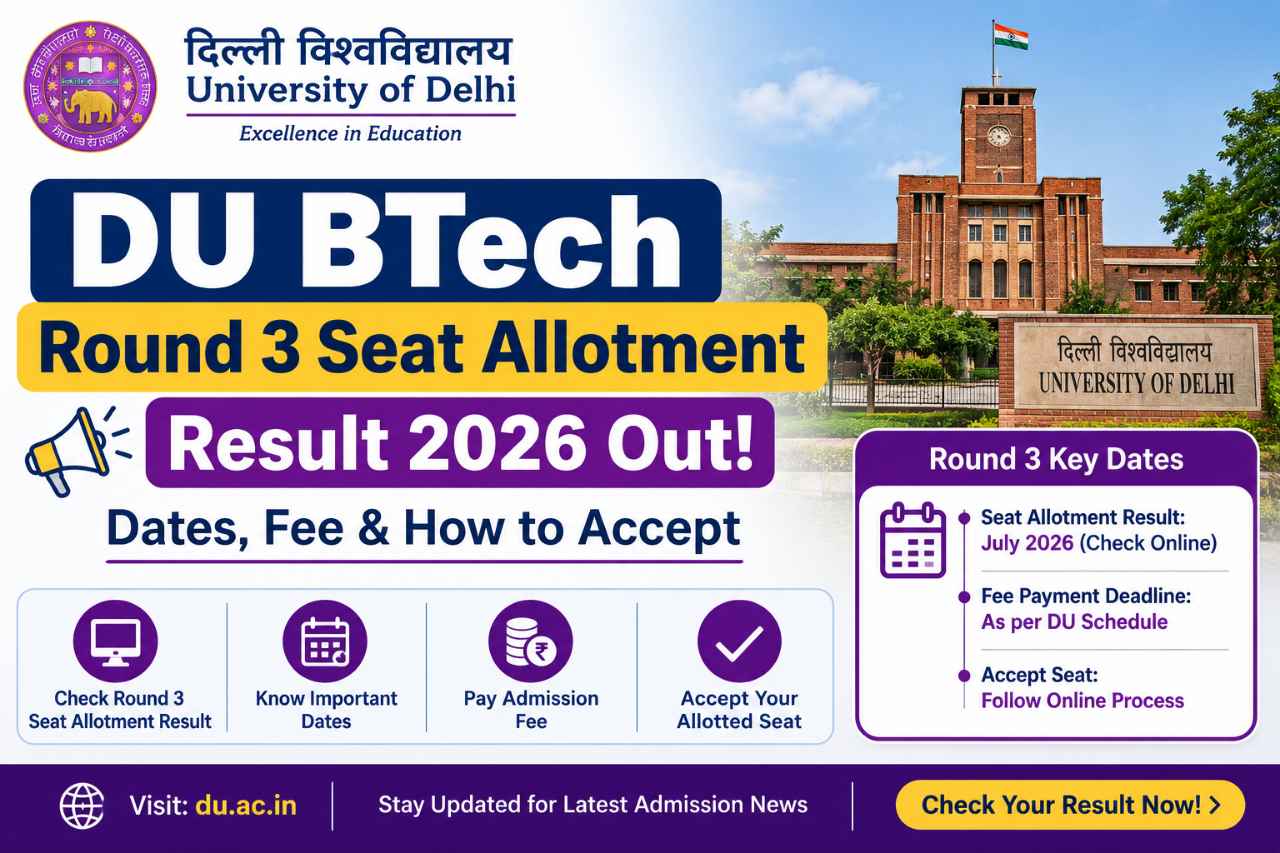

The University of Delhi (DU) has released the BTech Round 3 seat allotment result 2026 on its official admission portal. Candidates who applied through the Common Seat Allocation System (CSAS) can now log in at admission.uod.ac.in to see whether they have received a college and branch in this round. Round 3 is the final scheduled allocation round for DU BTech admissions this year, which makes the next few days critical for every shortlisted applicant.
If you have been allotted a seat, you must accept it online, upload documents for verification, and pay the admission confirmation fee within the prescribed deadlines. Missing even one step can lead to automatic cancellation of your allotment. This guide explains the complete Round 3 schedule, fee structure, step-by-step process, document checklist, and backup options for candidates who were not allotted a seat in Delhi University.
DU BTech Round 3 Allotment Result 2026: Key Highlights
The Bachelor of Technology (BTech) programme at Delhi University is administered by the Faculty of Technology. Admissions are conducted through CSAS based on JEE Main ranks and candidate preferences filled during registration. After Round 1 (June 24, 2026) and Round 2 (July 3, 2026), the university declared Round 3 results on July 20, 2026.
Round 3 typically absorbs remaining vacant seats across participating engineering colleges. For many candidates, this is the last structured chance to secure a government-funded BTech seat in Delhi without waiting for an uncertain spot round. The allotment letter shows your allotted insttute, branch, category, and reporting instructions.
Why Round 3 Matters for BTech Aspirants
Unlike undergraduate programmes under DU's other faculties, BTech admission follows a centralized engineering counselling model. Seats are distributed across premier institutes such as Delhi Technological University (DTU) and Netaji Subhas University of Technology (NSUT), both among the most sought-after engineering destinations in the National Capital Region.
Candidates who upgraded in earlier rounds may have vacated seats, creating fresh opportunities in Round 3. Even if your rank seemed borderline after Round 2, checking the Round 3 result is essential because seat movement can be significant in the final scheduled round.
Important Dates for DU BTech Round 3 Admission 2026
DU has set a tight three-day window for post-allotment formalities. Treat these dates as non-negotiable deadlines rather than tentative timelines.
- Round 3 seat allotment result: July 20, 2026
- Last date to accept allotted seat: July 21, 2026
- Document verification by allotted colleges: Till July 22, 2026
- Last date for online admission confirmation fee payment: July 23, 2026
All times and cut-offs follow the official CSAS portal unless DU publishes a specific extension notice. Always verify the latest update on the admission website before planning travel or fee arrangements.
Round-Wise Schedule Comparison
Understanding how Round 3 fits into the overall BTech admission cycle helps you plan better and compare your options across rounds.
- Round 1: Allotment on June 24, 2026 | Accept by June 29 | Fee payment by July 1, 2026
- Round 2: Allotment on July 3, 2026 | Accept by July 8 | Fee payment by July 10, 2026
- Round 3: Allotment on July 20, 2026 | Accept by July 21 | Fee payment by July 23, 2026
Each round follows the same basic sequence: result declaration, seat acceptance, document verification, and fee payment. The compressed timeline in Round 3 means candidates should act on the same day the result is declared if possible.
How to Check DU BTech Round 3 Allotment Result Online
The allotment result is available only on the official DU admission portal. Third-party websites may summarize results, but always confirm your status directly on CSAS to avoid misinformation.
Step-by-Step Login Process
- Visit the official portal at admission.uod.ac.in using a laptop or mobile browser.
- Click on the BTech admission or CSAS login link displayed on the homepage.
- Enter your CSAS application number and password created during registration.
- Navigate to the seat allocation section and open the Round 3 allotment status.
- Download and save the allotment letter showing your college, branch, and category details.
If you forgot your password, use the portal's recovery option immediately. Do not wait until the acceptance deadline, as password reset delays can cost you the seat.
What to Check on Your Allotment Letter
Read every field on the allotment letter carefully before clicking accept. Confirm that the allotted insttute matches your preference order, the branch is the one you intend to pursue, and your category (General, OBC, EWS, SC, ST, PwBD, or Orphan) is correctly reflected. Any discrepancy should be reported to the CSAS helpdesk and the allotted college without delay.
How to Accept the Allotted Seat and Pay the Admission Fee
Receiving an allotment is not the same as confirming admission. You must complete three mandatory actions: online seat acceptance, document upload and verification, and payment of the admission confirmation fee.
Seat Acceptance Process
- Log in to the CSAS portal at admission.uod.ac.in with your credentials.
- Click the Accept Seat option before the July 21, 2026 deadline.
- Review the terms and conditions, then confirm acceptance.
- Upload scanned copies of all required documents in the prescribed format and file size.
- Track verification status on the portal until the college approves your documents.
Once you accept the seat, withdrawing or switching to another insttute within CSAS is generally not permitted unless DU announces a specific withdrawal window. Think carefully before confirming, especially if you are simultaneously holding options at other universities.
Admission Confirmation Fee Structure 2026
The admission confirmation fee must be paid online through the CSAS portal. The amount varies by category. Failure to pay by the deadline results in automatic cancellation of the allotted seat, which may then be offered to another candidate.
- General, OBC, EWS, SC, and ST candidates: Rs 1,00,000
- PwBD (Persons with Benchmark Disabilities) candidates: Rs 25,000
- Orphan candidates: Rs 10
This fee is part of the overall admission process and is separate from the annual tuition and other charges levied by the allotted college. Keep the payment receipt, transaction ID, and admission slip downloaded from the portal for future reference, including orientation and hostel allotment.
Documents Required for DU BTech Admission Verification
Colleges under the Faculty of Technology verify uploaded documents against originals during the reporting process. Prepare both digital scans and physical originals well in advance.
Essential Document Checklist
- JEE Main scorecard and rank card for the relevant session
- Class 10 mark sheet and passing certificate
- Class 12 mark sheet and passing certificate
- Category certificate (SC, ST, OBC, EWS) issued by competent authority, if applicable
- PwBD certificate in prescribed format, if applicable
- Orphan certificate or supporting documents, if applicable
- Character certificate from the last attended school
- Transfer certificate or migration certificate, as required by the college
- Passport-size photographs and valid photo ID (Aadhaar, passport, or school ID)
- DU CSAS application form printout and allotment letter
Document verification by colleges continues till July 22, 2026. Upload clear, legible scans in the format specified on the portal. Blurry or incomplete uploads are a common reason for verification delays.
Participating Colleges and Programmes Under DU BTech
DU BTech admissions cover multiple institutes under the Faculty of Technology. The most prominent include DTU and NSUT, both of which consistently rank among India's top government engineering colleges. Branches typically include Computer Science, Information Technology, Electronics and Communication, Mechanical Engineering, Electrical Engineering, and other specializations depending on institute capacity.
Securing a seat at DTU or NSUT Delhi opens doors to strong placement records, industry tie-ups, and affordable fee structures compared with many private institutions. Candidates allotted seats at these institutes should prioritize completing formalities within the Round 3 deadline.
Cutoffs and Seat Movement Across Rounds
Closing ranks in Round 3 are often higher (more relaxed) than Round 1 because many top-ranked candidates have already settled in preferred colleges. Branch-wise cutoff trends vary each year based on seat matrix, category reservations, and the number of candidates who freeze or float their allotments. If you were close to the Round 2 cutoff for your preferred branch, Round 3 may still deliver a favourable outcome.
What If You Were Not Allotted a Seat in Round 3?
Not receiving an allotment in Round 3 does not necessarily mean the end of your engineering admission journey. DU may announce spot rounds to fill remaining vacant seats, subject to an official notification after July 23, 2026. Monitor admission.uod.ac.in daily for any spot round schedule, eligibility criteria, and registration window.
Alternative Engineering Options in Delhi NCR
While waiting for a possible DU spot round, explore other credible BTech pathways in and around Delhi. State and private universities offer quality programmes with their own entrance or JEE Main-based admission processes.
- GGSIPU Engineering – Popular choice for Delhi NCR students with IPU CET and other admission routes
- Jamia Hamdard University Engineering – Established programmes in the capital with diverse specializations
- Amity University Noida – Private university with multiple engineering branches and modern infrastructure
- Galgotias University Greater Noida – NCR-based option for candidates seeking immediate admission clarity
- Shiv Nadar University Engineering – Strong academic environment in the NCR region
Engineering Options Beyond Delhi
Candidates open to relocating can also consider well-known private and state universities in Rajasthan and other states. Institutions such as Poornima University Jaipur, Manav Rachna University Engineering, and Lovely Professional University Engineering continue admissions through separate counselling and direct application channels. Compare fee structures, placement data, and accreditation before committing.
Action Plan for Allotted Candidates: Do This Today
Given the compressed Round 3 timeline, a structured action plan reduces the risk of missing a deadline due to oversight or technical issues.
- Step 1: Log in to admission.uod.ac.in and verify your Round 3 allotment status immediately.
- Step 2: Download the allotment letter and cross-check college, branch, and category details.
- Step 3: Accept the seat online before July 21, 2026, without waiting for the last hour.
- Step 4: Upload all required documents in the correct format on the CSAS portal.
- Step 5: Arrange the admission confirmation fee (Rs 1,00,000 for most categories) in your bank account.
- Step 6: Complete online fee payment by July 23, 2026, and save the receipt.
- Step 7: Prepare originals for college-level verification and note reporting or orientation dates.
- Step 8: Watch the DU portal for spot round announcements if you plan to participate further.
Common Mistakes to Avoid During Round 3 Admission
Every year, candidates lose allotted seats due to preventable errors. Awareness of these pitfalls can save months of preparation and counselling effort.
- Delaying seat acceptance: Waiting until late on July 21 increases the risk of portal congestion or payment gateway failures.
- Ignoring document upload: Accepting the seat without uploading documents can stall verification and jeopardize admission.
- Paying from a non-functional account: Ensure sufficient balance and daily transaction limits before initiating payment.
- Assuming fee payment is optional: Seat acceptance alone does not confirm admission; fee payment by July 23 is mandatory.
- Missing college communication: Check email, SMS, and the CSAS dashboard for college-specific reporting instructions.
- Relying on unofficial sources: Trust only admission.uod.ac.in and official college websites for dates and procedures.
Spot Round Possibility After Round 3
Round 3 is the last scheduled allocation round, but DU may conduct spot rounds if vacant seats remain after July 23, 2026. Spot rounds typically require fresh registration, a separate fee, and acceptance of available seats without guarantee of preferred branch or college. Past years have seen spot rounds for various DU programmes, but announcements depend on actual vacancy data.
Candidates who did not receive Round 3 allotments should keep their JEE Main credentials, documents, and fee arrangements ready. Simultaneously, secure a backup admission at another institution before their deadline expires, so you are not left without any option if no DU spot round materializes.
Eligibility Reminder: Who Can Confirm a Round 3 Allotment?
Only candidates who registered for DU BTech admissions through CSAS and participated in earlier counselling rounds are eligible for Round 3 seat allocation. Your JEE Main rank, category, and filled preferences determine whether you receive an allotment. Candidates must have passed Class 12 with Physics, Mathematics, and a qualifying subject combination as prescribed by the Faculty of Technology.
If your documents do not match the category claimed during registration, the college may reject verification even after seat acceptance. For example, an OBC-NCL certificate must be issued within the validity period specified by DU. PwBD candidates must hold a certificate in the format recognized by the university. Double-check eligibility criteria on the official portal before paying the confirmation fee, because refunds after cancellation follow strict rules.
Understanding the CSAS Preference System
During registration, candidates rank colleges and branches in order of preference. CSAS allotments are generated based on your rank, category, seat availability, and preference list. In Round 3, you receive an allotment only if seats remain in options you listed and your rank meets the round-specific cutoff. Candidates who did not fill enough preferences in earlier stages may find fewer options in the final round. While you cannot change preferences after allotment, understanding this logic helps explain why you may receive a lower-preference branch even with a decent JEE Main rank.
Physical Reporting and Orientation at the Allotted College
Online formalities through CSAS are only the first part of admission. After fee payment, the allotted institute—whether DTU, NSUT, or another Faculty of Technology college—will communicate reporting dates, orientation schedules, and hostel allotment procedures separately. Watch your registered email and mobile number daily.
On reporting day, carry original documents along with self-attested photocopies. Colleges may conduct in-person verification, collect additional forms, and guide students on academic registration for the first semester. Hostel applicants should submit separate applications within the college deadline, as hostel seats are limited and often allocated on a first-come basis after admission confirmation.
Parent and Guardian Checklist
Parents play a key role during the compressed Round 3 window. Ensure the admission confirmation fee is available in an account the student can access for online payment. Keep printed copies of the allotment letter, fee receipt, and document checklist in a folder. If travelling from outside Delhi, book accommodation only after confirming reporting dates from the college. Institutions like The Northcap University Engineering and BML Munjal University serve as useful backup options for families evaluating multiple admission offers simultaneously.
Fee Refund and Withdrawal Rules: What You Should Know
Delhi University has revised fee refund policies for the 2026-27 admission cycle. Before accepting a Round 3 seat, read the official refund guidelines on admission.uod.ac.in. In general, the admission confirmation fee is adjusted against the total fee payable to the college upon joining. Withdrawal after payment may result in partial forfeiture depending on the date and reason for withdrawal.
Candidates holding confirmed seats at private universities such as SRM University Engineering or Chitkara University Engineering should compare refund timelines at both institutions before deciding. Accepting DU Round 3 while retaining another admission without understanding exit costs can lead to financial loss. When in doubt, contact the CSAS helpdesk and your allotted college admission office for written clarification.
Conclusion
The DU BTech Round 3 seat allotment result 2026 marks a decisive phase for engineering aspirants targeting Delhi's top government institutes. Allotted candidates must accept their seat by July 21, 2026, complete document verification by July 22, and pay the admission confirmation fee by July 23, 2026 through the CSAS portal at admission.uod.ac.in. With institutes like DTU and NSUT on the line, timely action is the difference between securing a premier BTech seat and losing it to the next candidate in queue.
Whether you received an allotment or not, stay informed through official channels, prepare documents meticulously, and keep alternative pathways such as GGSIPU and other engineering colleges in view. Engineering admission in India rewards candidates who combine rank awareness with deadline discipline—and Round 3 is where that discipline matters most.