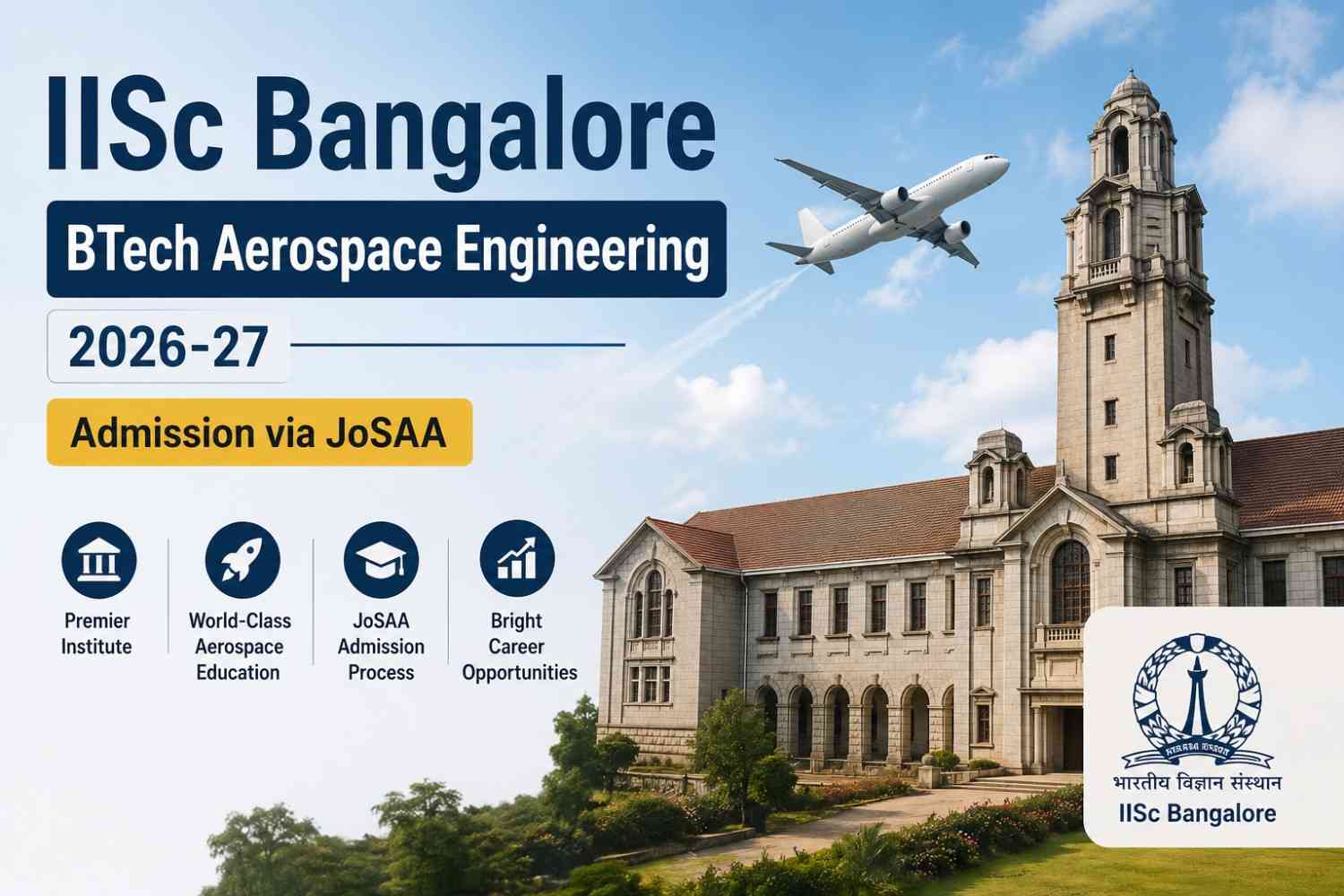

The Indian institute of Science (IISc) Bangalore has announced a four-year Bachelor of Technology (BTech) programme in Aerospace Engineering for the 2026-27 academic session. This is a major step for one of India's most respected research institutes, which historically focused on postgraduate science and engineering education. Admissions will run exclusively through JoSAA 2026 counselling based on JEE Advanced ranks—there is no separate IISc application form.
For JEE Advanced aspirants targeting cutting-edge aerospace study in Bengaluru, this programme opens a prestigious new option alongside IITs and leading private universities. This guide covers eligibility, curriculum, fees, seat intake, the JoSAA application process, and how IISc Aerospace Engineering compares with other engineering pathways across India.
What Is IISc Bangalore's New BTech in Aerospace Engineering?
IISc Bangalore, established in 1909 and consistently ranked among India's top research institutions, is expanding its undergraduate engineering portfolio. Aerospace Engineering joins Mathematics and Computing (launched in 2022-23) and two other new branches Mechanics and Computing, and Materials Science and Engineering—for 2026-27.
The programme is a full-time, four-year BTech with eight semesters and 128 credits. It is designed to train engineers in aircraft and spacecraft systems, combining core aerospace subjects with IISc's research-oriented culture. Classes begin in August 2026, and instruction is in English on the institute 400-acre Bengaluru campus.
Why This Launch Matters for Indian Higher Education
Until recently, IISc did not offer mainstream undergraduate BTech degrees. The 2022-23 Mathematics and Computing BTech was its first UG engineering programme. Adding Aerospace Engineering signals IISc's commitment to building a small but elite undergraduate cohort integrated with world-class labs and faculty.
For students who rank highly in JEE Advanced but prefer a research-intensive environment over a large IIT campus, IISc presents a compelling alternative. The aerospace sector in India—spanning ISRO, DRDO, private space startups, aviation MRO, and defence manufacturing—is expanding rapidly, and graduates with strong fundamentals in aerodynamics, propulsion, and control systems are in demand.
Programme Highlights and Curriculum Structure
The BTech in Aerospace Engineering at IISc covers the full spectrum of modern aerospace education. Core areas include aerodynamics, propulsion, structures and materials, flight mechanics, space mechanics, and guidance and control systems. The curriculum balances theory, computation, laboratory work, and project-based learning.
Key Learning Features
- Aerospace Engineering X Lab: Dedicated hands-on laboratory sessions where students work with models, simulations, and experimental setups relevant to aerospace systems.
- Design-Build-Fly capstone: A final-year project where teams design, build, and test aerospace prototypes—mirroring real industry and research workflows.
- Flexible electives: Students can choose electives across IISc departments, allowing cross-disciplinary exposure in computing, materials, mechanics, and related fields.
- Structured research projects from Year 3: High-performing students engage in guided research early, a hallmark of the IISc academic model.
- Graduate-level course access: Exceptional undergraduates may access advanced postgraduate courses, accelerating depth in specialised topics.
Semester-Wise Progression (Overview)
While IISc publishes detailed semester plans on its official BTech admissions portal at btech-ug.iisc.ac.in, the general arc follows standard engineering progression:
- Years 1–2: Mathematics, physics, engineering fundamentals, introductory aerospace topics, and programming.
- Year 3: Core aerospace modules—aerodynamics, propulsion, structures—and beginning of research-oriented project work.
- Year 4: Advanced electives, industry-aligned modules, and the Design-Build-Fly capstone alongside optional research thesis components.
This structure prepares graduates for MTech and PhD pathways at IISc or abroad, as well as direct industry roles in aviation and space sectors.
IISc BTech Aerospace Engineering 2026-27: Key Details at a Glance
| Particular | Details |
|---|---|
| Programme name | BTech in Aerospace Engineering |
| Institute | Indian institute of Science (IISc), Bangalore |
| Duration | 4 years (8 semesters) |
| Total credits | 128 |
| Total BTech seats (all branches) | 125 |
| Supernumerary seats for foreign students (Aerospace) | 3 |
| Total academic fee | Rs 3.58 lakh |
| Admission mode | JoSAA 2026 counselling via JEE Advanced 2026 rank |
| Class commencement | August 2026 |
| Hostel | On-campus accommodation for full programme duration |
| Medium of instruction | English |
All BTech Programmes Offered at IISc in 2026-27
IISc now offers four BTech branches. Understanding the full portfolio helps candidates prioritise choices during JoSAA choice filling.
| Programme | Status | Foreign Student Seats |
|---|---|---|
| Mathematics and Computing | Existing (since 2022-23) | 5 |
| Aerospace Engineering | New from 2026-27 | 3 |
| Mechanics and Computing | New from 2026-27 | 3 |
| Materials Science and Engineering | New from 2026-27 | 3 |
All 125 BTech seats are allocated across these four programmes through JoSAA. Branch-wise seat distribution and opening-closing ranks are published during counselling rounds.
Eligibility Criteria for IISc BTech Aerospace Engineering 2026
Admission is merit-based through JEE Advanced 2026. IISc does not conduct a separate entrance test or interview for BTech admissions.
JEE Advanced Requirement
Candidates must qualify JEE Advanced 2026 and hold a valid All India Rank (AIR). Registration on the JoSAA portal is mandatory for seat allocation. Foreign nationals may register directly for JEE Advanced 2026 without appearing for JEE Main, as per current JoSAA business rules.
Class 12 Performance Criteria
Apart from JEE Advanced qualification, candidates must meet Class 12 aggregate marks requirements specified in JoSAA 2026 Business Rules:
- General category: Minimum 75% aggregate marks in Class 12 (or equivalent qualifying examination).
- SC, ST, and PwD categories: Minimum 65% aggregate marks in Class 12.
Always verify the latest JoSAA business rules document on josaa.nic.in before registration, as criteria may include subject-wise requirements for Physics, Chemistry, and Mathematics.
Who Should Consider This Programme?
IISc Aerospace Engineering suits students who:
- Rank among JEE Advanced toppers and seek a research-oriented undergraduate experience.
- Are passionate about aviation, space technology, and computational aerospace modelling.
- Prefer a compact, elite cohort over larger IIT batches.
- Plan long-term careers in R&D, higher studies, or India's growing private space economy.
How to Apply: JoSAA 2026 Counselling Process
There is no separate application on the IISc admissions website for BTech Aerospace Engineering. The entire selection process is handled through the Joint Seat Allocation Authority (JoSAA) at josaa.nic.in.
Follow these steps carefully to secure a seat:
- Qualify JEE Advanced 2026 with a valid rank in the merit list.
- Register on JoSAA 2026 when the registration window opens, using your JEE Advanced credentials.
- Complete choice filling and lock IISc Bangalore BTech Aerospace Engineering among your preferred options. Place it high in your list if it is your top target.
- Participate in seat allocation rounds (Round 1, Round 2, and subsequent rounds as announced).
- Report to the allotted institute seat acceptance, with document verification and fee payment within the stipulated deadline.
Keep your Class 12 marksheet, JEE Advanced scorecard, category certificate (if applicable), and identity documents ready before reporting.
Fees, Financial Planning, and Campus Life
The total academic fee for the IISc BTech programme is Rs 3.58 lakh. This is competitive compared with many private engineering colleges and several IITs, especially given IISc's research infrastructure and faculty profile.
Hostel and Campus Facilities
All BTech students are housed on the IISc campus in Bengaluru. On-campus hostel accommodation is available for the full duration of the programme. The 400-acre campus hosts advanced laboratories, libraries, computing facilities, and proximity to Bengaluru's aerospace and technology ecosystem—including ISRO centres, aviation companies, and deep-tech startups.
Budget Checklist Before Reporting
- Academic fee: Rs 3.58 lakh (confirm instalment schedule on the official portal).
- Hostel and mess charges as notified by IISc separately.
- Personal expenses, books, and project materials for laboratory and capstone work.
Expected Cutoffs and Competition Level
As Aerospace Engineering is a new branch at IISc for 2026-27, opening and closing ranks will be published during the first JoSAA counselling round. Given IISc's reputation and limited total BTech intake (125 seats across four branches), expect competition comparable to top IIT branches.
Historical JoSAA data for IISc Mathematics and Computing shows extremely tight cutoffs—often requiring ranks within the top few hundred in JEE Advanced for General category candidates. Aerospace Engineering may follow a similar pattern, though exact ranks depend on seat distribution and candidate preferences in 2026.
Actionable tip: Monitor JoSAA round-wise opening and closing ranks immediately after Round 1. If your rank is borderline, keep IISc Aerospace Engineering in higher choice slots but maintain backup options at IITs or NITs with aerospace-related departments.
Career Pathways After IISc BTech Aerospace Engineering
Graduates can pursue diverse career routes:
- Higher studies: MTech, MS, or PhD at IISc, IITs, international universities, or specialised aerospace institutes.
- Public sector: ISRO, DRDO, HAL, NAL, and other defence and space organisations.
- Private sector: Aviation OEMs, airlines, MRO firms, and space startups such as Skyroot, Agnikul, and Bellatrix Aerospace.
- Research and academia: R&D roles leveraging IISc's research project exposure from Year 3 onward.
The Design-Build-Fly capstone and Aerospace Engineering X Lab give graduates practical portfolios that strengthen job and graduate-school applications.
How IISc Aerospace Engineering Compares With Other Options in India
JEE Advanced opens doors to IITs with aerospace departments (IIT Bombay, IIT Madras, IIT Kanpur, IIT Kharagpur, and others). IISc differs in scale and culture—it is research-first, with a smaller UG batch and deeper integration with postgraduate science and engineering.
Students who miss top IIT aerospace cutoffs often explore strong regional programmes. Delhi NCR institutions such as BPIT Engineering College, NIET Engineering College, and Guru Gobind Singh Indraprastha University Engineering offer established BTech pathways through state and university-level counselling.
In Punjab and Chandigarh, Chandigarh Engineering College and Chitkara University Engineering attract engineering aspirants seeking industry-linked curricula. Lovely Professional University Engineering is another widely chosen option for mechanical and allied branches that can lead toward aerospace specialisation at postgraduate level.
Private universities with strong engineering reputations—including Shiv Nadar University Engineering, SRM University Engineering, and Graphic Era University Engineering—provide alternatives for students taking JEE Main, state entrance exams, or university-specific tests rather than JEE Advanced.
North India colleges such as Galgotias College of Engineering, Krishna Institute of Engineering and Technology, Dronacharya College of Engineering, and Manav Rachna University Engineering serve thousands of BTech aspirants annually. While these differ from IISc in selectivity and research intensity, they remain practical choices for students building foundational engineering skills before MTech specialisation in aerospace.
Institutions like DIT University Engineering in Dehradun and Northern India Engineering College in Delhi similarly cater to students who want accredited BTech degrees with placement support, even if their JEE Advanced ranks fall outside IISc or IIT cutoffs.
Action Plan for JEE Advanced 2026 Aspirants
If IISc Aerospace Engineering is your goal, start preparing now with a structured timeline:
- Track JEE Advanced 2026 results and note your All India Rank immediately upon release.
- Register on JoSAA 2026 as soon as the portal opens—late registration can cost you a counselling round.
- Prepare documents: Class 12 marksheet, JEE Advanced scorecard, category certificate, photo ID, and domicile papers if required.
- Strategise choice filling: Lock IISc Aerospace Engineering high in your preference list if it is your primary target; include realistic backups.
- Arrange finances: Plan for the Rs 3.58 lakh academic fee plus hostel and living costs before the reporting deadline.
- Watch official updates: Follow btech-ug.iisc.ac.in and josaa.nic.in for seat matrix, fee revisions, and round schedules.
Important Dates and Official Sources to Monitor
Exact JoSAA 2026 dates are announced by the Joint Seat Allocation Authority after JEE Advanced results. Typically, registration, choice filling, and multiple allocation rounds span several weeks in June and July. IISc will publish branch-wise opening and closing ranks during counselling.
Always rely on official portals:
- IISc BTech admissions: btech-ug.iisc.ac.in
- JoSAA counselling: josaa.nic.in
- JEE Advanced: jeeadv.ac.in
IISc vs IIT Aerospace Programmes: Quick Comparison
Many JEE Advanced toppers debate between IISc and IIT aerospace departments. Both require strong ranks, but the learning environment differs significantly. Use this comparison to decide where IISc Aerospace Engineering fits in your JoSAA list.
| Factor | IISc Bangalore BTech Aerospace | IIT Aerospace Departments |
|---|---|---|
| Institute focus | Research-first science and engineering institute | Broad engineering institutes with large UG populations |
| Batch size | Small cohort across 125 total BTech seats (4 branches) | Larger branch-wise batches at each IIT |
| Admission route | JoSAA via JEE Advanced only | JoSAA via JEE Advanced only |
| Research exposure | Structured projects from Year 3; graduate course access | Varies by IIT; strong but often later in the programme |
| Campus location | Bengaluru—India's aerospace and startup hub | Spread across multiple cities nationwide |
| Total academic fee | Rs 3.58 lakh (IISc BTech) | Varies by IIT; typically comparable or higher over four years |
Tip for choice filling: If your rank supports both IISc and a top IIT aerospace branch, list the institute you prefer for culture and career goals—not just perceived brand name. IISc suits research-minded students; IITs offer wider alumni networks across industries.
Documents Required for JoSAA Reporting at IISc
After seat allotment, incomplete documentation is one of the most common reasons candidates lose confirmed seats. Prepare originals and photocopies of the following before visiting IISc Bangalore:
- JEE Advanced 2026 admit card and scorecard showing All India Rank
- Class 10 certificate for date of birth verification
- Class 12 marksheet and passing certificate meeting aggregate criteria
- Category certificate (SC/ST/OBC-NCL/EWS/PwD) issued by competent authority, if applicable
- Photo identity proof (Aadhaar, passport, or other government ID)
- Passport-size photographs as specified in JoSAA reporting guidelines
- Medical fitness certificate, if required by institute notification
- Proof of fee payment (Rs 3.58 lakh academic fee plus any institute deposits)
Cross-check the latest document checklist on josaa.nic.in and btech-ug.iisc.ac.in, as requirements may be updated before reporting begins.
Common Mistakes to Avoid During JoSAA Counselling
Even high-ranking candidates lose preferred seats due to procedural errors. Avoid these pitfalls when targeting IISc Aerospace Engineering:
- Not locking choices: Filling preferences without locking before the deadline means your choices are ignored entirely.
- Listing IISc too low: If Aerospace Engineering is your dream branch, placing IISc below less-preferred institutes can result in allotment elsewhere in Round 1.
- Missing reporting deadlines: Seat acceptance and institute reporting have strict windows. A missed deadline can lead to seat cancellation.
- Ignoring float and slide options: Understand JoSAA rules for upgrading within rounds without losing a secured seat prematurely.
- Skipping official notifications: Rely on josaa.nic.in and btech-ug.iisc.ac.in—not unverified social media posts—for schedule changes.
Bengaluru Advantage: Why Location Matters for Aerospace Students
Studying aerospace engineering in Bengaluru offers practical advantages beyond the classroom. The city hosts ISRO headquarters, HAL facilities, NAL laboratories, and a growing cluster of private space companies. Internships, industry talks, and collaborative projects are easier to access when your campus sits inside India's primary aerospace ecosystem.
IISc's 400-acre campus also places BTech students alongside leading researchers in adjacent disciplines—materials science, mechanical engineering, electrical engineering, and computer science—making cross-department electives genuinely meaningful. For students comparing IISc with colleges in other cities, such as YMCA University Engineering or The Northcap University Engineering in the NCR region, the Bengaluru location is a distinct factor in long-term aerospace networking and internship access.
Backup Planning: Engineering Pathways Beyond IISc
Not every aspirant will secure an IISc BTech seat. A smart counselling strategy includes well-researched backups at IITs, NITs, IIITs, and accredited private universities. Mechanical engineering, engineering physics, and related branches can serve as stepping stones toward aerospace MTech programmes.
Colleges such as Jamia Hamdard University Engineering, Sharda University Engineering, and Integral University Engineering offer BTech programmes for students entering through JEE Main, state exams, or institutional tests. Rajasthan-based options like Government Engineering College Ajmer and Lords Institute of Engineering and Technology Jaipur provide affordable government and private routes for building core engineering foundations.
Remember: missing IISc in Round 1 does not end your aerospace ambitions. Strong postgraduate programmes at IISc, IITs, and international universities remain open to graduates from a wide range of undergraduate institutions.
Conclusion
IISc Bangalore's BTech in Aerospace Engineering for 2026-27 is a landmark addition to India's undergraduate engineering landscape. With 128 credits across eight semesters, hands-on labs, a Design-Build-Fly capstone, and research exposure from the third year, the programme targets students who want depth not just a degree in aerospace systems.
Admission is entirely through JoSAA 2026 based on JEE Advanced ranks, with no separate IISc form. Eligible candidates need valid JEE Advanced scores and Class 12 aggregates of at least 75% (General) or 65% (SC/ST/PwD). The total academic fee stands at Rs 3.58 lakh, with on-campus hostel accommodation on IISc's Bengaluru campus.
For high-ranking JEE Advanced aspirants, this programme deserves a top slot in JoSAA choice filling. Others should track opening ranks in Round 1 and compare IISc with IIT aerospace departments and strong regional colleges. Stay updated on josaa.nic.in and btech-ug.iisc.ac.in for the latest seat matrix, cutoffs, and reporting instructions.