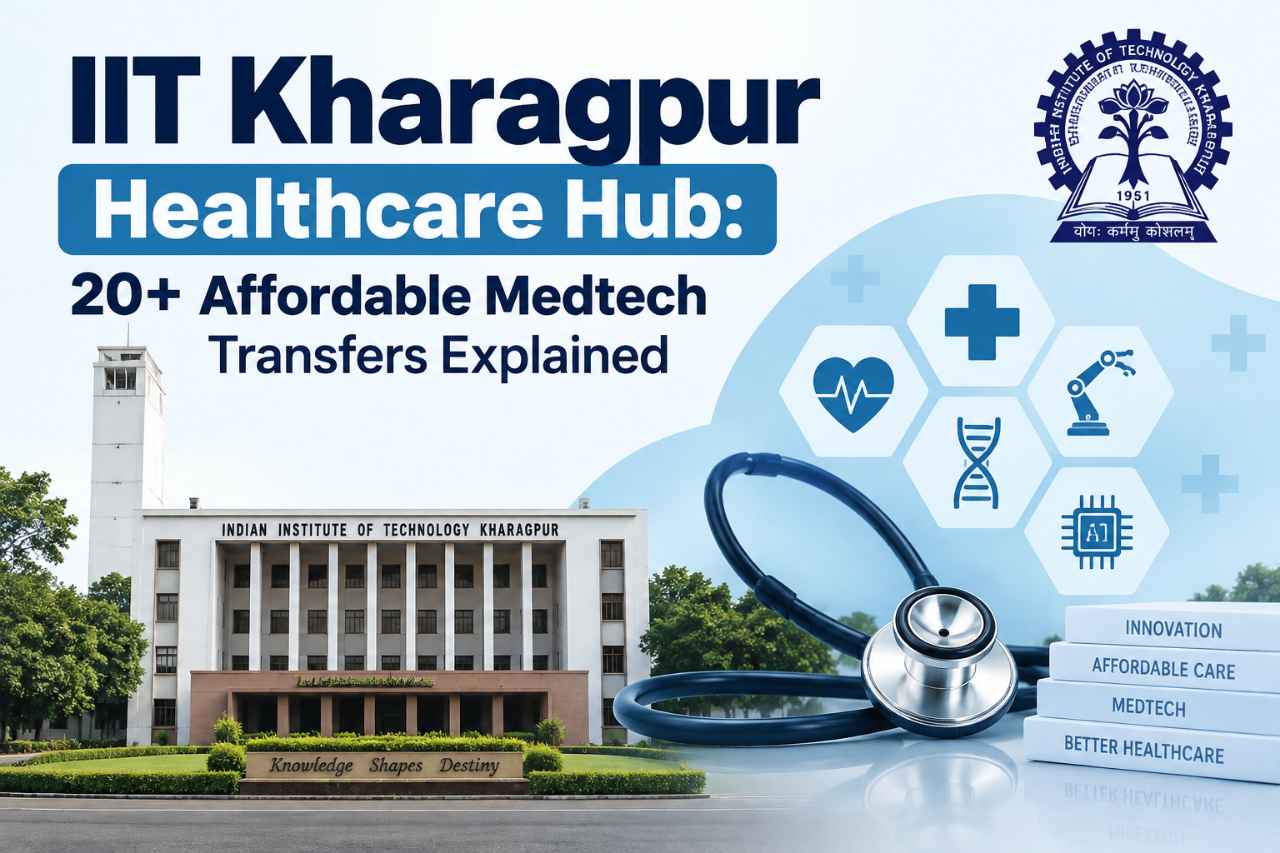
India's push for affordable, locally developed medical technology took a significant step forward when the Common Research and Technology Development Hub (CRTDH) on affordable healthcare at Indian institute Of Technology Kharagpur completed its initial government-funded phase and entered a self-sustaining operational model. Set up in 2019 with support from the Department of Scientific and Industrial Research (DSIR), the hub has already facilitated more than 20 technology transfers, helping startups and small innovators move affordable diagnostic and medical devices from laboratory benches toward commercial production and, crucially, toward rural communities where healthcare access remains limited.
For students exploring careers at the intersection of engineering, biotechnology, and public health, this development offers a practical blueprint of how premier institutes translate research into real-world impact. This guide explains what the IIT Kharagpur healthcare hub does, why its transition to financial independence matters, how rural health units are expanding access, and what aspiring engineers and medical technology entrepreneurs can learn from this model.
What Is the IIT Kharagpur Affordable Healthcare Technology Hub?
The CRTDH on affordable healthcare at IIT Kharagpur is a dedicated innovation facility designed to bridge the gap between academic research and market-ready medical products. Unlike a conventional laboratory that serves only faculty and students, this hub functions as a shared infrastructure platform where startups, small and medium enterprises (SMEs), and individual innovators can access equipment, technical mentorship, and validation support without bearing the full capital cost of setting up independent medical device development facilities.
According to an institute statement reported in September 2026, the hub provides laboratories, technical assistance, and allied resources to teams developing healthcare products ranging from low-cost diagnostic tools to rugged medical equipment suited for resource-constrained settings. The underlying philosophy aligns with a broader national goal: reduce dependence on imported medical devices while ensuring that affordability does not come at the cost of reliability or usability.
Core Objectives of the Hub
- Develop affordable medical technologies tailored to Indian price points and usage conditions
- Support early-stage innovators who lack access to advanced prototyping and testing infrastructure
- Facilitate technology transfer from research prototypes to companies ready for scaled manufacturing
- Extend healthcare access to underserved rural and semi-urban populations through field deployments
- Build domestic capacity in medical equipment design, testing, and commercialisation under the Atmanirbhar Bharat vision
Institutes such as the Sree Chitra Tirunal Institute For Medical Sciences And Technology Thiruvananthapuram have long pioneered indigenous biomedical devices, while newer centres like The University Of Trans Disciplinary Health Sciences And Technology emphasise cross-disciplinary health innovation. The IIT Kharagpur hub adds an engineering-heavy, industry-partnership-driven layer to this ecosystem, making it especially relevant for B.Tech and M.Tech students interested in medtech entrepreneurship.
From Government Funding to a Self-Sustaining Model
One of the most important milestones in the hub's journey is the completion of its initial DSIR-funded phase and the inauguration of its sustainable operational phase on Saturday, September 6, 2026. DSIR Secretary and CSIR Director General N Kalaiselvi inaugurated the new phase in the presence of IIT Kharagpur Director Prof Suman Chakraborty, signalling institutional confidence that the hub can continue delivering value without ongoing grant dependency.
Why the Transition Matters for Indian Higher Education and Industry
Government-supported research hubs often face a critical test: can they survive and scale after public funding ends? Kalaiselvi noted that a CRTDH's ability to function independently after grant support concludes is a strong indicator of programme success. For students and faculty, this matters because sustainable hubs create long-term internship, project, and employment pathways rather than short-lived pilot programmes.
Under the new model, the hub will meet operating expenses through:
- User fees charged to startups and companies accessing shared facilities
- Industry support from partners seeking co-development or licensing opportunities
- Technology transfer partnerships that generate revenue when innovations move to commercial production
Importantly, innovators will continue to receive infrastructure access and technical assistance. The shift is not a withdrawal of support but a maturation toward a hybrid public-private innovation model similar to technology incubators at leading institutes such as Indian Institute Of Technology Bombay Iit Bombay and Indian Institute Of Technology Delhi Iit Delhi, where industry collaboration sustains cutting-edge research facilities.
Connection to Viksit Bharat 2047 and Medical Self-Reliance
Kalaiselvi emphasised strengthening India's capacity to develop its own medical equipment rather than relying predominantly on imports. Affordable, locally designed devices can reduce procurement costs for public health systems, create manufacturing jobs, and improve spare-part availability in district hospitals and primary health centres. This aligns with the broader vision of a developed India by 2047, where innovation hubs act as regional engines of economic and social progress.
20+ Technology Transfers: What Has the Hub Achieved So Far?
Since its establishment in 2019, the hub has facilitated more than 20 technology transfers. A technology transfer, in this context, means handing over a validated innovation—often with documentation, training, and licensing support—from the research environment to a company or production partner capable of manufacturing and distributing the product.
Types of Affordable Medical Technologies Emerging from the Hub
While specific product names vary, the hub's portfolio typically spans categories critical to tier-2, tier-3, and rural healthcare:
- Point-of-care diagnostic devices for rapid testing without central laboratory infrastructure
- Low-cost monitoring equipment suitable for primary health centres with intermittent power supply
- Portable imaging and screening tools designed for community health camps
- Assistive and rehabilitation devices addressing mobility and chronic care needs at accessible price points
- Digital health interfaces that connect field data with district-level medical officers
Several of these technologies are reportedly moving toward commercial production, which is the ultimate measure of impact. A prototype that never leaves the campus laboratory helps no patient; a transferred technology that reaches pharmacies, clinics, and ASHA worker kits can change outcomes at scale.
How Technology Transfer Differs from Pure Research
Students sometimes confuse publishing a research paper with achieving societal impact. Technology transfer involves additional steps: regulatory awareness, design for manufacturability, quality control protocols, user training materials, and supply chain planning. The CRTDH model embeds these considerations early, which is why hubs like this one are increasingly featured in discussions about India's medtech startup ecosystem alongside engineering colleges that offer biomedical specialisations.
Affordable Healthcare Means More Than Lower Prices
IIT Kharagpur Director Prof Suman Chakraborty offered a nuanced definition of affordable healthcare that deserves attention from every aspiring healthcare innovator. He stated that affordability is not merely about making equipment cheaper; it is about developing products that are reliable, easy to use, and capable of functioning in difficult real-life conditions.
Design Principles for Rural and Resource-Limited Settings
Medical devices that perform flawlessly in air-conditioned urban hospitals may fail in a village clinic with voltage fluctuations, dust, limited technician support, and high patient volumes. The hub therefore prioritises:
- Robust build quality resistant to heat, humidity, and transport stress
- Minimal training requirements so community health workers can operate devices safely
- Low maintenance costs with locally available consumables where possible
- Clear error indicators that prevent misdiagnosis when conditions are non-ideal
- Scalable manufacturing using processes Indian SMEs can adopt
This design philosophy mirrors challenges faced across India's healthcare map—from West Bengal villages served through the hub's partnerships to remote districts where engineering graduates from institutes like Malaviya National Institute Of Technology Mnit Jaipur and Ramaiah Institute Of Technology increasingly contribute to health-tech startups.
The Lab-to-Market-to-Village Pipeline
Chakraborty described the hub's long-term objective as helping innovations move from laboratories to markets and ultimately to the people who need them most. This three-stage pipeline—lab, market, village—captures the full mission better than any single metric. Students interested in social impact entrepreneurship should study each stage: scientific validation, business model design, and last-mile distribution through public and non-government channels.
Rural Health Units and Community-Level Impact
Beyond technology transfer statistics, the hub has collaborated with healthcare organisations and non-government organisations (NGOs) to establish rural health units. These units help deploy affordable diagnostic technologies in villages and other areas where access to medical testing facilities remains limited.
Why Rural Deployment Is the Real Success Metric
India's healthcare challenge is not only a shortage of doctors but also uneven diagnostic infrastructure. A patient in a metropolitan city may access MRI, CT, and advanced blood panels within hours; a patient in a remote block may travel dozens of kilometres for basic tests. Portable, affordable diagnostics tested and refined through CRTDH partnerships can:
- Enable early detection of diabetes, anaemia, infectious diseases, and pregnancy-related complications
- Reduce unnecessary referrals to overcrowded district hospitals
- Support Ayushman Bharat and state health missions with point-of-care data
- Empower ASHA and ANM workers with reliable tools rather than paper-based screening alone
For college students considering project work or final-year theses, rural health deployments offer rich opportunities in frugal innovation, human-centred design, and field studies—skills that recruiters in medtech and public health technology value highly.
Who Can Benefit from the Hub? Startups, SMEs, and Innovators
The hub explicitly targets three groups: startups, small businesses, and individual innovators. Each group faces different barriers, and the CRTDH model attempts to lower them through shared infrastructure.
Startups
Early-stage medtech startups often struggle to fund ISO-compliant testing, biocompatibility studies, and iterative prototyping. Access to IIT Kharagpur's laboratories reduces capital expenditure and accelerates time-to-market, which can be decisive when competing for seed funding or government innovation grants.
Small and Medium Enterprises (SMEs)
Established SMEs in electronics, plastics, or instrumentation can diversify into medical devices by licensing transferred technologies from the hub. This creates manufacturing clusters and jobs in states beyond traditional medtech hubs like Maharashtra and Karnataka.
Individual Innovators
Doctors, engineers, and tinkerers with a single breakthrough idea often lack institutional affiliation. CRTDH programmes that welcome individual innovators democratise access to world-class testing facilities, much as fab labs and maker spaces democratised hardware prototyping—though with the rigorous standards medical products demand.
Career and Education Pathways in Affordable Medtech
If news about the IIT Kharagpur hub has sparked your interest, several academic and career routes can prepare you to contribute to similar initiatives across India.
Relevant Degree Programmes and Skills
| Focus Area | Useful Programmes | Key Skills to Build |
|---|---|---|
| Medical device design | B.Tech/M.Tech in Biomedical, Mechanical, Electronics Engineering | CAD, embedded systems, biomechanics, regulatory basics |
| Diagnostics and biosensors | Biotechnology, Chemical Engineering, Applied Sciences | Microfluidics, assay development, data analysis |
| Health informatics | Computer Science, IT, AI/ML specialisations | Telemedicine platforms, edge computing, privacy-compliant data systems |
| Public health deployment | MPH, hospital administration, NGO partnerships | Field research, health economics, community engagement |
| Entrepreneurship | Incubation cells, DSIR/ BIRAC programmes | IP licensing, fundraising, supply chain, CDSCO awareness |
Aspiring engineers from colleges such as Netaji Subhas University Of Technology Nsut Delhi, Indian Institute Of Information Technology Kota Iiit Kota, or Vel Tech Rangarajan Dr Sagunthala R D Institute Of Science Technology Chennai can complement their degrees with online courses in medical device regulation, quality management (ISO 13485), and design thinking for low-resource settings.
Internships, Competitions, and Research Projects
Watch for calls from IIT Kharagpur's incubation and research centres, DSIR-linked CRTDH networks nationwide, and events like healthcare hackathons sponsored by state innovation councils. Document field validation work in your portfolio—employers and postgraduate admissions committees increasingly value demonstrated impact over generic project titles.
How IIT Kharagpur Compares Within India's Innovation Landscape
IIT Kharagpur is not the only institute pursuing healthcare technology, but its CRTDH model is distinctive in combining DSIR infrastructure funding, explicit affordability mandates, and rural deployment partnerships. Peer institutions including IIT Bombay and IIT Delhi operate strong research programmes in healthcare engineering, while NITs and regional engineering colleges feed talent into startups commercialising hub outputs.
Students choosing colleges should look beyond brand names alone. Evaluate whether an institute offers biomedical labs, industry tie-ups, incubation support, and social innovation cells. A tier-2 college with an active medtech incubator may provide more hands-on device development experience than a prestigious programme limited to theoretical coursework.
Actionable Tips for Students and Early-Career Professionals
- Study frugal innovation case studies from Indian medtech successes and failures to understand cost-quality trade-offs.
- Learn regulatory fundamentals early; even a prototype must anticipate CDSCO classification and clinical validation pathways.
- Build interdisciplinary teams combining engineers, clinicians, and designers—solo inventors rarely scale devices alone.
- Spend time in field settings before finalising designs; observe power, water, workflow, and user literacy constraints firsthand.
- Explore CRTDH and BIRAC schemes when launching startups; shared labs can save lakhs in early capital expenditure.
- Follow hub announcements from IIT Kharagpur for technology licensing opportunities if you represent an SME or NGO.
- Connect rural health missions with affordable devices if you work in public health—deployment partnerships multiply impact.
Challenges Ahead and What to Watch
Despite impressive technology transfer numbers, affordable medtech in India still faces headwinds: lengthy regulatory approvals, fragmented procurement in state health systems, limited venture capital for hardware compared to software, and the need for post-sales service networks in rural areas. The hub's shift to self-sustainability will be tested against these market realities over the coming years.
Observers should monitor whether transferred technologies achieve widespread clinical adoption, whether rural health units expand to additional districts, and whether user-fee models remain accessible to cash-constrained startups. Continued DSIR and industry alignment will be essential even after the initial grant phase ends.
Understanding DSIR and the CRTDH Network in India
The Department of Scientific and Industrial Research (DSIR) under the Ministry of Science and Technology supports Common Research and Technology Development Hubs across sectors to fill a gap that many engineering graduates discover only after entering industry: translating prototypes into certified, manufacturable products requires shared facilities most individual innovators cannot afford. CRTDHs function as regional innovation anchors, and the IIT Kharagpur healthcare hub is among the most visible examples in the medtech space.
For admission seekers comparing institutes, this context helps explain why IIT Kharagpur consistently attracts students interested in interdisciplinary research. Beyond traditional departments, the campus ecosystem includes incubators, industry-sponsored labs, and now a self-sustaining healthcare hub that connects academic talent with real commercialisation pathways. Similar exposure to innovation culture can be found at other leading campuses, though the explicit rural healthcare mandate makes this hub particularly distinctive.
Funding Models Students Should Know About
Early-stage medtech ventures in India often combine multiple support streams: DSIR/CRTDH lab access, Biotechnology Industry Research Assistance Council (BIRAC) grants, state startup policies, and angel or venture funding for scaling. Understanding this layered funding landscape helps students plan careers that move beyond salary jobs into impact-driven entrepreneurship. Colleges with active innovation cells—whether at National Institute Of Technology Delhi Nit Delhi or Jaypee Institute Of Information Technology—often serve as feeders into these national programmes.
Conclusion
The IIT Kharagpur Common Research and Technology Development Hub on affordable healthcare represents a mature milestone in India's medtech journey: more than 20 technology transfers since 2019, a deliberate pivot to financial sustainability after DSIR's initial funding phase, and active deployment of diagnostic tools in rural health units alongside NGOs. For DSIR Secretary N Kalaiselvi, the hub demonstrates that publicly seeded innovation infrastructure can evolve into lasting national capacity; for Director Prof Suman Chakraborty, it reaffirms that affordable healthcare demands rugged, usable products—not merely inexpensive ones.
Students planning engineering careers, entrepreneurs eyeing the medical device market, and counsellors advising on emerging career tracks should treat this development as evidence that India's premier institutes are increasingly judged not only by placements and rankings but by how effectively they connect campus innovation to village clinics. Whether you aim for IIT Kharagpur or build skills at regional technology institutes, the underlying lesson is universal: the most meaningful healthcare technology is the kind that works where patients actually live—and hubs like this one are designed to make that possible.