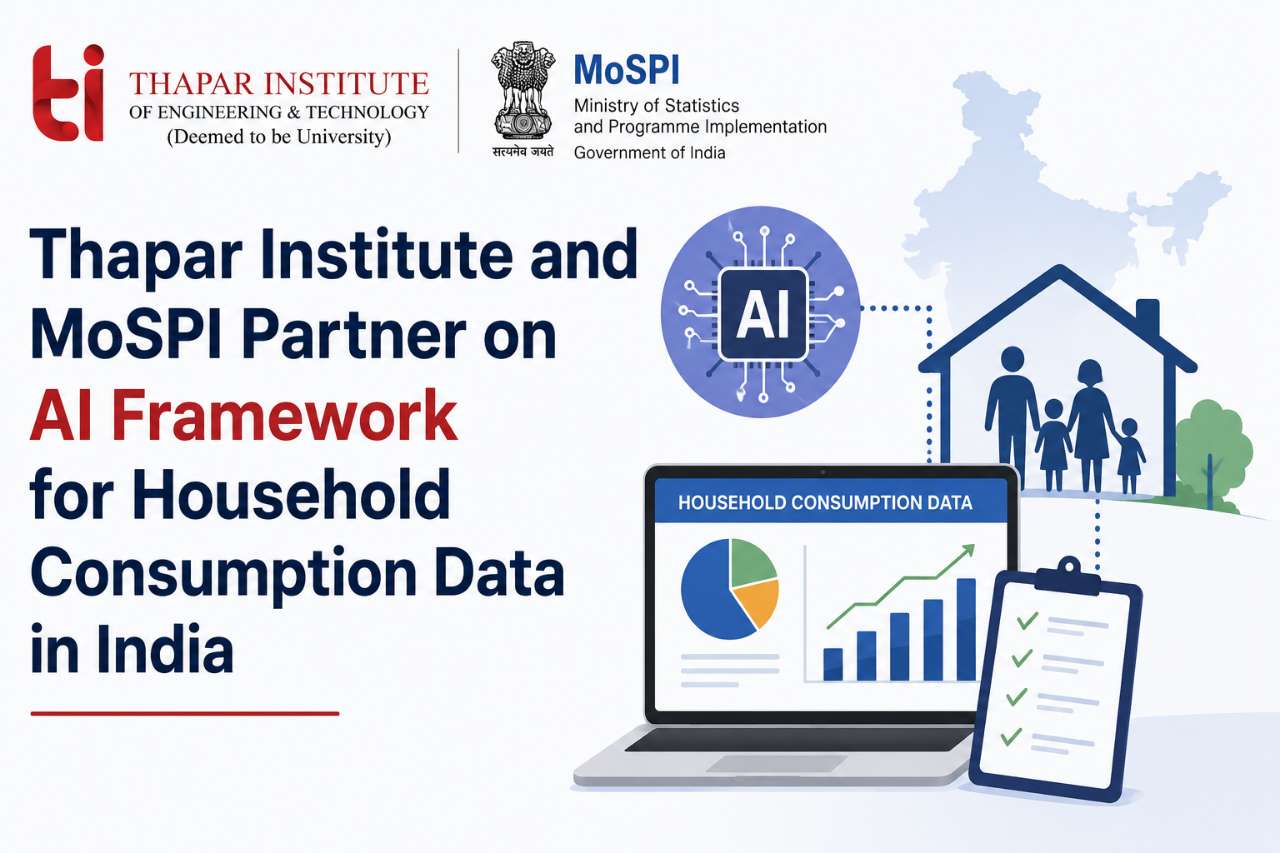
In a significant step for India's official statistics ecosystem, the Thapar Institute of Engineering and Technology Patiala (TIET) has signed a formal agreement with the Ministry of Statistics and Programme Implementation (MoSPI), Government of India. The collaboration aims to develop a predictive and analytical framework for monthly household consumption expenditure using artificial intelligence and advanced data science methods. For students, educators, and policy watchers across India, this partnership signals how premier engineering institutes are moving beyond campus placements to contribute directly to National economic planning, poverty estimation, and evidence-based policymaking.
Household consumption data sits at the heart of how India measures living standards, tracks inequality, and updates price indices. When a leading private deemed-to-be university joins hands with the ministry responsible for the Census, National Sample Survey, and Consumer Price Index, the outcome could reshape how policymakers read the economy between major survey rounds. This article explains what the agreement covers, why it matters for Indian higher education, and what aspiring data scientists and economists should know.
What Is the Thapar Institute and MoSPI Agreement?
According to the official announcement reported on September 3, 2026, TIET and MoSPI entered into a research collaboration to build an AI-based framework for estimating Monthly Per Capita Consumption Expenditure (MPCE) at national and state levels. The study will analyse household spending patterns using data from the Household Consumption Expenditure Survey (HCES) and generate evidence that supports poverty estimation, inequality analysis, and broader economic planning.
The agreement was signed by Padmakumar Nair, Vice Chancellor of TIET, and R. Rajesh, Additional Director General of MoSPI's Capacity Development Division. MoSPI Secretary Saurabh Garg attended the signing ceremony along with senior ministry officials, underscoring the institutional weight of the project.
Core Objectives of the Collaboration
- Predictive modelling: Develop tools that estimate monthly household consumption between full HCES survey rounds.
- State and national analysis: Break down spending patterns across geographies to support targeted policy design.
- Poverty and inequality inputs: Supply refreshed evidence for social sector programmes and welfare targeting.
- AI in official statistics: Demonstrate how machine learning can complement traditional survey methodology without replacing rigorous field data collection.
Unlike a one-off consultancy report, this is positioned as a sustained research partnership. Faculty and researchers at TIET will work alongside MoSPI statisticians to co-design models, validate outputs, and align findings with the standards expected of official statistics in India.
Why Household Consumption Data Matters for India
Every family in India makes daily choices about food, housing, transport, education, and healthcare. Aggregated at scale, these choices reveal whether living standards are rising, which regions lag behind, and how inflation affects different income groups. MoSPI's consumption surveys feed into some of the country's most consequential economic indicators.
Key Uses of Consumption Statistics
- Poverty estimation: MPCE thresholds help classify households above or below poverty lines used in planning and evaluation.
- Inequality analysis: Spending distribution highlights gaps between rural and urban areas, and across states.
- Consumer Price Index (CPI): Consumption baskets inform how retail inflation is measured and weighted.
- GDP and demand analysis: Private final consumption expenditure is a major component of national accounts.
The Economic Survey 2025-26 noted that private final consumption expenditure's share in GDP rose to 61.5% in FY26—the highest since 2011-12—with India's growth estimated at 7.4%, supported by domestic demand. In this context, understanding how households spend—and predicting shifts between survey years—becomes strategically important for fiscal planning, monetary policy discussions, and sectoral investment.
Understanding HCES 2023-24: The Data Foundation
The proposed AI framework will build on MoSPI's HCES 2023-24, which covered more than 2.61 lakh households across India. HCES is among the largest consumption surveys conducted in the country and provides granular detail on what households buy, how much they spend, and how patterns differ by location and demographic group.
Key Findings from HCES 2023-24 (As Reported)
| Area | Average Monthly Per Capita Consumption Expenditure (MPCE) |
|---|---|
| Rural India | Rs 4,122 |
| Urban India | Rs 6,996 |
The rural–urban gap reflects structural differences in prices, availability of services, and income opportunities. State-level variation can be even wider. Institutions such as the Indira Gandhi Institute of Development Research Mumbai and the International Institute for Population Sciences Mumbai have long trained researchers who work with similar large-scale survey datasets—making this TIET–MoSPI project part of a broader academic tradition linking Indian universities to national development data.
Because HCES is conducted periodically rather than monthly, policymakers sometimes face a lag between the latest field data and current economic conditions. That is precisely the gap TIET's predictive framework aims to address: offering modelled estimates that can be updated more frequently while remaining anchored to verified survey benchmarks.
How Artificial Intelligence Strengthens Official Statistics
Official statistics in India have historically relied on rigorous sampling design, enumerator training, and manual validation—a gold standard for accuracy but resource-intensive and slow to refresh. Artificial intelligence does not replace these foundations; instead, it can augment them by detecting patterns in high-dimensional data, imputing missing values carefully, and forecasting trends between survey waves.
What AI Can—and Cannot—Do Here
AI can help by:
- Identifying non-linear relationships between income proxies and consumption categories.
- Clustering households with similar spending behaviour for finer regional estimates.
- Integrating auxiliary datasets—such as price indices or employment indicators—to improve interim forecasts.
- Automating quality checks that flag anomalies before results reach publication stage.
AI cannot replace:
- Ground-truth household interviews that capture informal economy spending.
- Transparent methodological review required for official adoption.
- Ethical safeguards around privacy and representativeness of training data.
Students comparing institutes should note that AI-for-public-good projects differ from commercial tech roles. The work demands statistical literacy, domain knowledge of Indian economy, and respect for governance protocols—skills nurtured at places like Indraprastha Institute of Information Technology Delhi IIIT Delhi, Indian Institute of Technology Delhi IIT Delhi, and Indian Institute of Technology Bombay IIT Bombay, alongside specialised economics and population research centres.
Thapar Institute: Profile, Research Strength, and Context
Founded in 1956 in Patiala, Punjab, TIET is a deemed-to-be university and one of India's well-regarded private engineering institutions. It consistently ranks among top engineering colleges and attracts JEE Main and other entrance-exam qualifiers seeking strong industry connect, research labs, and campus infrastructure.
TIET's AI and Data Science Ecosystem
The MoSPI collaboration aligns with TIET's expanding focus on artificial intelligence. The institute hosts the Thapar School of Advanced AI and Data Science, established in partnership with NVIDIA, which provides GPU-enabled computing resources, specialised coursework, and industry-aligned projects. For admission seekers evaluating TIET against public institutions such as Malaviya National Institute of Technology Mnit Jaipur or National Institute of Technology Delhi Nit Delhi, this government partnership adds a distinctive public-policy research dimension to the institute's portfolio.
Vice Chancellor Padmakumar Nair emphasised that official statistics form the quiet foundation of national planning—from poverty estimation to price indices—and described TIET's participation as a privilege. He added that meaningful research improves how decisions are made for society, and that faculty would approach the study with the rigour it deserves. His statement reflects a broader shift in Indian higher education where institute leadership increasingly frames research impact in terms of societal outcomes, not only citation counts or patent filings.
How This Differs from Typical Industry MoUs
Many colleges sign memoranda of understanding with companies for internships, funded labs, or recruitment pipelines. A MoSPI agreement operates differently:
- Data sensitivity: Researchers work with nationally representative survey microdata under strict confidentiality norms.
- Methodological scrutiny: Outputs must withstand peer review from career statisticians, not just corporate KPIs.
- Public benefit: Findings aim to inform welfare programmes and macroeconomic assessments affecting millions of households.
For students at TIET, exposure to such projects can strengthen postgraduate applications in econometrics, public policy, and data science—especially when combined with internships at think tanks, multilateral agencies, or ministries.
MoSPI's Role and the Push for Academic Partnerships
MoSPI is the nodal ministry for the Indian statistical system. It oversees the Census, National Sample Survey Office (NSSO) surveys, national accounts, and coordination with state statistical bureaus. In recent years, the ministry has actively sought collaborations with universities to modernise data infrastructure and explore innovative methods, including AI and big-data analytics.
The Capacity Development Division, represented at the signing by Additional Director General R. Rajesh, plays a key role in training statisticians and building institutional partnerships. By engaging TIET—a strong engineering school with proven AI capabilities—MoSPI diversifies its academic network beyond traditional economics and statistics departments.
Parallel Paths in Indian Higher Education
Students interested in similar intersections have multiple pathways:
- Engineering with AI/ML minors: Institutes like Indian Institute of Information Technology Design And Manufacturing Kurnool and Indian Institute of Information Technology Design Manufacturing Kancheepuram emphasise computing and design thinking applicable to data systems.
- Development economics and research: Programmes at IGIDR and IIPS prepare graduates for survey analysis and policy evaluation.
- Management and public policy: Schools such as Management Development Institute, Indian Institute of Foreign Trade Iift Delhi, and International Management Institute Imi Delhi connect macroeconomic literacy with sector strategy.
- Applied sciences and health economics: Medical and technology institutes—including Sree chitra Tirunal Institute For Medical Sciences And Technology Thiruvananthapuram— increasingly use population-level data for resource allocation studies.
Challenges in Building AI Models for Consumption Data
Developing a predictive MPCE framework is technically demanding and politically sensitive. Indian households exhibit vast heterogeneity in spending habits—a migrant worker in Mumbai, a farming family in Bihar, and a salaried professional in Bengaluru cannot be captured by a single regression line. Seasonality around harvests, festivals, and school fees further complicates month-to-month forecasting.
Researchers must also address representativeness. Survey weights ensure that sampled households mirror national demographics; any AI model must preserve these properties when generating interim estimates. Overfitting to historical patterns risks missing structural breaks—such as sudden fuel price changes, pandemic disruptions, or new welfare transfers—that shift consumption overnight.
Transparency remains non-negotiable for official statistics. MoSPI will expect clear documentation of training data, feature selection, uncertainty intervals, and validation against holdout survey segments. This is why university partnerships emphasise faculty oversight and peer review rather than black-box algorithms deployed without audit trails.
Implications for Students, Admissions, and Careers
If you are a Class 12 student, graduate, or working professional watching this news, the practical question is simple: what should you do with this information?
For JEE and Engineering Aspirants
TIET's MoSPI project reinforces that computer science, mathematics, and statistics are not siloed disciplines—they power real governance tools. When comparing colleges, look beyond placement averages to research centres, faculty publications in data science, and active government or NGO collaborations. An institute with NVIDIA-backed AI infrastructure and live MoSPI engagement offers project experience that recruiters in analytics, fintech, and public-sector consulting value highly.
Admission to TIET typically requires strong performance in JEE Main and Class 12 board exams. Candidates should review cutoffs for Computer Science Engineering, Artificial Intelligence, and Data Science branches, which are likely to see continued interest following high-profile government collaborations.
For Data Science and Economics Graduates
Demand is rising for professionals who can bridge Python notebooks and policy briefs. Roles at NSSO, NITI Aayog, RBI, state planning boards, and international organisations require understanding of Indian survey design, sampling weights, and CPI methodology. Building a portfolio with reproducible analysis on public datasets—such as Periodic Labour Force Survey or HCES summary tables—demonstrates readiness better than generic Kaggle competitions alone.
Actionable Tips for Skill Building
- Learn R or Python with libraries for survey data (e.g., handling weights and strata).
- Study introductory econometrics and national accounts from NCERT or IGIDR open resources.
- Follow MoSPI releases and Economic Survey chapters on consumption and poverty.
- Participate in college hackathons focused on social impact, not only startup pitches.
- Consider postgraduate programmes combining AI with development studies if policy impact motivates you.
Delhi-NCR students exploring technology institutes—whether Maharaja Agrasen Institute Of Technology, Guru Tegh Bahadur Institute Of Technology, or Delhi Institute Of Technology—can replicate elements of this pathway through local internships with analytics firms serving government clients, even before landing a flagship institute seat.
Interdisciplinary Learning: Design, Data, and Human Behaviour
Household consumption is not only a numbers problem—it reflects culture, geography, and aspiration. Institutes that blend human-centred research with quantitative methods produce graduates who ask better questions before building models. Design schools such as the National Institute of Design and its regional campuses—including National Institute of Design Andhra Pradesh and National Institute of Design Haryana—train students to translate complex data into accessible visual narratives for policymakers. Similarly, home science and social research centres like Avinashilingam Institute For Home Science Higher Education For Women Coimbatore study household welfare from a community perspective. For TIET engineers collaborating with MoSPI, partnering across disciplines will be essential to ensure AI outputs remain interpretable and actionable.
Broader Trends: AI, Official Data, and Digital India
India's digital public infrastructure—Aadhaar, UPI, GST network, and expanding administrative datasets—creates new opportunities and responsibilities for statistical agencies. Integrating survey data with digital traces requires legal frameworks, consent norms, and statistical expertise. MoSPI's cautious engagement with academic AI labs reflects a prudent approach: innovate within the boundaries of statistical ethics.
Globally, national statistical offices from the UK to Singapore have piloted machine-learning-assisted nowcasting. India's scale—1.4 billion people, diverse consumption baskets, and federal structure—makes the problem harder but the payoff larger. A validated MPCE nowcasting model could improve mid-year budget assumptions, state transfer calculations, and monitoring of nutrition or fuel subsidy programmes.
What Success Would Look Like
Within academia, success may mean peer-reviewed papers and open methodological documentation. For MoSPI, success means models that pass validation against subsequent survey rounds and earn trust from the Chief Economic Adviser's office, state governments, and multilateral partners. For citizens, success translates into policies better aligned with how households actually experience inflation and poverty—especially in rural districts where average MPCE remains significantly lower than urban averages.
What to Watch Next
Over the coming months, stakeholders should monitor whether TIET publishes technical papers describing model architecture, whether MoSPI integrates interim MPCE estimates into working papers, and how state governments respond to finer-grained consumption forecasts. For college applicants, watch whether TIET expands AI and data science intake, adds MoU-linked research internships, or introduces elective courses on official statistics. Management aspirants at institutes like Birla Institute Of Management Technology and New Delhi Institute Of Management may also find case-study material emerging from this partnership for courses on analytics and public policy.
Conclusion: A Model for University–Government Research
The Thapar Institute and MoSPI agreement to develop an AI-based framework for household consumption expenditure represents more than a headline partnership. It illustrates how Indian higher education can contribute expertise to official statistics at a time when private consumption drives nearly two-thirds of GDP and policymakers need timely, trustworthy evidence.
For prospective students, the takeaway is clear: choose programmes that combine technical depth with domain knowledge of Indian economy and society. Whether you aim for TIET, an IIT, an NIT, a specialised IIIT, or a research institute in Mumbai or Delhi, the skills behind this project—survey literacy, machine learning, ethical data governance, and clear communication—will remain in demand.
As HCES 2023-24 data feeds into the new framework and researchers publish findings, CollegeDwar will continue tracking how such collaborations shape admissions trends, emerging specialisations, and career pathways at the intersection of AI and public policy in India.