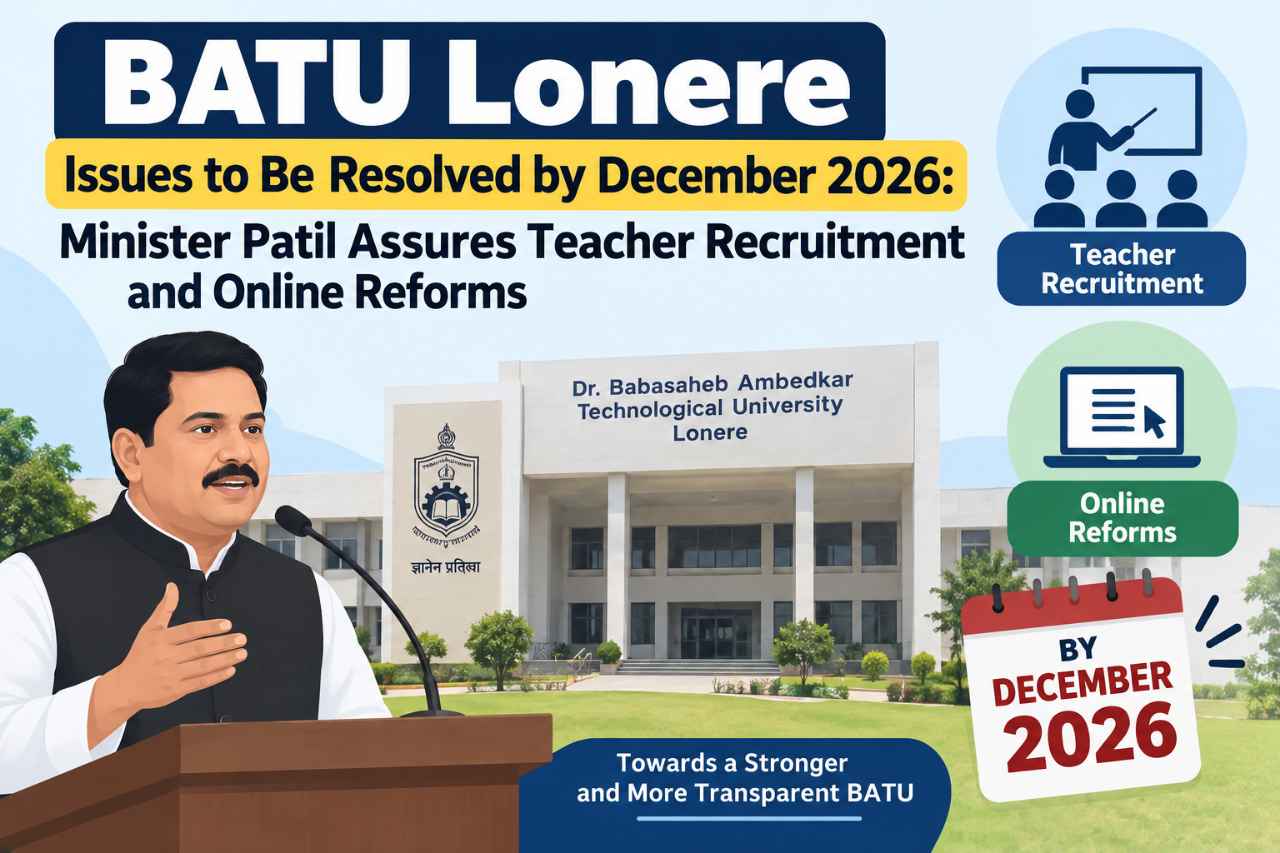

Maharashtra's higher education landscape received a significant policy signal on September 4, 2026, when Higher and technical Education Minister Chandrakant Patil publicly committed to fixing long-standing administrative and academic problems at Dr Babasaheb Ambedkar Technological University (BATU) Lonere. Speaking at the university's 28th convocation ceremony, the minister assured students, parents, and affiliated colleges that exam delays, result bottlenecks, mark sheet errors, and vacant professor positions would be addressed on a fixed timeline with major reforms visible by December 2026 and faculty recruitment wrapped up within three months.
For thousands of engineering and technology students across Maharashtra, BATU is not just another state university. It is the affiliating body for numerous colleges offering B.Tech, M.Tech, diploma, and other professional programmes. When the university's examination cell slows down or administrative gaps widen, the impact ripples across campuses in Pune, Mumbai, Nashik, Aurangabad, and beyond. This article explains what went wrong, what the minister promised, what digitisation means for students, and how aspirants can protect their academic timelines while reforms take shape.
What Is BATU Lonere and Why Does It Matter?
Dr Babasaheb Ambedkar Technological University (BATU), headquartered at Lonere in Raigad district, is Maharashtra's state technical university. Established to promote quality education in engineering, technology, and applied sciences, BATU affiliates a large network of engineering colleges and polytechnics across the state. Its controller of examinations oversees semester exams, revaluation, backlog clearances, and degree conferral for lakhs of students over the years.
The university campus near the historic Raigad Fort carries symbolic weight it sits in a region associated with social reform movements, including the Chavdar Tank Satyagraha led by Dr Babasaheb Ambedkar. Today, BATU positions itself as a centre for knowledge, liberty, and social transformation. That mission, however, depends heavily on timely exams, accurate results, adequate faculty, and responsive student services areas where student complaints have mounted in recent years.
Key Functions BATU Performs for Students
- Affiliation and academic regulation of engineering and technology colleges across Maharashtra
- Conduct of semester examinations and declaration of results for affiliated programmes
- Issuance of mark sheets, transcripts, and degrees after convocation
- Approval of syllabi, credit systems, and academic calendars for affiliated institutions
- Research and postgraduate programmes at the Lonere campus and recognised centres
When any of these functions stall, students face delayed placements, missed postgraduate admissions, and difficulty obtaining verification documents for jobs or study abroad. That is why the minister's intervention at the 28th convocation drew immediate attention from student bodies and college administrators statewide.
The Problems BATU Students Have Been Facing
Over the past several academic cycles, BATU has accumulated a backlog of student grievances. While individual cases vary, the recurring themes are consistent enough to suggest systemic strain rather than isolated errors.
Examination and Result Delays
Students and college officials have reported delays in conducting semester examinations on schedule, followed by long gaps before results are published. In competitive fields like engineering where campus recruitment and GATE preparation depend on cleared backlogs even a single delayed semester can push graduation by six months or more.
Errors in Mark Sheets and Records
Incorrect subject codes, missing internal marks, name mismatches, and grade calculation errors have forced many students to apply for corrections through college offices. Each correction cycle adds weeks of waiting, especially when physical records must be verified manually.
Vacant Professor and Faculty Positions
Affiliated colleges and the university itself have struggled with unfilled professor and lecturer posts. Faculty shortages affect lab supervision, project guidance, and the minimum teaching hours required under AICTE norms. Students often feel the gap during practical sessions and final-year projects.
Administrative Bottlenecks
From migration certificates to degree verification, students have complained about slow responses from university departments. During peak admission and convocation seasons, helplines and inquiry counters become overwhelmed.
These issues have pushed some students to explore migration to other universities a trend Minister Patil explicitly said he wants to reverse by restoring confidence in BATU before the end of 2026.
Minister Patil's Assurances at the 28th Convocation
The 28th convocation of BATU Lonere was held in the presence of Governor and Chancellor Jishnu Dev Varma, Vice-Chancellor, Controller of Examinations Gitanjali Mahamunkar, faculty members, graduating students, and distinguished guests. Minister Chandrakant Patil used the occasion to address concerns head-on rather than defer them to routine committees.
Resolution by December 2026
Minister Patil stated that the government would work to resolve all outstanding university issues including vacant professor posts, delayed exam results, and other student-related matters by December 2026. He expressed confidence that students would see visible changes in how the university functions after this deadline, reducing the pressure to transfer elsewhere.
Teacher Recruitment Within Three Months
Separately, the minister assured that the process of filling vacant professor positions at BATU Lonere would be completed within the next three months from the date of his announcement. For students entering critical semesters especially third and final year timely faculty appointment can restore lab coverage, viva panels, and project supervision capacity.
Preventing Further Academic Loss
Central to the minister's message was a commitment to timely declaration of exam results. He emphasised that the government's priority is to prevent any further academic loss for students who have already endured delays. That framing aligns with broader Maharashtra policy goals of stabilising state universities after years of post-pandemic disruption and staffing gaps.
Digitisation: BATU's Push for Online Admissions and Exams
One concrete reform already underway is the digitisation of student records and processes. BATU has taken steps to make admission and examination processes completely online, reducing dependence on paper files that get misplaced or delayed in transit between colleges and the university headquarters.
What Online Processes Mean for Students
- Faster exam form submission with digital validation of eligibility and fee payment
- Real-time tracking of application status for revaluation, photocopy requests, and backlog exams
- Reduced mark sheet errors when data flows directly from college LMS to university servers
- Easier document downloads for provisional certificates and convocation lists
Minister Patil stressed that technology should not serve administrative convenience alone it must improve the student academic experience. That includes mobile-friendly portals, transparent timelines, and SMS or email alerts when results are published. Students should register updated mobile numbers and email IDs with their colleges to benefit from these alerts.
Actionable Tips for Students During the Transition
- Verify that your college has uploaded correct enrolment data to the BATU portal before each exam cycle.
- Download and save hall tickets, fee receipts, and result PDFs immediately after publication.
- Report discrepancies within the official grievance window rather than waiting until convocation.
- Keep scanned copies of all semester mark sheets in cloud storage for placement and higher-study applications.
- Follow BATU's official website and your college notice board not unverified social media rumours.
Impact on Engineering Aspirants and Affiliated Colleges
Maharashtra hosts one of India's largest clusters of engineering institutions. BATU-affiliated colleges compete for students alongside autonomous institutes, deemed universities, and colleges under other state boards. When BATU's reputation suffers due to delays, colleges face enrolment pressure even if their own campus infrastructure is strong.
For Current BATU-Affiliated Students
If you are already enrolled in a BATU-affiliated programme, migration is rarely quick or painless. Most transfers require NOC from both institutions, credit mapping, and approval timelines that can exceed one semester. Minister Patil's December deadline suggests that staying put may become less risky if reforms materialise but students should prepare backup plans for postgraduate entrances and job applications that cannot wait.
For 2026–27 Admission Seekers
Students comparing engineering options in Maharashtra should weigh BATU-affiliated colleges on factors beyond university brand alone: NAAC grade, placement record, lab infrastructure, faculty strength, and fee structure. State-level counselling through MHT-CET and other routes remains the primary entry path for most candidates.
Students exploring established private universities with strong engineering departments may also consider alternatives such as D Y Patil University Pune Ambi in Maharashtra, or nationally recognised options like Parul University Engineering and Lovely Professional University Engineering for broader programme choices. Institutions such as Pandit Deendayal Petroleum University and University of Petroleum and Energy Studies appeal to students targeting energy-sector careers.
Comparing University Types: A Quick Reference
| Factor | State Technical University (BATU) | Private/Deemed University |
|---|---|---|
| Fee structure | Generally lower in govt-affiliated colleges | Often higher; scholarships may apply |
| Exam autonomy | Centralised through BATU | Internal exam boards |
| Result timelines | Dependent on university processing | Usually faster internal cycles |
| Degree recognition | UGC-recognised state degree | UGC/AICTE recognised; check NAAC |
| Migration flexibility | Requires university NOC | Varies by institution policy |
Special Announcements from the Convocation
Scheme for Daughters of Single Mothers
Beyond BATU-specific reforms, the university's press release noted a statewide initiative: data on daughters of single mothers pursuing higher education in Maharashtra's universities and colleges will be collected to assess their numbers and needs. A meeting chaired by Chief Minister Devendra Fadnavis is expected to decide on a special scheme offering financial and academic support to these students. Eligible students should ensure accurate family details are recorded during college admission so they can benefit if the scheme is rolled out.
Chhatrapati Shivaji Maharaj Statue Inauguration
Minister Patil also announced that a statue of Chhatrapati Shivaji Maharaj on the BATU campus has been completed and will be inaugurated by the Chief Minister soon. While symbolic, the development reflects ongoing investment in campus identity and student life at Lonere.
Faculty Recruitment: Why Three Months Matters
Vacant professor posts at a technical university are not a mere HR statistic. AICTE and university statutes prescribe minimum qualifications Ph.D. for professors in many departments, NET/SET for certain appointments, and industry experience for specialised labs. Delays in recruitment often stem from advertisement cycles, interview panel formation, reservation roster compliance, and approval from the Maharashtra Public Service Commission or equivalent routes.
Minister Patil's three-month timeline is ambitious but signals political will. Students should expect gradual improvement rather than overnight change: newly recruited faculty need onboarding, timetable adjustments, and lab allocation before teaching quality normalises.
Universities focused on teacher education such as Delhi Teachers University and Tamil Nadu Teachers Education University Chennai demonstrate how dedicated institutions build faculty pipelines. BATU's challenge is different: it must recruit technical faculty at scale while simultaneously clearing exam backlogs.
What Students Should Do Until December 2026
Policy assurances are welcome, but prudent students combine optimism with documentation discipline. Here is a practical checklist:
- Monitor official BATU notifications for exam schedules, result dates, and convocation lists.
- Maintain a personal academic file with every hall ticket, mark sheet, and fee receipt.
- Coordinate with your college exam cell rather than visiting Lonere for every query colleges often have direct liaison officers.
- Apply early for revaluation or photocopy if you suspect scoring errors; windows close quickly.
- Plan GATE, CAT, or campus placement timelines assuming a buffer of at least one month beyond announced result dates.
- Explore skill certifications through platforms and institutions like ITM Skills University to strengthen your profile while awaiting degree completion.
Broader Context: State Universities Under Scrutiny
BATU is not alone in facing governance challenges. Universities across India from Bihar to West Bengal have seen protests over administrative control, faculty shortages, and delayed salaries. Maharashtra's proactive ministerial intervention at a convocation platform mirrors a broader trend: state governments recognising that university dysfunction directly affects youth employment and regional development.
For engineering aspirants comparing options outside Maharashtra, institutions such as Netaji Subhas University of Technology NSUT Delhi, Delhi Technological University DTU, and Guru Gobind Singh Indraprastha University Engineering represent Delhi's strong public engineering ecosystem. In Rajasthan, universities like JECRC University Jaipur, Poornima University Jaipur, and Suresh Gyan Vihar University Jaipur SGVU offer alternative pathways for students willing to relocate.
Within Maharashtra, other Patil-led institutions such as Ajeenkya D Y Patil University, D Y Patil International University, and D Y Patil Agriculture And Technical University serve different academic niches from innovation-focused programmes to agriculture-technology crossover degrees.
MHT-CET, CAP Rounds, and Choosing BATU-Affiliated Colleges
Most engineering seats in Maharashtra are filled through MHT-CET counselling conducted by the State Common Entrance Test Cell. During Centralised Admission Process (CAP) rounds, students rank colleges based on placement data, location, fees, and branch availability not always the affiliating university. Yet the university's exam efficiency eventually affects every graduate from that college.
Before locking a BATU-affiliated option in CAP round counselling, verify these details on the college website and through campus visits:
- AICTE approval status and current academic year intake permission
- Last three years' placement percentages for your preferred branch
- Average time taken for result clearance ask final-year students directly
- College-level exam cell responsiveness when university delays occur
- Hostel, transport, and lab infrastructure independent of university headquarters
Students who miss Maharashtra state seats sometimes explore private universities in other states. Options such as Amity University Noida, Galgotias University Greater Noida, and Shiv Nadar University Engineering attract applicants seeking autonomous exam calendars. The right choice depends on your budget, branch preference, and tolerance for geographic relocation not merely university headlines in the news cycle.
Student Grievance Redressal: Know Your Options
While waiting for December 2026 reforms, students should understand formal complaint channels rather than relying on informal WhatsApp groups alone. Most affiliated colleges maintain a Student Grievance Redressal Committee (SGRC) mandated under UGC regulations. Escalation paths typically include:
- College-level SGRC for exam form rejections, internal mark disputes, and attendance issues
- BATU enquiry and grievance sections for result corrections, degree verification, and convocation eligibility
- Directorate of Technical Education (Maharashtra) for policy-level concerns affecting multiple colleges
- Public grievance portals of the Maharashtra government when standard channels fail
When filing any grievance, attach scanned evidence hall tickets, fee receipts, email trails and note reference numbers. Written records strengthen your case if delays continue past the minister's deadline and you need to approach ombudsman offices or consumer forums for document-related service failures.
Timeline: Key Milestones to Watch
- September 2026: Minister Patil's announcement at 28th convocation; three-month faculty recruitment clock starts
- October–November 2026: Expected faculty advertisement, interviews, and joining phases
- December 2026: Target month for resolving exam, result, and administrative backlogs
- Early 2027: Students should evaluate whether result timelines and mark sheet accuracy have improved before planning migration
Conclusion
The September 2026 convocation at BATU Lonere marked more than a ceremonial degree award it became a public accountability moment for Maharashtra's technical education system. Minister Chandrakant Patil's promise to resolve exam delays, result errors, and vacant professor posts by December 2026, coupled with a three-month faculty recruitment drive, offers tangible hope to students who have waited too long for stable academic timelines.
Digitisation of admissions and examinations represents the structural fix behind those promises. If executed well, online workflows can reduce mark sheet errors, speed up result publication, and restore trust among affiliated colleges. Students, meanwhile, should stay informed through official channels, document every academic milestone, and plan career moves with realistic buffers until reforms prove themselves on the ground.
For thousands of engineering graduates across Maharashtra, BATU's recovery is not an abstract administrative goal it is the difference between timely placements, postgraduate admissions, and years of lost opportunity. The December deadline now sets the benchmark against which the university and the state government will be measured. Staying informed, maintaining complete academic records, and using official grievance channels will help students navigate this transition period with confidence regardless of how quickly reforms unfold on the ground.