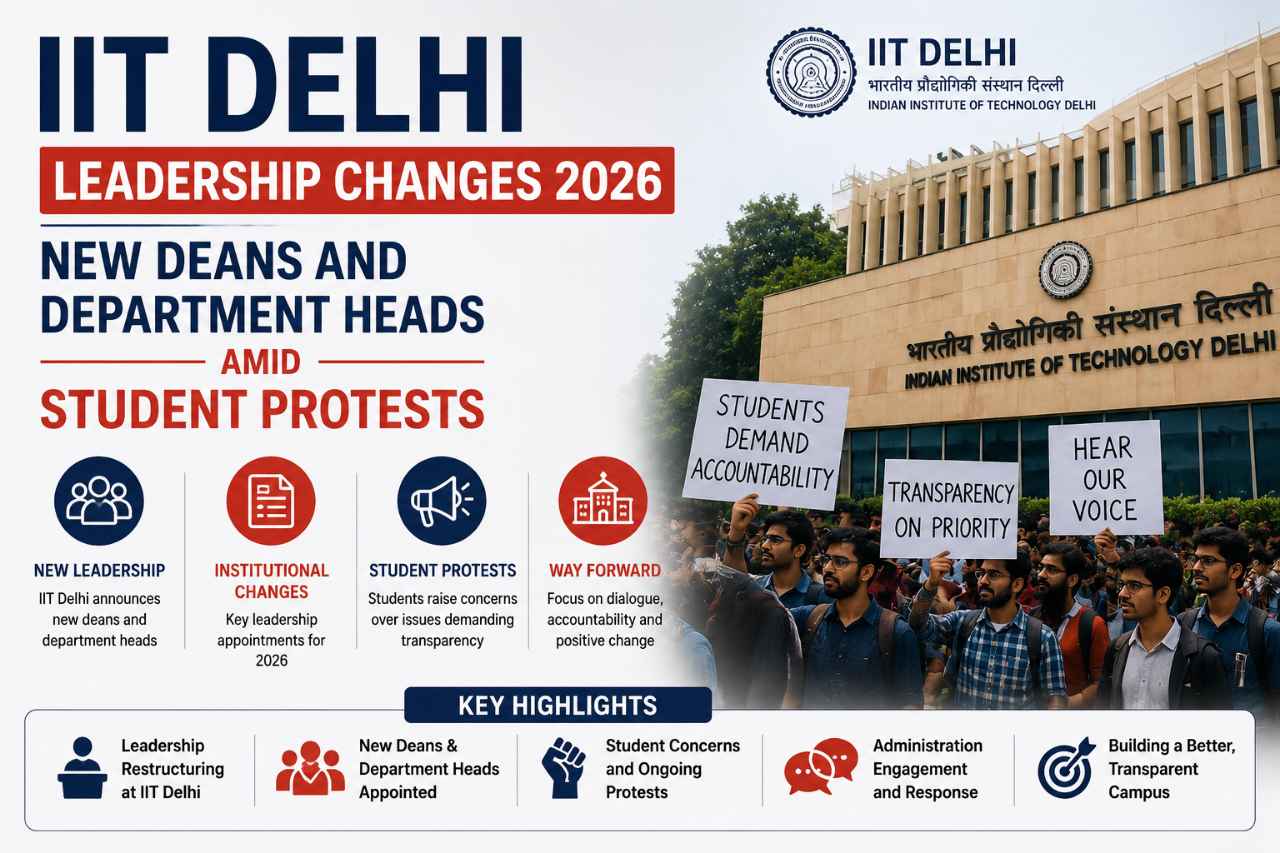

On August 28, 2026, the indian institute of Technology Delhi (IIT Delhi) released an official notification announcing a wide set of leadership appointments and tenure extensions across departments, centres, schools, and administrative units. The changes take effect from September 1, 2026, and include a new Dean (Students Affairs), fresh heads for major engineering and science departments, and renewed leadership at several interdisciplinary centres.
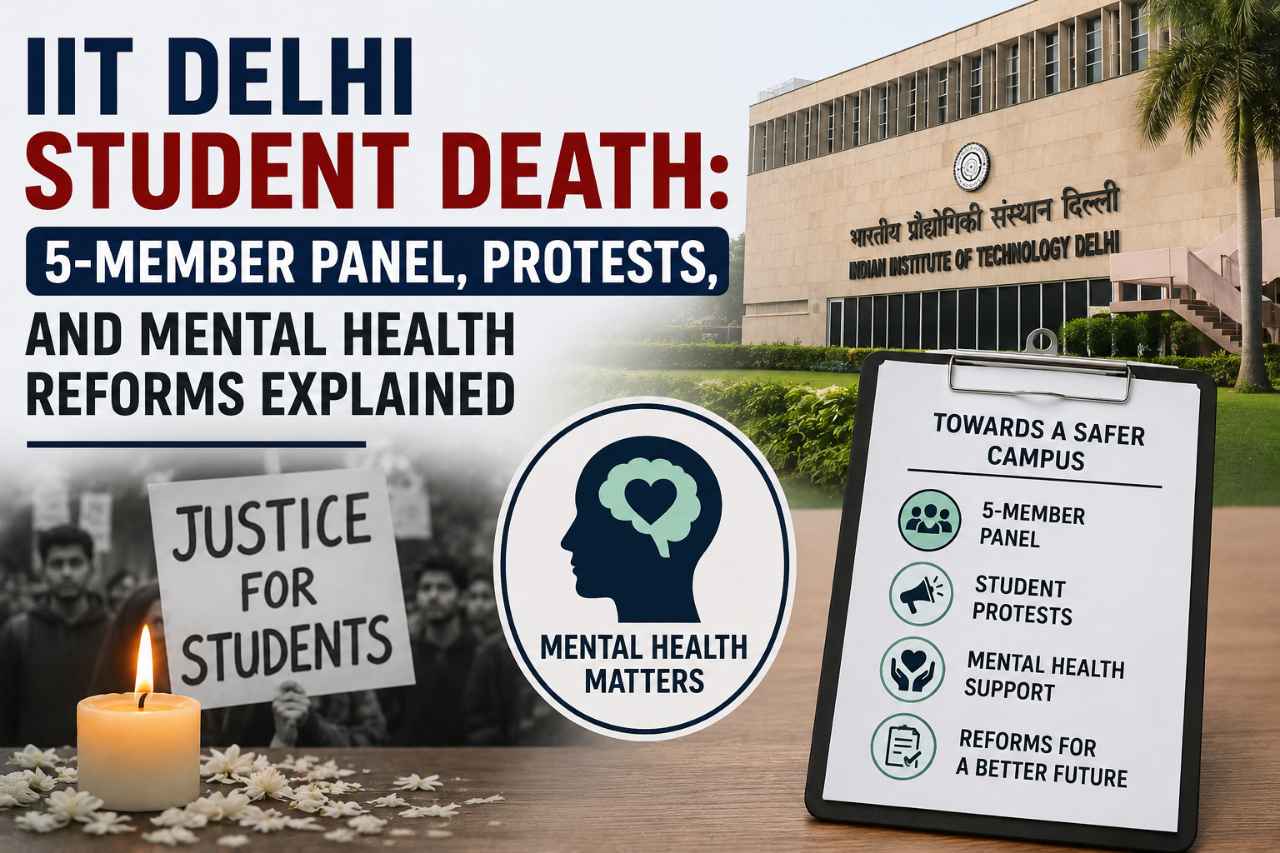
These administrative updates arrive at a sensitive moment. The campus has witnessed sustained student protests following the death of Rishikesh Kumar, an MSc Physics student. Protesters have called for independent accountability, stronger student-support systems, and leadership changes in offices linked to student welfare. Institute sources, however, have clarified that many of the August 28 appointments reflect scheduled tenure cycles rather than direct responses to resignation demands.
For students preparing for JEE Advanced, GATE, or postgraduate admissions—and for parents evaluating India's top technical universities—understanding what is happening at IIT Delhi matters. Leadership transitions shape hostel policies, counselling infrastructure, research opportunities, and the day-to-day experience of life on campus. This article explains the latest appointments, the protest context, what students across Delhi NCR can learn from the episode, and how to evaluate institutional safety and support before choosing a college.
What IIT Delhi Announced on August 28, 2026
The August 28 notification from IIT Delhi is essentially a leadership roster update. Rather than a single headline appointment, it bundles together dean-level roles, department headships, centre directorships, and school leadership across the institute. According to the official order, most new terms run until August 31, 2028, while several extensions are valid until August 31, 2027.
The notification also states that remaining appointments will continue as per earlier orders. It references a Deans Committee decision from November 28, 2018, which expects Deans and Associate Deans to devote roughly 50 percent of their time to administrative work and grants them a corresponding 50 percent waiver on average teaching load within their academic units.
Key Dean-Level Appointments and Extensions
Among the most closely watched roles is the Dean (Students Affairs) portfolio, because it directly oversees student life, welfare coordination, and interfaces with hostel administration, counselling referrals, and campus grievance channels. The August 28 order names S. Pradyumna from the Department of Applied Mechanics as the new Dean (Students Affairs) for a term ending August 31, 2028. This is marked in the notification as a new appointment rather than a simple extension.
In parallel, Dipti Ranjan Sahoo from Civil Engineering receives a one-year extension as Dean (Infrastructure) until August 31, 2027. Infrastructure deanships matter for hostel maintenance, campus facilities, dining infrastructure, and the physical environment that shapes student wellbeing—issues that have featured prominently in recent campus discussions.
- Dean (Students Affairs): S. Pradyumna — new appointment until August 31, 2028
- Dean (Infrastructure): Dipti Ranjan Sahoo — one-year extension until August 31, 2027
- Associate Dean roles: Multiple one-year extensions across academic and student-facing units
Students comparing IIT Delhi with other Delhi institutions—such as Delhi Technological University (DTU), Netaji Subhas University of Technology (NSUT), or NIT Delhi—should note that dean tenures at IITs typically follow fixed cycles tied to faculty rotation. That structure is meant to prevent administrative burnout while keeping academic leadership fresh.
Department Head Appointments: Physics, CSE, and Core Engineering
Department heads at IIT Delhi play a dual role. They manage faculty hiring, curriculum updates, research grants, and postgraduate admissions within their units, while also serving as the first escalation point for academic grievances affecting students in those departments. The August 28 notification reshuffles leadership across several high-enrollment departments.
Physics Department: A Closely Watched Appointment
Santanu Ghosh has been appointed Head of the Physics Department until August 31, 2028. This appointment draws particular attention because the ongoing campus protests follow the death of an MSc Physics student. Protesters had specifically demanded accountability from the previous Physics Department head and senior student-affairs officials. Institute sources quoted in media reports have cautioned against interpreting scheduled headship rotations as admissions of institutional failure; however, students argue that leadership change alone does not substitute for an independent investigation and structural reforms.
For MSc and PhD aspirants, the Physics Department at IIT Delhi remains one of the country's most competitive destinations. Admission typically flows through national-level gateways such as JAM (Joint Admission Test for Masters) and institute-specific shortlisting. Before applying, candidates should review not only cutoffs and research areas but also departmental mentorship culture, lab access timelines, and postgraduate housing norms—topics that featured in recent protest memoranda.
Other Major Department Headships
Beyond Physics, the notification names several other influential leadership roles:
- Computer Science & Engineering: Amit Kumar — until August 31, 2028
- Mechanical Engineering: Prabal Talukdar — until August 31, 2028
- Chemistry: Selvarajan Nagendran — one-year extension until August 31, 2027
- Electrical Engineering: Shankar Prakriya — until August 31, 2027
- Chemical Engineering: Anurag S. Rathore — until August 31, 2027
Computer Science and Electrical Engineering consistently attract the highest JEE Advanced rank bands. Mechanical and Chemical Engineering remain strong choices for students targeting core manufacturing, process industries, and emerging deep-tech sectors. Chemistry headship extensions affect MSc and research pipelines that feed materials science, energy storage, and pharmaceutical research clusters—areas where Delhi's research ecosystem, including institutes like the Indian Agricultural Research Institute (IARI), creates collaborative opportunities.
Centre and School Leadership: Interdisciplinary Research Hubs
Modern IIT campuses are not organized solely around traditional departments. Centres and schools often house cross-disciplinary programmes in rural technology, electronics, sensors, artificial intelligence, and biological sciences. These units frequently admit students through specialised channels and industry partnerships.
Centre Heads Named in the Notification
- Centre for Rural Development and Technology (CRDT): Priyanka Kaushal — until August 31, 2028
- Centre for Applied Research in Electronics (CARE): Monika Aggarwal — until August 31, 2028
- Centre for Sensors, Instrumentation and Cyber-Physical System Engineering (SeNSE): Satish Kumar Dubey — until August 31, 2028
These appointments signal continued investment in applied research that connects IIT Delhi to manufacturing, IoT, and rural innovation ecosystems. Students interested in hardware-software integration or policy-linked technology may find centre-affiliated projects more aligned with their goals than conventional department labs alone.
School-Level Appointments
At the school level, IIT Delhi has appointed:
- Amar Nath and Shashi Khosla School of Information Technology: Aaditshwar Seth — until August 31, 2028
- Yardi School of Artificial Intelligence: Chetan Arora — until August 31, 2028
- Kusuma School of Biological Sciences: Vivekanandan Perumal — one-year extension until August 31, 2027
The Yardi School of Artificial Intelligence reflects IIT Delhi's strategic push into AI research and education—a field that also sees strong programmes at IIIT Delhi. Biological sciences interfaces connect to medical research ecosystems across Delhi, including premier institutions such as AIIMS New Delhi, Maulana Azad Medical College, and VMMC Delhi, though admission pathways and training models differ sharply between IITs and medical colleges.
Other Administrative Units and Support Infrastructure
Not every leadership change sits in a marquee department. The August 28 order also covers units that affect daily student life in quieter but meaningful ways.
- Central Workshop: Sudarsan Ghosh (Mechanical Engineering) — head until August 31, 2028
- Hindi Cell (Central Library): Dr. Neeraj Chaurasia — two-year extension until August 31, 2028
The central workshop supports engineering practicum, fabrication, and project builds across departments. Library and language cells contribute to academic accessibility. While these appointments rarely dominate headlines, they illustrate how IIT governance spans dozens of micro-units, each with its own tenure calendar.
Tenure Cycles vs. Protest Demands: What Officials Say
Media reports citing institute sources emphasize that the August 28 notification should be read alongside standard faculty-administration rotation policies. Several positions reportedly reached scheduled tenure end dates; others were flagged explicitly as extensions. The document itself distinguishes between "new appointment" and extension language, which supports the official view that the order is primarily administrative housekeeping.
However, protesters and student representatives have drawn a different conclusion. They view the timing—amid demonstrations demanding resignations from the Dean and Associate Deans in the Student Affairs Office and the Head of the Physics Department—as insufficient accountability. Separate media reports indicate that Associate Dean (Student Welfare) Sreedevi may have submitted her resignation, though the August 28 notification does not confirm resignation acceptance. When official documents and on-ground reports diverge, prospective students should rely on verified institute communications and independent news sources rather than speculation.
Campus Protests After the Death of MSc Student Rishikesh Kumar
To understand why these appointments became national news, it is necessary to separate two threads: the routine governance of a large IIT, and an extraordinary student-led mobilization triggered by tragedy.
Background and Student Demands
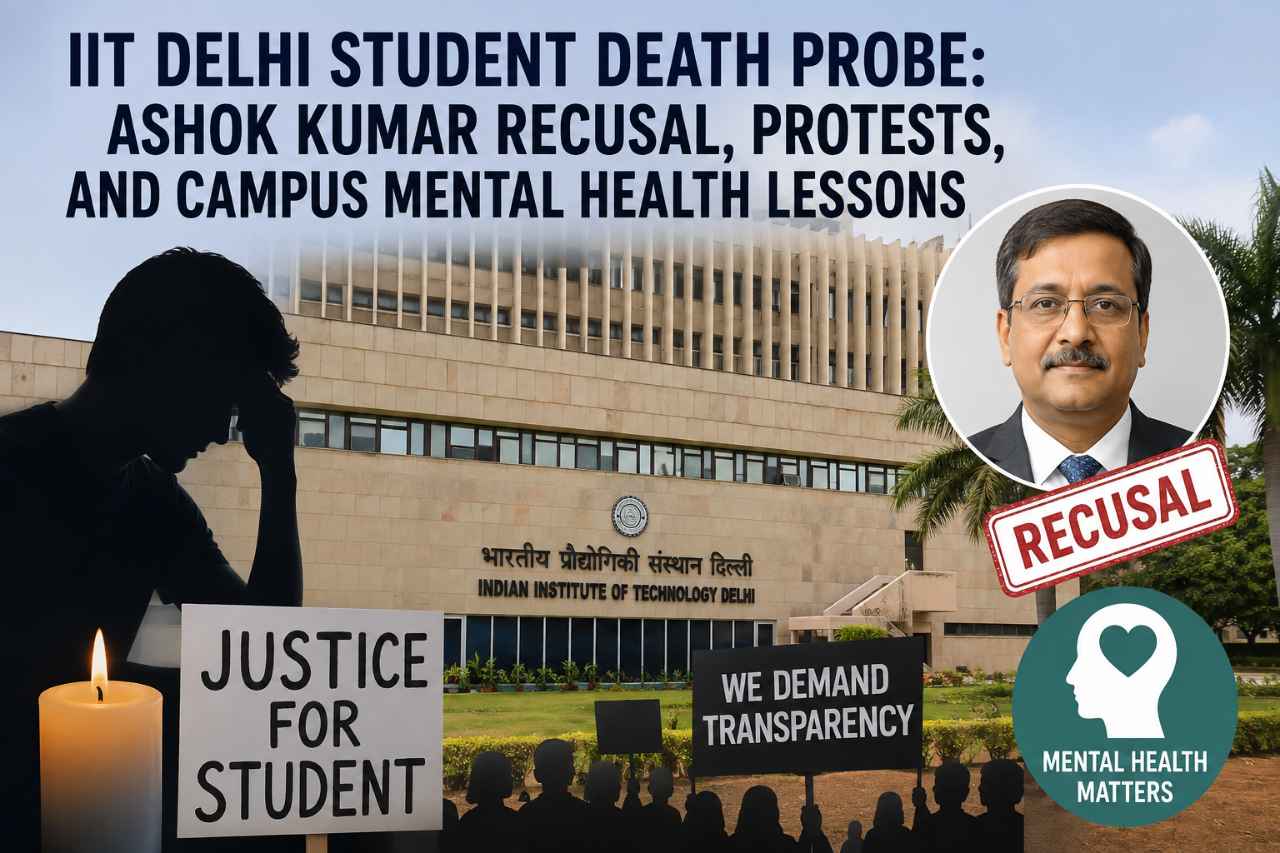
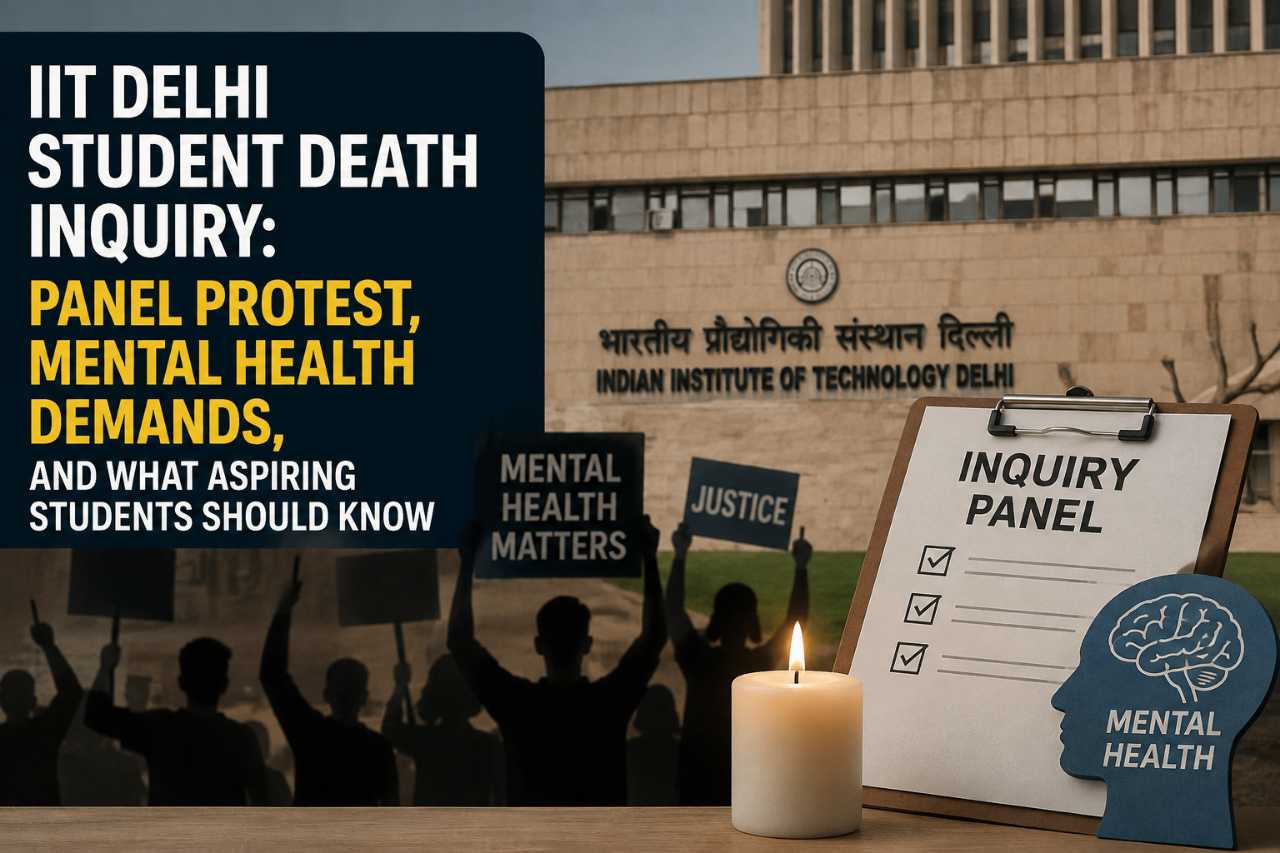
Students began protesting after the death of Rishikesh Kumar, an MSc Physics student at IIT Delhi. Demonstrations on campus included calls for an independent inquiry into the circumstances surrounding the incident, accountability from senior officials, and broader reforms to student support systems.
Reported protest demands have included:
- An independent investigation rather than a purely internal inquiry
- Resignation of the Dean and Associate Deans in the Student Affairs Office, and the Head of the Physics Department
- Compensation of Rs 1 crore for the student's family
- Review of alleged institutional issues such as non-allocation of housing, denial of academic projects, and gaps in mental-health support protocols
- Assurance that students participating in peaceful protest would not face disciplinary retaliation
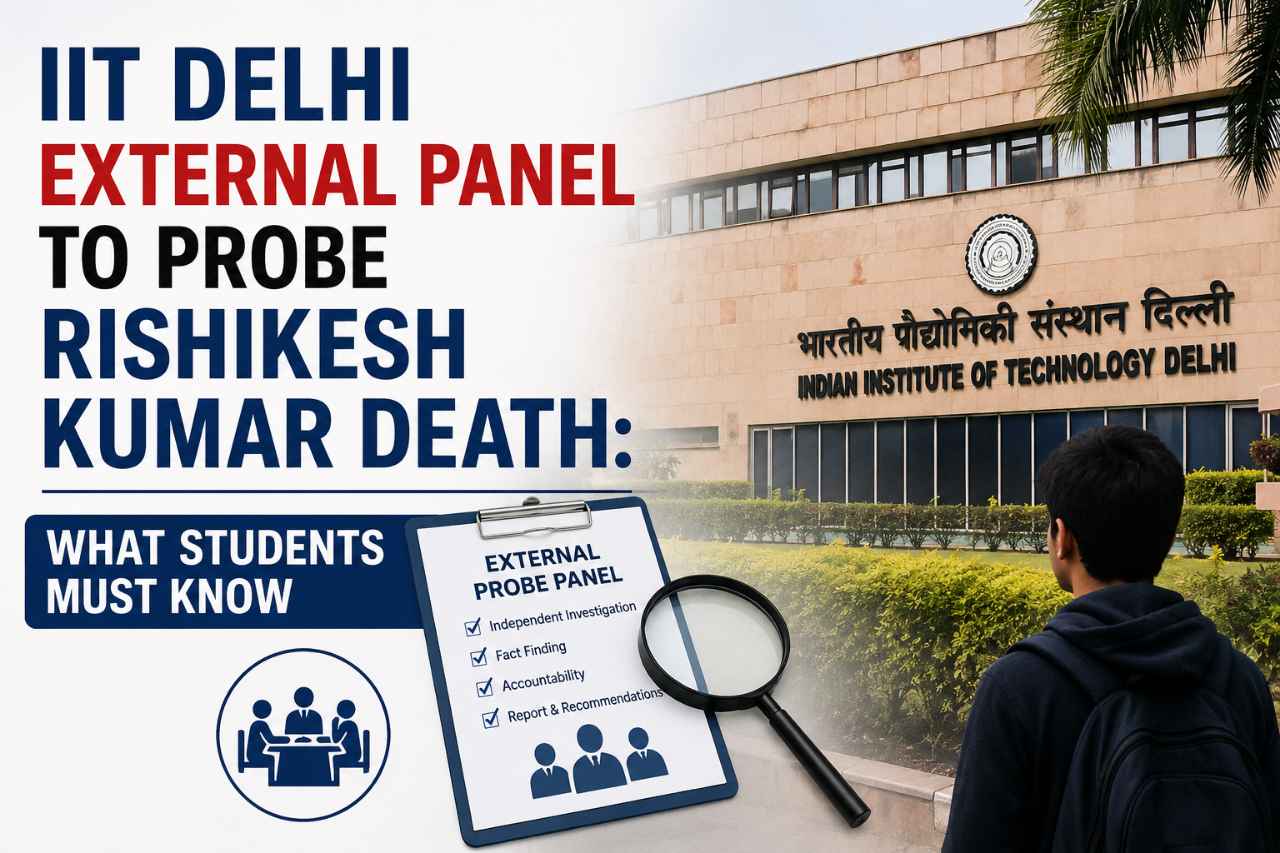
IIT Delhi has publicly stated its commitment to student wellbeing and has reportedly formed an external panel to examine the case—developments covered in related news reports linked to the same episode. Delhi Police have also registered an abetment-to-suicide case, according to separate press reports, which adds a legal dimension beyond internal campus proceedings.
Why This Matters Beyond IIT Delhi
Campus mental health, hostel allocation fairness, and grievance redressal are not unique to a single institute. Students at Jamia Millia Islamia, St Stephen's College, Hindu College, Miranda House, and professional schools such as New Delhi Institute of Management have, at various times, raised similar concerns about support systems, transparency, and administrative responsiveness. The IIT Delhi case therefore functions as a case study for every family weighing high-pressure academic environments.
How Prospective Students Should Evaluate Campus Safety and Support
Google's helpful content and E-E-A-T (Experience, Expertise, Authoritativeness, Trustworthiness) standards reward articles that help readers make informed decisions—not sensational headlines. If you are preparing for engineering or science programmes, use the IIT Delhi episode as a prompt to ask structured questions before admission.
Checklist Before Accepting Any Offer
- Grievance mechanism: Is there a published, time-bound process for academic and non-academic complaints?
- Counselling access: Are mental-health services staffed adequately, confidential, and available outside business hours?
- Hostel policy clarity: Are allotment rules, waiting lists, and appeal paths written and accessible?
- Research and project allocation: For MSc and PhD students, when and how are supervisors and projects assigned?
- Student representation: Do student councils have formal seats in committees that decide welfare policies?
- Transparency during crises: Does the institute communicate through official portals rather than rumour channels?
Visit official websites, read prospectuses, speak with current students where possible, and cross-check news from multiple outlets. Platforms like CollegeDwar consolidate college profiles—whether for IIFT Delhi, IMI Delhi, or FORE School of Management—so applicants can compare location, courses, and institutional type alongside technical institutes.
Comparing IIT Delhi With Other Delhi NCR Options
Delhi NCR hosts a dense cluster of higher-education institutions spanning engineering, medicine, law, journalism, and liberal arts. A balanced college shortlist might include:
- Research-intensive tech institutes: IIT Delhi, DTU, NSUT, NIT Delhi, IIIT Delhi, Delhi Institute of Technology
- Medical sciences: AIIMS Delhi, MAMC, UCMS Delhi
- Law and policy: Indian Law Institute
- Media and communication: Indian Institute of Mass Communication
- Architecture and planning: School of Planning and Architecture
- Undergraduate arts and sciences: Lady Shri Ram College, Kirori Mal College, Ramjas College, Hansraj College
No ranking alone captures fit. A student passionate about biomedical interfaces might parallel-track IIT biotech centres with medical colleges like AIIMS Delhi. Another aiming for corporate leadership might weigh Delhi School of Management or TERI School of Advanced Studies for sustainability-focused management pathways.
IIT Delhi Admissions Context: Programmes Linked to the News
Leadership changes do not alter admission cutoffs overnight, but they can influence programme culture over a student's degree cycle. Here is how major entry routes connect to the departments mentioned in the August 28 notification.
Undergraduate Entry Through JEE Advanced
B.Tech admission to IIT Delhi remains tied to JEE Advanced ranks, JoSAA counselling, and branch allocation. Computer Science, Electrical Engineering, and Mechanical Engineering typically require top percentile ranks. Chemical Engineering offers strong process-industry pathways. Physics departments at IITs primarily serve B.Tech students through foundational courses rather than separate UG physics degrees at every campus.
Postgraduate Entry: MSc Physics and Interdisciplinary Programmes
MSc Physics admissions generally flow through IIT JAM and subsequent counselling. Candidates should monitor official IIT Delhi notices for eligibility, interview stages, and seat matrices. The MSc cohort is smaller and research-intensive; supervisor access, lab rotation, and hostel priority lists become immediate practical concerns—issues central to recent protests.
Interdisciplinary AI and IT schools admit through separate channels that may include GATE scores, institute tests, or sponsored fellowships. Always verify the current year's brochure on the official IIT Delhi website because nomenclature and entry routes evolve.
Why Administrative Continuity Still Matters During Disruption
When classes were cancelled or campus routines disrupted during protests—as reported in related coverage—admissions timelines, exam schedules, and project deadlines can ripple across semesters. Continuing "rest of the appointments as per earlier notifications" language suggests IIT Delhi is trying to maintain governance continuity even while addressing student dissent. For applicants, the lesson is to track both academic calendars and campus climate during offer acceptance windows.
Legal, Policy, and Institutional Governance Dimensions
Large central institutes like IIT Delhi operate under the IIT Council framework, UGC-aligned norms, and internal statutes. Dean and head appointments typically route through institute committees and director approvals. That governance layer explains why students may perceive "no change" even when they demand resignations—official rotations and protest demands operate on different clocks.
Independent Inquiry vs. Internal Committees
Student protesters have insisted on an independent probe. Institutes often constitute internal committees first; external panels may follow public pressure. Media reports indicate IIT Delhi has moved toward an external panel, though student groups have also questioned panel composition in related coverage. From an applicant's perspective, the credibility of inquiry mechanisms is now part of institutional reputation—similar to how transparency debates affect universities like South Asian University or professional colleges under public scrutiny.
Mental Health Protocols and UGC Guidance
Across india, UGC and AICTE advisories increasingly urge campuses to maintain counselling cells, anti-ragging committees, and mental-health helplines. Compliance on paper, however, differs from felt accessibility on the ground. When evaluating any college—whether Gargi College, Jesus and Mary College, Kamala Nehru College, or a flagship IIT—ask whether wellness services are integrated into orientation week, hostel life, and examination periods, not relegated to a static PDF on a website.
Actionable Tips for Students and Parents in 2026
High-achieving applicants often optimize for rank and brand while under-weighting daily living conditions. The following tips translate the IIT Delhi news cycle into practical decision support aligned with SEO and answer-engine friendly clarity.
Before the Exam: Build Realistic Institute Lists
- Shortlist 8–12 institutions across stretch, match, and safe bands.
- Include Delhi NCR alternatives such as DTU, NSUT, NIT Delhi, and Delhi Technical Campus.
- Read recent campus news from at least two independent sources for each top choice.
After Results: Verify Welfare Infrastructure
- Email or call the institute's Student Affairs office with specific questions on counselling and hostel appeals.
- Join only verified applicant groups; treat unmoderated social media claims with caution.
- If joining postgraduate programmes, clarify project allocation timelines in writing before relocation.
During College Life: Know Your Rights
- Save copies of allotment letters, project approvals, and grievance tickets.
- Know the names and contact routes of the Dean (Students Affairs), wardens, and internal complaints committees.
- Escalate through official channels first; document each step if unresolved.
Delhi remains India's largest student hub. From ILBS for super-speciality medical training to Daulat Ram College, Deshbandhu College, and Deen Dayal Upadhyaya College for undergraduate programmes, the city offers diversity in cost, culture, and career outcomes. Institutions like Indraprastha College for Women, Atma Ram Sanatan Dharma College, and Dyal Singh College serve thousands of learners alongside the IIT ecosystem. Choosing wisely means weighing prestige, support, and personal fit—not just brochure rankings.
Conclusion: Leadership Transitions Amid a Demanding Moment for IIT Delhi
IIT Delhi's August 28, 2026 notification is, on its face, a comprehensive update to dean, department, centre, and school leadership with effective dates from September 1. Key highlights include S. Pradyumna's appointment as Dean (Students Affairs), Santanu Ghosh's appointment as Head of Physics, and new or extended terms across Computer Science, Mechanical Engineering, Chemistry, Electrical Engineering, Chemical Engineering, and multiple interdisciplinary units.
Yet the order cannot be separated from the human and political context surrounding Rishikesh Kumar's death and the protests that followed. Students have demanded independent accountability, financial support for the bereaved family, housing and project-policy reforms, and protection for protesters. Institute officials, citing tenure schedules, frame many changes as routine governance rather than direct concessions to those demands.
For India's higher-education audience—JEE and GATE aspirants, MSc applicants, and parents investing savings in elite technical education—the episode underscores a simple principle: institutional prestige must be weighed alongside student support, transparency, and grievance responsiveness. Use verified notifications, official counselling services, and trusted college guides on CollegeDwar to compare IIT Delhi with peer institutions such as Delhi Metropolitan Education and Janki Devi Memorial College across the capital. The best choice is not always the highest-ranked name on a list, but the environment where a student can learn, research, and thrive with dignity and adequate support.